LangSmith BYOC Reaches General Availability Across 15 AWS Regions
- Cargo
- Machine Learning
- Shipped
- Shipper
- James Miller
- Readers
- 988
LangSmith BYOC runs agent observability and deployment in a customer’s AWS account, while LangChain manages the infrastructure and upgrades.
LangSmith BYOC is now generally available on Amazon Web Services (AWS), giving Enterprise customers a managed deployment whose sensitive application data stays in their own AWS account and virtual private cloud (VPC). LangChain operates the service, while customers retain control of the environment that stores their traces, prompts, datasets, experiments and agent runtime data.
The offer targets teams that need LangSmith’s tools for building and operating agents but cannot place application data outside their existing cloud boundary. Agent traces can contain personal, health or customer records, internal API responses and tool outputs. BYOC keeps that material in a customer-selected AWS region while providing tracing, evaluation, deployment and management capabilities.
It is available to LangSmith Enterprise customers in 15 AWS regions across the US, EU and APAC. The model is designed to bridge two deployment choices: LangSmith Cloud, which offers a managed service, and self-hosted LangSmith, which gives teams more operational control but requires them to run the platform themselves.
Managed operations inside the customer’s AWS account
Self-hosting means maintaining databases, Kubernetes, networking, backups, upgrades and reliability over time. That work can draw engineering attention away from building and improving agents. BYOC keeps the customer’s AWS account, VPC, databases, object storage and application data under the customer’s ownership, while LangChain provisions and operates the LangSmith deployment.
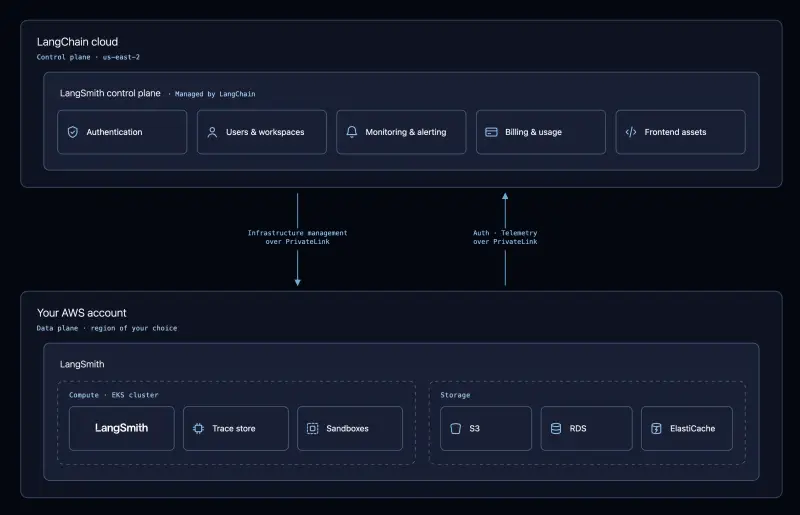
The architecture separates management from application data. LangChain’s control plane handles authentication, user management, organization and workspace settings, billing and usage metadata, and the LangSmith frontend. It also provisions and monitors customer deployments. Sensitive application data resides in a data plane running in the customer’s AWS account.
That data plane includes a private Amazon Elastic Kubernetes Service (EKS) cluster, databases and object storage. It holds traces, prompts, datasets, experiments, evaluators, Insights runs, annotation queues, agent deployments, sandboxes and other runtime data. The control plane does not store this sensitive application data.
Communication between the two planes uses AWS PrivateLink and stays off the public internet. The management connection exposes the cluster’s Kubernetes API server to LangChain’s control plane so it can install and reconcile LangSmith components. The runtime connection supports authentication, workspace configuration, telemetry and billing metadata. The EKS cluster has no public API endpoint, and its worker nodes have no public IP addresses.
Network access, setup and ongoing operations
Running the data plane in the customer’s VPC lets agents and sandboxes reach internal databases, private APIs and on-premises systems through existing network paths. Teams can also create additional data planes across environments, AWS accounts and regions. Organization-level settings, including users and roles, carry across deployments, helping larger teams adopt LangSmith without maintaining a separate operating model for each group.
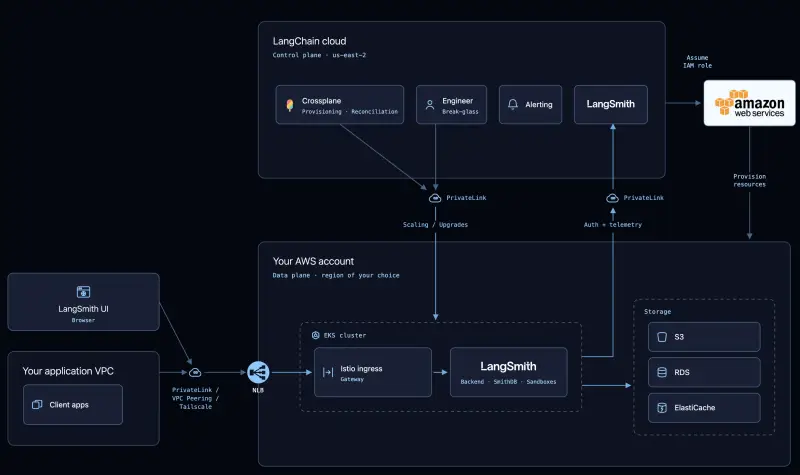
Setup starts with a Terraform module that creates the IAM role LangChain uses to provision infrastructure. The customer then creates a data plane in LangSmith. LangChain provisions the VPC, EKS cluster, databases, storage, ingress and in-cluster services. It also manages infrastructure and LangSmith version upgrades, scaling, patching, backups and health monitoring.
Each deployment uses a standardized AWS architecture similar to the one LangChain uses for LangSmith Cloud. It includes a dedicated VPC, private EKS cluster, private load balancer, and DNS and ingress configured on the LangChain BYOC domain. Amazon RDS and the trace store receive daily backups written to Amazon S3 in the customer’s account. LangSmith services and node capacity autoscale; Amazon RDS and Amazon ElastiCache use multiple availability zones and automatic failover.
Crossplane provisions and reconciles the deployment by assuming the customer-created IAM role. Its permissions are scoped to infrastructure management. Where AWS supports it, access is restricted to resources tagged managed_by=langsmith and to specific name prefixes. The role does not include permissions to read trace objects from S3 or connect to the PostgreSQL and Redis data stores.
Operational access also has an audit trail. Urgent support uses explicit, customer-approved access patterns. LangSmith audit logs stay in the data plane, EKS audit logs go to Amazon CloudWatch in the customer’s account, and VPC flow logs are stored in an S3 bucket owned by the customer.
Capabilities included and deployment considerations
Most LangSmith capabilities are available on BYOC. Teams can trace agent activity, use projects, dashboards and alerts, and evaluate systems with datasets, experiments, evaluators and annotation queues. Insights analyzes traces to surface usage patterns, recurring behaviors and failure modes. Context Hub provides prompts, memory and other context files.
Customers can deploy and manage agents inside their data plane, run code and filesystem work in sandboxes on a dedicated node group, and use Fleet to build and run no-code agents. The LLM Gateway provides model access through one LangSmith API key, with centralized spending, rate limit and data protection policies. SmithDB, LangChain’s observability backend for trace data, persists that data to S3 in the customer’s account. Managed Deep Agents, the LLM auth proxy and Engine also support BYOC.
Latent Health Cofounder Rishabh Jain said the deployment lets the team use LangSmith observability to improve agents while keeping sensitive data in its own environment. The account illustrates the intended trade-off: teams can use managed platform operations while retaining their AWS data boundary and private network access.
BYOC’s practical fit depends on whether that split matches a team’s requirements. Customers still own the AWS environment and create the IAM role; LangChain takes on the platform’s operational lifecycle. For teams moving agent workloads into production across multiple groups or regions, the key question is whether managed operations inside their own cloud account reduces enough platform work while meeting their data and network needs. BYOC is available to Enterprise customers on AWS; organizations can contact LangChain and review the documentation for deployment details.


