LangSmith LLM Gateway Adds Spend Limits, Fallbacks and Data Redaction for Agents
- Cargo
- Machine Learning
- Shipped
- Shipper
- Robert Garcia
- Readers
- 753
LangSmith’s public beta centralizes runtime limits, model fallbacks and sensitive data handling across agents, providers and customers.
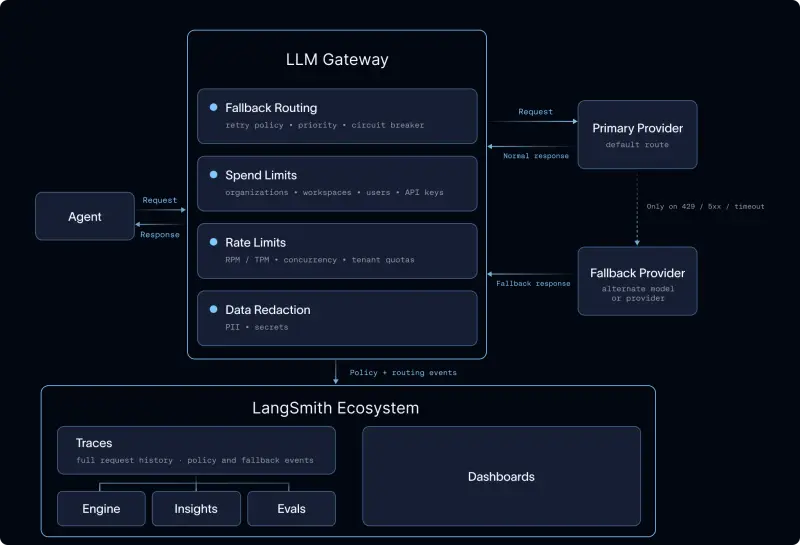
LangSmith LLM Gateway puts runtime controls between production agents and the models they call. Its public beta brings spend caps, rate limits, fallback routing and sensitive data redaction into one place, so teams can apply them across models and applications instead of maintaining separate implementations in each agent.
That central layer addresses two common production failures: a model provider outage that leaves a customer facing errors, and an agent trapped in retries that runs up an unexpectedly large bill. A gateway can enforce limits as requests happen, while recording activity for teams to inspect. LangChain says the service is available in public beta for Plus and Enterprise plans.
Controls at request time
Spend caps can be set for a time period and tracked at four levels: organization, workspace, API key and user. That gives teams options for setting a company-wide ceiling, allocating limits to teams, isolating a project’s usage or controlling an individual’s spend. Once a cap is reached, the agent receives a 402 response with an error explaining the block.
Rate limits are available at those same four levels. They’re intended to contain traffic spikes and accidental overuse before they strain provider limits or affect other agents and teams. Together, spend and request limits give operators a way to constrain usage while traffic is flowing, rather than finding the cost or reliability problem only after it has happened.
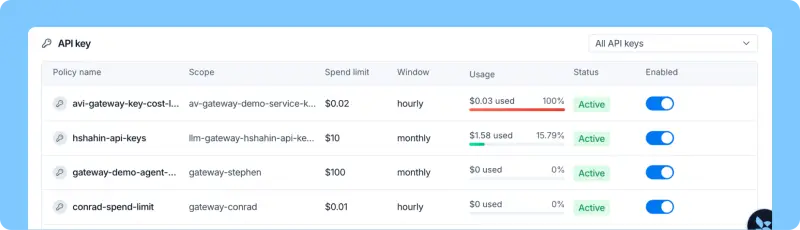
For multi-customer products and resellers, teams can apply separate spend and rate limits to customers without issuing each one a separate API key. A custom request header identifies the customer or team; the gateway then applies the corresponding limits while calls use a shared key. Teams can review customer spend and adjust limits centrally. The customer-level controls are aimed at applications that need distinct usage boundaries under a common integration.
Fallback rules can route requests to another model or host when a provider is down, rate-limited or unavailable. This makes fallback behavior configurable across applications instead of requiring each agent to contain its own provider-specific routing logic. The practical benefit depends on having a suitable alternate model and host configured; the gateway handles routing, but teams still need to decide what fallback behavior fits their application.
Data protection features detect and redact personally identifiable information and secrets in requests before they reach model providers. The gateway also redacts sensitive data in traces recorded in LangSmith. This feature is currently limited to Enterprise plan users, so availability differs from the broader beta.
Tracing and model choice
Gateway events appear as metadata in LangSmith traces. When a request is blocked by a spend cap, rate limit or another control, operators can inspect the event in context and assess whether the configuration needs adjustment. The trace metadata connects enforcement with the production traffic that triggered it.
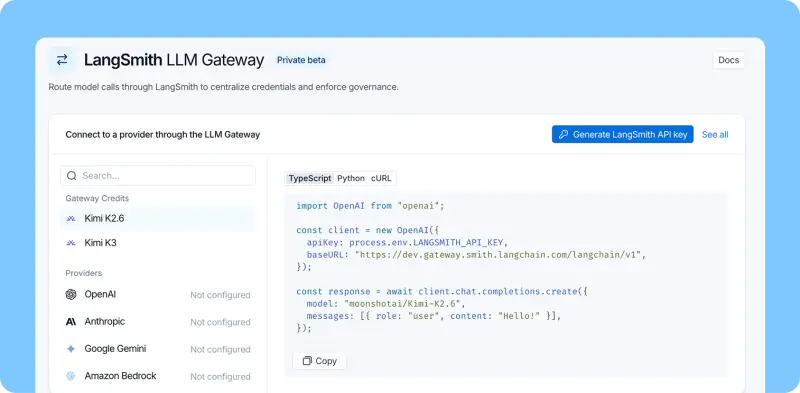
The gateway provides one routing interface for calls to supported providers, including OpenAI, Anthropic and Fireworks, as well as custom models with OpenAI-compatible or Anthropic-compatible endpoints. It is designed around bring-your-own-key use: teams supply provider credentials and use LangSmith for routing and controls without adding separate instrumentation to every model call. Setup involves storing provider keys as workspace secrets.
There’s also hosted inference for open models, powered by Fireworks and available through LangSmith using Gateway Credits. This offers a way to start using open models through the same interface without separately arranging provider access. LangChain frames open model choice as useful for balancing cost, quality, latency, privacy and deployment needs. No comparative benchmark results or pricing figures are provided here, so teams will need to evaluate those tradeoffs for their own workloads.
LangChain says teams are using the gateway for public-facing agents that need firm spend limits and for multi-customer systems that need shared billing, usage tracking and customer-specific caps. Friday Digital Agency AI Engineer Hylke Sybesma describes the appeal as setting a hard ceiling and agreeing on spend and other supported controls with a customer. That account illustrates a workflow, but it doesn’t provide an independent measure of cost savings or reliability gains.
Integration and next steps
Teams can call the gateway through its API or connect it to coding harnesses such as Claude Code, Codex and Deep Agents Code. The basic integration is to point an agent at the LangSmith Gateway endpoint, authenticate with a LangSmith API key, add provider credentials to workspace secrets and configure limits, fallbacks and data handling. Updating the agent’s base_url is the stated code change; the rest of the application can remain as it is.
LangChain says it plans to broaden guardrails for risks that arise when agents call external models and interact with production systems. It also points to planned CI/CD capabilities for deploying prompts and context, running A/B tests, managing blue-green and shadow deployments, and defining controls with Infrastructure-as-Code. These are future additions, not capabilities described as available in the current beta.
For teams evaluating the beta, the key question is whether a shared routing layer simplifies operational work across their existing agents and providers. The current feature set focuses on usage boundaries, traffic control, fallback routing, trace visibility and, for Enterprise users, data redaction. Setup details are available in the quickstart guide; Enterprise users can request access to Data Protection controls.