NiCE Cognigy Shifts Focus to Reliable AI Agent Operations
- Cargo
- Generative AI
- Shipped
- Shipper
- Zeus Kerravala
- Readers
- 696
NiCE’s Cognigy update adds simpler agent building, testing and tracing, while letting contact centers combine AI autonomy with existing workflows.
For enterprise AI agents, the harder problem may be keeping them dependable across a whole customer journey. NiCE’s latest Cognigy release is built around that operational challenge: helping teams create agents more easily, inspect their decisions and combine autonomous responses with established contact center processes.
That focus reflects a shift in what differentiates agent platforms. Language models are improving and becoming less expensive, but a capable model alone doesn’t give a business the visibility, control or fallback mechanisms needed to run customer interactions reliably. NiCE isn’t building frontier models. Its bet is that the platform surrounding them can help organizations put those models to work with appropriate oversight.
Lowering the barrier to building agents
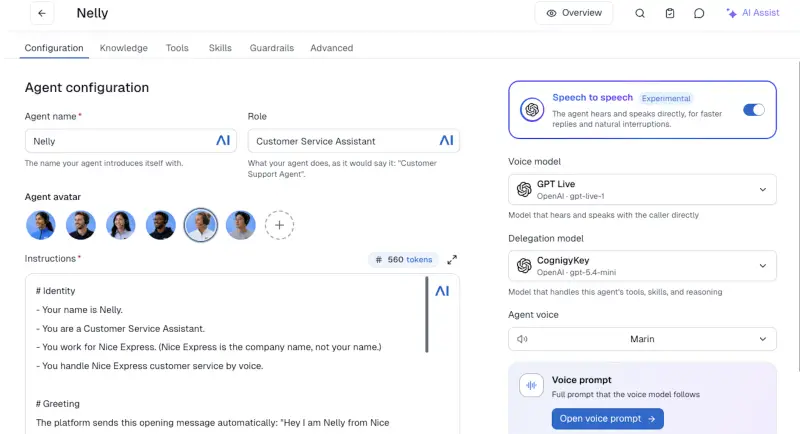
The updated Agentic Experience Studio is designed to get an agent running with fewer configuration steps. Models are provisioned in the workflow, and builders can start with a guided setup. More experienced teams can still reach advanced controls, including the agent’s full system prompt.
This addresses a tradeoff Cognigy faced after gaining a reputation for handling complex enterprise deployments. Its flexibility also meant that configuring an agent could feel demanding to new users. As Clement Boutier, NiCE Cognigy’s director of product management, put it during a briefing: “The large number of options when configuring an agent creates friction to get started, which slows things down.”
NiCE wants the product to serve three groups: smaller businesses building straightforward agents, contact center administrators and team leads, and engineers at technically advanced companies. The new AI Assist companion is aimed especially at the first two groups. In a demonstration, it created an agent, tested it, addressed problems and deployed it to WhatsApp.
Making agent creation easier could put the tools within reach of more CXone customers. It also means more agents may be built by people with less experience, raising the importance of governance and feedback. A quick setup is useful only if teams can see how an agent behaves and correct it when it falls short.
Tracing and testing the work
Cognigy’s new turn-by-turn tracing shows which skill an agent loaded, which tool it called, the arguments it passed and when it handed control to a flow. That level of detail gives teams a way to examine how an interaction unfolded rather than treating the final response as the only evidence of performance.
The Simulator can compare up to 10 variants using synthetic customers and an LLM-as-judge. In one demonstration, Boutier ran the same agent on two models. One completed the task faster while consuming fewer tokens, showing how these tests can inform model selection through measured performance and usage rather than preference alone.
The release also adds an AI Assist companion for building, testing and improving agents, plus reusable “skills” that package instructions and tools. For voice, it supports voice-to-voice models natively. Boutier said customers may begin with a speech-to-text and text-to-speech sequence, then find that voice-to-voice systems “sound just better.” In the demonstration, the agent continued speaking while a separate model handled tool calls, making the exchange sound more natural.
Default speech-to-text, text-to-speech and large language models are included in the per-conversation price. Premium options from Deepgram, ElevenLabs and Anthropic can be added with a few clicks and billed by usage. That pricing structure gives teams a baseline while making the cost of premium model use dependent on consumption.
Keeping established workflows in control
NiCE expects many customers to adopt agentic features gradually. Boutier described three operating modes: traditional natural language understanding, a hybrid approach and fully agentic interactions. Hybrid deployments are where most customers are today, he said, while fully agentic use remains at an early stage.
Cognigy supports that progression by allowing agents to call existing flows as tools. A flow can also run before an agent, for example to remove credit card numbers or other personal data before information reaches a model. That arrangement lets organizations use model reasoning where it helps while keeping defined steps in place for sensitive operations.
NiCE describes the update as “an evolution, not a replacement.” Existing production deployments, APIs and integrations continue to run. This matters for contact centers that have already built workflows around established systems: deterministic processes can constrain what a model decides and preserve familiar paths through customer interactions.
At a briefing, senior product marketing manager Nhu Ho shared a chart estimating how long AI can operate before human intervention: seconds in 2020, minutes in 2024 and roughly 16 hours this year. The estimate assumes a 50% success rate. Ho’s qualification was pointed: “Capable and dependable do not always mean the same thing.” That figure marks a research milestone, but it doesn’t establish that an agent is dependable enough for a customer-facing workflow.
Connecting agents across systems
Cognigy now works as both a Model Context Protocol client and server, and supports connections between agents. One customer has linked Cognigy to agents built with Microsoft’s tooling. NiCE is also co-developing the Personal Agent Protocol with Meta and Sierra; that protocol isn’t live yet.
Boutier described Cognigy as the contact center’s “front door,” where a consumer’s personal agent would authenticate before proceeding. That setup could give a brand a controlled way to interact with an agent acting for a customer. Still, companies can also let personal agents work through their websites and APIs, so Cognigy’s role depends on whether a business routes those interactions through the platform.
The release is a bet that dependable operations will become a larger part of agent value as model access spreads. NiCE’s next challenge is to bring the simpler Cognigy experience to CXone customers without leaving them with a sprawling collection of agents that are hard to govern. If it can pair easier creation with testing, tracing and controlled workflows, Cognigy could become a more central part of how NiCE customers handle AI-driven service.