LangChain Raises $300 Million as Its Agent Development and Operations Stack Expands
- Cargo
- Generative AI
- Shipped
- Shipper
- Maria Deutscher
- Readers
- 320
LangChain’s $300 million round values the company at $3 billion and backs tools for building, coordinating and maintaining AI agents.
LangChain’s $300 million funding round puts a price of $3 billion on a company whose software spans several stages of agent development: connecting models to tools, coordinating multi-step workflows, and monitoring systems after deployment. That breadth helps explain why its business reaches beyond an open-source framework into paid tools for operating agents in production.
CapitalG, Alphabet’s investment fund, led the round, with IVP, Sapphire Ventures, GIC and DFJ Growth also participating, according to reporting by The Wall Street Journal. The San Francisco company was founded around developer tools, and its open-source products remain central to its profile. The financing comes as companies work to turn agent prototypes into software that can handle more involved tasks reliably.
From model connection to multi-agent workflows
LangChain’s namesake framework, released in 2022, provides building blocks for connecting an AI agent to a large language model and to external tools. Developers can also set a system prompt and control details such as the format of the agent’s responses. The framework’s appeal is practical: it packages common integration work so teams can focus more of their effort on the behavior and application they want to build.
That convenience doesn’t settle whether an agent will perform well. The model, prompts, connected tools and task design all shape the result. LangChain supplies a way to assemble those components; teams still need to decide which actions an agent may take and how to handle errors, unexpected outputs and tasks that exceed its capabilities.
For workflows that exceed the scope of a single agent, LangGraph lets developers connect multiple LangChain-powered agents into a coordinated process. It can also include human review for sensitive actions. That design gives teams a way to divide work into steps and insert a person where a workflow calls for additional oversight. The source description doesn’t specify how teams should define those checkpoints, so the quality of a deployment still depends on implementation choices.
Deep Agents adds features intended to support more complex work on top of LangChain and LangGraph. These include a virtual file system where agents can store data, a planning tool for organizing work, and a feature for creating subagents. Together, the products suggest a progression from assembling an agent to structuring a larger task around several agents and supporting capabilities.
Production work is the paid layer
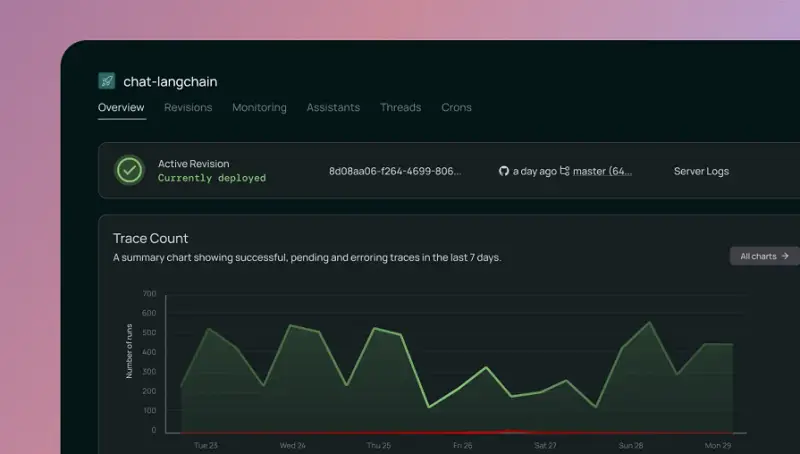
LangChain sells LangSmith for building and maintaining agents. Its features address a part of deployment that can become difficult to manage as teams make repeated changes: keeping track of iterations, comparing results and diagnosing problems. Developers can store versions centrally, restore an earlier version if an update introduces a bug, and compare the output quality of different versions before choosing one for production.
LangSmith also records traces: logs that capture the steps an agent takes while processing a prompt. The product analyzes those records to identify technical issues, rank them by severity and generate code fixes. Traces can help teams see where a workflow went wrong, especially when a task crosses multiple tools or agents. They don’t, by themselves, establish that an agent’s answer is correct or that a proposed fix is suitable. Those judgments remain part of the team’s evaluation and maintenance work.
This focus on operations is a notable part of LangChain’s position. Open-source components make it possible to assemble agent workflows, while LangSmith provides paid features for tracking and maintaining them. For developers, the relevant question is not just whether a framework speeds up a prototype, but whether its surrounding tools fit the team’s process for testing changes and responding to failures once users depend on the software.
Adoption, hiring and what the round supports
After its previous funding round last year, LangChain disclosed that its open-source tools were downloaded about 90 million times per month. The article also names Autodesk and Cisco among the companies using LangSmith. Download volume indicates broad developer interest, but it doesn’t reveal how many installations become active projects, how often those projects reach production, or how much revenue the paid product generates.
LangChain reportedly plans to nearly double its headcount, reaching 850 employees by the end of 2027. The intended hires span infrastructure, AI engineering, sales and marketing. Expanding those teams could support development and customer adoption, though the reported plan doesn’t specify how the company will divide the new roles or how quickly it expects to fill them.
The $300 million round and $3 billion valuation reflect investor expectations for a company serving both agent developers and teams responsible for operating their systems. The practical test will be whether LangChain’s framework, workflow tools and production features help customers manage agents as their tasks grow more complex. Its reported download figures offer one signal of reach; continued use of LangSmith and the ability to maintain dependable workflows will say more about how well that reach translates into sustained adoption.