Dharma Field Extractor Reports 0.834 F1 on Document Data Extraction
- Cargo
- Machine Learning
- Shipped
- Shipper
- James Smith
- Readers
- 957
Dharma-AI’s 2B model returns document fields as JSON, scoring 0.834 and costing 6 to 147 times less than tested frontier APIs.
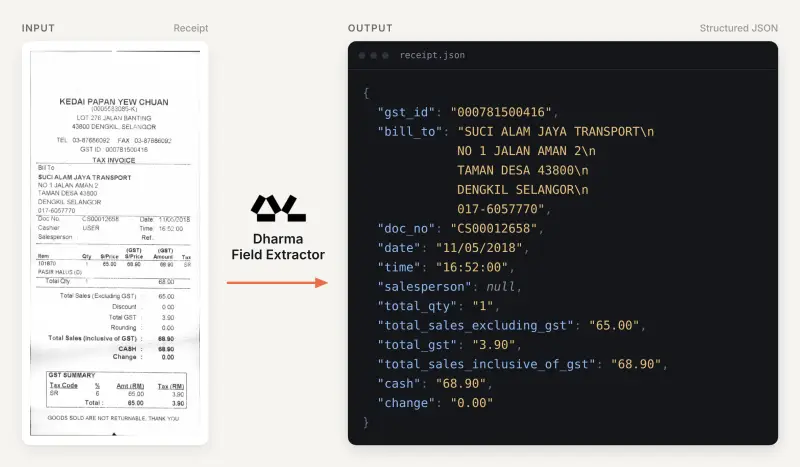

Dharma-AI’s Field Extractor targets a common gap between reading a document and putting its contents to work: it turns selected information in a document image into typed JSON. The company reports a benchmark score of 0.834 for its 2-billion-parameter model, above the four general-purpose configurations it evaluated, with estimated run costs 6 to 147 times lower than those APIs.
The distinction from optical character recognition (OCR) matters for teams building document workflows. OCR returns the text on a page, preserving its sequence and formatting. That suits tasks such as digitizing a manuscript or reviewing a full contract. But a downstream system often needs only particular values: an invoice number, due date and total, or a patient name and exam date. Plain OCR leaves another step: identifying each value and mapping it to the right field.
Two ways to request fields
Field Extractor accepts a document image and either an open request to identify the available fields or a schema specifying exactly what to return. The first mode fits documents whose contents or layout aren't known in advance. The schema mode suits established workflows where data must fit an existing record.
For example, a supplier invoice can be represented with its line items as an ordered list, including each item's quantity and value, alongside invoice totals. An ID can be returned under the field names an employee system expects. The model also targets medical requisitions routed to a scheduler and contracts whose relevant information includes parties, terms, penalties and amounts.
In both modes, the output is JSON with values typed according to the request. A field that isn't present returns as null. When a schema is supplied, the model follows its keys and doesn't add fields, which makes the response easier to pass to another system. Dharma-AI says one checkpoint handles the different document types without per-type fine-tuning.
Training and evaluation
The base is DharmaOCR-LITE v1.1, a 2-billion-parameter model that the company describes as an updated, optimized version of the OCR model behind its earlier work. That model had already received OCR specialization through supervised fine-tuning and direct preference optimization (DPO). Dharma-AI then trained a low-rank adaptation (LoRA) on 43,384 examples for both extraction modes.
The examples span receipts, commercial invoices, forms, bank statements, IDs and synthetic documents. They are annotated at the field level, allowing evaluation of whether the model found the right value in the right place, rather than simply whether it transcribed a page accurately.
The benchmark contains 546 documents tested under three conditions, for 1,638 cases total: extracting all fields without a schema, filling a partial schema containing real fields, and handling a schema that also asks for fields absent from the document. Its score combines field-level F1, with matches determined by field path and table position; Levenshtein similarity for matched values; and the proportion of outputs that are valid JSON.
Dharma-AI compared the model with four general-purpose frontier configurations. Its reported score of 0.834 exceeds Claude Opus 5 at 0.816 and GPT-5.6 Luna at 0.741, the strongest and weakest results among those named. The reported quality gap ranges from 1.8 points against Claude Opus 5 to 9.3 points against GPT-5.6 Luna.
Cost depends on deployment
The cost comparison uses different accounting methods. For API models, Dharma-AI measured average input and output tokens per page, including reasoning tokens, and applied each provider's published list pricing. All frontier configurations ran with reasoning set to low; Claude Opus 5 used adaptive effort, which can skip reasoning on simpler pages while staying at that level.
The Field Extractor isn't billed per token in this comparison. Its cost estimate is based on GPU time on one L40S, priced at $2.24 per hour. The company estimates that this makes extraction about six times cheaper than GPT-5.6 Luna and about 147 times cheaper than GPT-5.6 Sol. Those figures aren't a quoted service price: self-hosted costs depend on hardware, workload volume and required latency.
That distinction is relevant to adoption. Teams considering a self-hosted model need to account for their own infrastructure and throughput needs, while API comparisons depend on token use and provider pricing. The benchmark presents a measured cost scenario, not a universal cost guarantee.
Examples and limits
The public SROIE and FUNSD datasets appear in the benchmark and weren't used for training. On a SROIE receipt, Dharma-AI reports that the model extracted all 18 requested fields correctly. It treated a multiline, unlabeled billing address as one field, returned null for the blank salesperson and reference fields, and matched the receipt's numbers to the cent.
On a FUNSD photocopying variance form, the request included twelve boolean checklist fields and a nested group of five options. The model marked the single checked box as true and the other eleven as false. It also read a handwritten Bates ID and returned null for two blank fields. These examples illustrate different challenges: organizing values from a receipt and interpreting checkboxes, handwriting and missing information on a degraded form.
The results extend a pattern Dharma-AI has previously reported for OCR. Its earlier paper evaluated a 3-billion-parameter DharmaOCR-LITE model on Brazilian Portuguese and placed it above the commercial frontier APIs tested there. Field extraction is a separate task and benchmark, so the result doesn't establish performance across document types or workflows that weren't evaluated.
For developers, the practical case is focused: a relatively small model can be trained to map document images directly into fields, avoiding a separate OCR-to-mapping step for supported workflows. The score and cost estimates make it worth evaluating where document volume is high and the required output schema is clear. Actual performance will depend on the documents, schemas, hardware and latency targets in each deployment.
Try the model through the Dharma-AI document portal, or see its Hugging Face page for models and demos. The underlying OCR model is available as DharmaOCR-LITE.


