Prophecy DataGPT Turns Chatbot Data Requests Into Reviewable Workflows
- Cargo
- Generative AI
- Shipped
- Shipper
- Duncan Riley
- Readers
- 540
DataGPT builds reusable data workflows inside ChatGPT, Claude and Copilot, with human review, Git-backed code and execution on company data platforms.
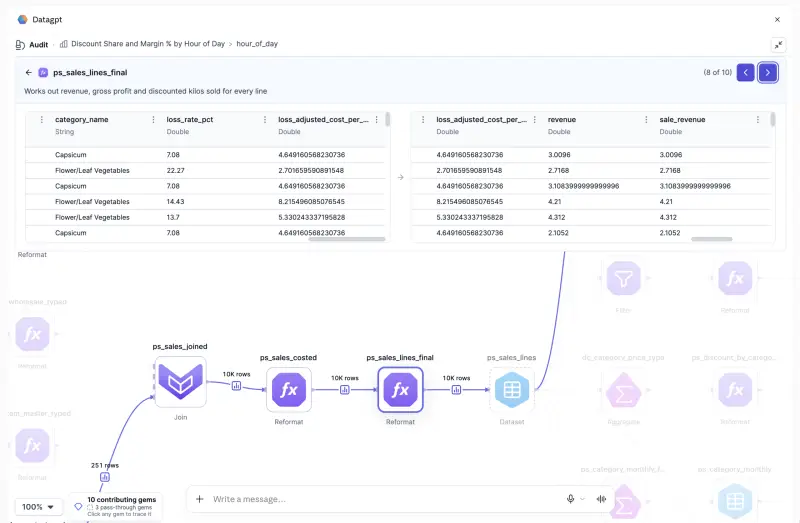
Prophecy’s DataGPT aims to make chatbot-driven data work repeatable and reviewable. The service lets business analysts create workflows from ChatGPT, Claude or Copilot, inspect the steps behind each result, then approve those steps before scheduling them. That shifts a familiar task—asking a chatbot to reconcile spreadsheets—toward a process that can be checked and run again.
The product addresses a practical gap between asking questions of data and producing work that an organization can trust over time. An analyst can upload a spreadsheet to a chatbot and request a transaction reconciliation; the chatbot may generate a script, but the user may not be able to read or verify it. The reasoning and business definitions discussed in the chat can also disappear when the session ends. DataGPT’s central proposition is to preserve that work as a visible workflow rather than leave it as a one-off answer.
From a chat request to a repeatable workflow
Prophecy says an analyst can start with a messy Excel file, compare it with an audit list and records in SharePoint or Snowflake, and add business rules such as discounts on product bundles. The service displays the stages of the workflow alongside their results. If a stage produces an unexpected outcome, the analyst can adjust it before approving the complete process.
That review step matters because the output is only as useful as the definitions behind it. A reconciliation can depend on which transactions count, how exceptions are handled and how a discount is calculated. When those choices stay buried in a chat or an opaque script, another person may struggle to reproduce the result. A workflow that exposes its stages gives colleagues a concrete place to inspect those choices and correct them.
Once approved, a workflow can run monthly without the analyst having to rebuild it. Prophecy says each workflow is represented by open code in Git, and later runs follow that code rather than asking the AI model to generate the process again. That design separates the conversational step, which helps create or change a workflow, from its scheduled execution. Prophecy says reruns therefore carry no additional AI cost.
For teams, this makes the workflow’s maintenance and ownership important questions. The visible stages can help a business user find a problem, while the underlying code gives technical staff something they can inspect and manage. The product’s value will depend on whether both groups can work with that representation as the process grows more involved. The launch description doesn’t provide benchmark results or a comparison of workflow accuracy, so the practical test is how well teams can validate outputs against their existing records and rules.
Execution stays on the organization’s data platform
Prophecy says uploaded files do not remain inside the chat interface. They pass through its service to the customer’s data platform, where information technology staff and platform operators can view and govern the workflows. Scheduled jobs run on Snowflake, Databricks or Google BigQuery, depending on which platform the customer uses.
This arrangement is intended to give teams a way to manage work that might otherwise happen through unsanctioned chatbot use. It also means deployment involves more than enabling a connector: organizations will need to consider how data reaches Prophecy, who can create and approve workflows, and how the resulting jobs fit existing platform operations. The stated design keeps execution tied to the customer’s data environment, but the launch details do not specify access controls, data retention periods or the full set of supported source systems.
Signed-off workflows also contribute to a customer-specific knowledge graph built from its business rules and data catalogs. In principle, that gives DataGPT a structured record of organizational context that can inform later work. The description does not explain how the graph is updated, how conflicting rules are handled or how users can inspect its contents. Those details will shape whether it remains a helpful source of context as business definitions change.
Availability and adoption questions
DataGPT is available through connector marketplaces for ChatGPT, Claude and Copilot. Organizations that have not approved those tools can use Prophecy’s own application. Individuals can begin with a free account, while administrators can deploy the product centrally. Prophecy has not stated pricing for broader use, so teams evaluating it will need to clarify the costs of service access and the infrastructure required for scheduled workflows.
Prophecy was founded in 2017 and says it has raised more than $100 million. Its latest funding was a $47 million Series B extension led by Smith Point Capital in January 2025. The company names SAP, HSBC and Pfizer among its customers. Those details establish that the business has operated in the enterprise data market, but they don’t show how widely DataGPT itself has been deployed.
Prophecy founder and chief executive Raj Bains argues that business data users have received question answering while developers have gained tools to carry code through to production. DataGPT’s pitch is to close part of that gap by giving analysts a path from a request to an inspectable, reusable process. Its usefulness will turn on whether the workflow view makes errors and assumptions clear, and whether teams can maintain those processes as their data and business rules change.