Doom Runs on a USB Flash Drive’s LCD, Controlled by File Transfers
- Cargo
- Machine Learning
- Shipped
- Shipper
- Shane Downing
- Readers
- 546
A reverse-engineered flash drive runs Doom at about 13 frames per second, with a PC script turning timed reads and writes into game controls.
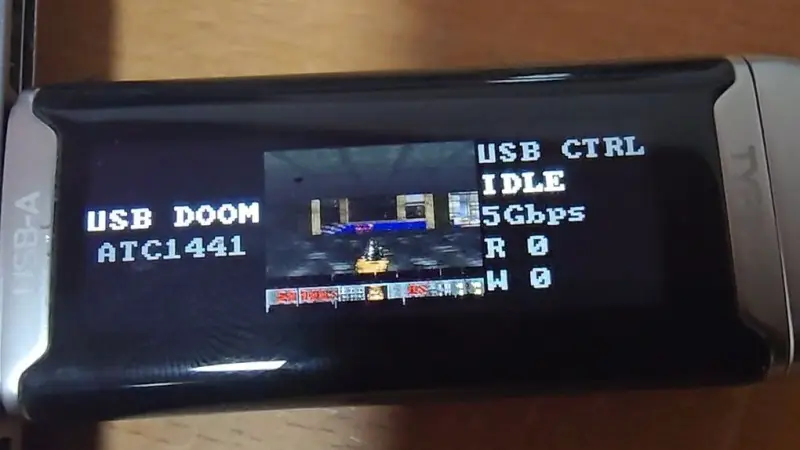
A USB flash drive can run Doom on its own small LCD, and the controls arrive as file transfers. Hardware hacker Aaron Christophel got the game working on a MOVESPEED MSSU10 by extracting and reverse-engineering the display microcontroller’s firmware, then wrote a PC script that encodes key presses as timed reads and writes. The result is a playable demonstration, though its roughly 13 frames per second makes it more a hardware experiment than a practical way to play.
A storage device with a second computer inside
The MSSU10 has USB-A and USB-C connectors and is sold in capacities starting at 128GB. Christophel paid about 50 euros for that smallest model. Its built-in color display normally reports drive information, including transfer speed, capacity usage and temperature. The project repurposes the screen and the small controller that operates it.
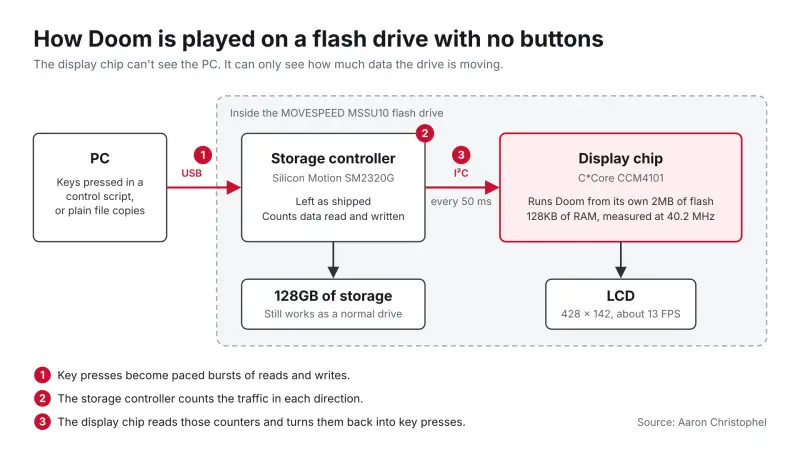
Storage is handled by a Silicon Motion SM2320G controller, a part also found in portable drives such as the Kingston XS2000 and Lexar SL660 Blaze. A separate C*Core CCM4101 microcontroller drives the display. It has 2MB of flash and a small amount of RAM, while the NAND flash carries SanDisk markings. The storage components are familiar from portable drives; the unusual part is the extra screen and its controller.
Opening the metal case required dealing with heavily glued plastic end pieces. After removing the USB-C end cap, Christophel slid out the board; the process caused minor cosmetic damage. The display lifted away and unplugged from the board. Its controller’s identifying marking had been removed, apparently with a laser, making it harder to identify the chip from its surface.
A debug connection provided a way in. Christophel connected a probe to the debug pads, ground and a 3.3V pin, then read the chip’s memory. The bootloader returned a version string dated 2023, and he extracted the full firmware. That information helped identify the controller and gave him material to work from during the reverse engineering. He also found that the chip is marketed for uses such as fingerprint readers and access control, though he found no related functions enabled in this drive.
File activity becomes a control signal
The display controller has no USB connection of its own, and the drive offers no buttons for controlling a game. Instead, the controller monitors activity from the main storage chip. It reads that chip’s read and write counters over I2C every 50 milliseconds, using the changes to estimate transfer speed for the normal status display.
Christophel used the same measurement as an input channel. His PC script, doomctl.py, translates keyboard presses into small transfers in both directions. Five transfer-rate levels per direction provide the signals; combinations of reads and writes map to game actions. Arrow keys move and turn, Space or Ctrl fires or opens doors, and M opens the menu.
That arrangement lets a program running on the PC control the game without adding buttons or wiring a separate input device to the display chip. Copying files without the script can still steer the game, but the script makes the controls more usable by producing deliberate, timed patterns. The setup depends on the drive’s controller reporting activity in a way the display microcontroller can observe.
Playable, with tight limits
The game renders at about 13 frames per second, while its logic runs at Doom’s usual 35 ticks per second. That gap is central to the experience: the game advances at its normal logic rate, but the display updates too slowly for smooth play. Christophel identified the microcontroller’s clock as the clearest potential performance improvement. The data sheet and the supplied firmware specify 200 MHz, yet his measurement was 40.2 MHz; why the measured frequency is lower remains unexplained.
The port is based on DMC100-DOOM, a version of the game by Artur Bieniek intended for very small microcontrollers. The CCM4101’s limited flash means only the first map, E1M1, fits. The drive has no buzzer, so there’s no sound. Christophel completed the level despite the low resolution and slow frame rate, showing that the small controller can run the game within its memory limits.
AI tools played a major role in both the reverse engineering and the port. Christophel said, “I would not be able to do such a thing in a few hours.” The work illustrates how firmware extraction and code generation can shorten a specialist hardware investigation, while still leaving practical constraints set by the target device’s memory, clock and display.
A reusable experiment
The project’s code and prebuilt firmware have been published as an open-source project, giving other hardware hackers a starting point for experiments with similar devices. The required equipment is relatively modest, centered on a debug probe, but changing firmware can replace the drive’s original behavior. Christophel recommends backing up the factory firmware before attempting a modification.
He reassembled his unit so it can still serve as a regular storage drive and retain the option to run Doom. The broader technical idea is the more reusable part: a device’s status channel can double as an input path when a separate controller is already measuring it. Whether that approach leads to further projects will depend on finding hardware with accessible debug interfaces, enough memory for a program, and observable signals that can be turned into controls.