STABL’s AI Research Agenda Focuses on Progress, Resilience and Institutional Change
- Cargo
- Machine Learning
- Shipped
- Shipper
- Sayash Kapoor
- Readers
- 939
STABL plans research on AI progress, societal resilience and how institutions can help turn new capabilities into practical benefits.
Advanced AI could reshape many parts of society, but stronger models alone won’t determine how quickly that change arrives or who benefits. The ability of organizations, professions and institutions to adapt may matter just as much. That premise sits at the center of STABL, a new non-profit research organization focused on AI progress and its effects.
STABL’s approach holds two ideas together: advanced AI could bring broad benefits, and the path from capability to social impact runs through human systems that change more slowly than software. The organization sees existing institutions as sources of stability that need serious reform to keep serving people through technological change. It also argues that managing risk calls for several kinds of defense, with resilience receiving too little attention compared with alignment.
A framework for thinking about AI and change
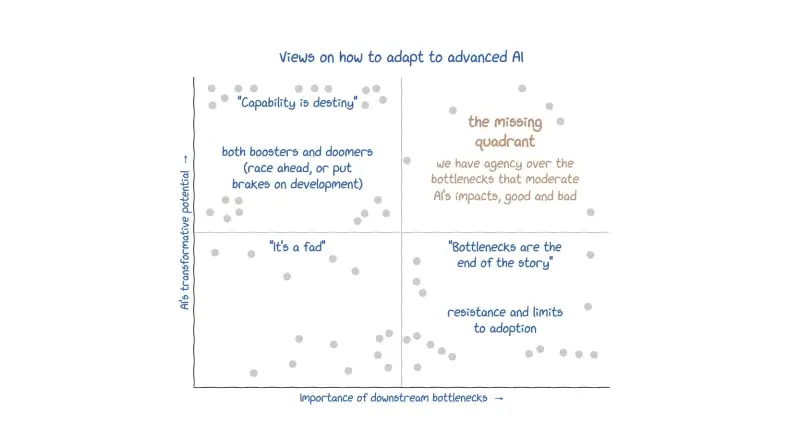
STABL describes its position using a two-by-two framework. One axis asks whether someone takes AI’s transformative potential seriously; the other asks whether they account for the bottlenecks between technical capability and real-world effects. The organization places itself in the quadrant that takes both seriously.
At one end of the debate is technological determinism: the expectation that superintelligent systems could overwhelm the limits imposed by organizations, institutions and social processes. Some technology executives have suggested that a century of progress might be compressed into a few years. This view can leave little room to ask how such change would move through workplaces, institutions or established systems.
Some of the strongest critics of AI capabilities share this emphasis on technology’s power. They focus on slowing capability gains as the main way to protect society, which can leave downstream conditions underexamined.
The opposite corner treats current organizations, processes and professions as largely fixed, and focuses on limiting adoption or shielding established structures from disruption. That perspective can identify real constraints: professional norms, organizational inertia, regulation and public resistance all affect how quickly new tools spread.
Slowing change can create time to shape its effects. But protecting existing arrangements for their own sake can also block useful improvements. STABL points to resistance to self-driving cars, despite claims that they can be safer than human drivers, and restrictions on AI-assisted legal advice as examples of this tension. The practical question is how to remove barriers that serve little purpose while preserving safeguards that do.
STABL’s preferred position starts with identifying bottlenecks and then asks whether they can be changed. Consider AI-assisted medicine. A model might speed up drug discovery, while clinical trials still take years because they must address safety and other constraints. Naming that delay is only the beginning: researchers can also ask whether in-silico testing can help, and how institutional processes might be redesigned to evaluate treatments more efficiently.
That emphasis on both technological potential and the conditions for realizing it is, in STABL’s view, underrepresented. The organization wants to help build a larger body of research in this area, support new organizations and work with existing groups across different parts of the debate.
Four areas for research
STABL’s work is organized around four questions: how to measure progress toward recursive self-improvement; how to defend against advanced AI risks; how to shape AI’s economic effects; and how specific professions and sectors should respond. Together, they connect research on model capabilities with investigation of the institutions and conditions that determine their impact.
1. Measuring progress toward recursive self-improvement
Many expectations of explosive AI progress depend on recursive self-improvement, in which AI systems automate parts of AI research and help produce more capable systems. STABL takes the possibility seriously and wants to test claims about it empirically. The organization argues that evaluations need to examine not only tasks with clear, easily checked answers but also long, open-ended work.
AI systems have made rapid gains on tasks where success can be verified automatically. STABL sees a widening gap between performance on those tasks and performance on less structured work. Through CRUX, it plans to run recurring evaluations of agents on lengthy, messy tasks, including open-ended AI research. In its first results, expert reviewers rejected the research papers produced by frontier agents. STABL intends to repeat the evaluations as models and scaffolds improve.
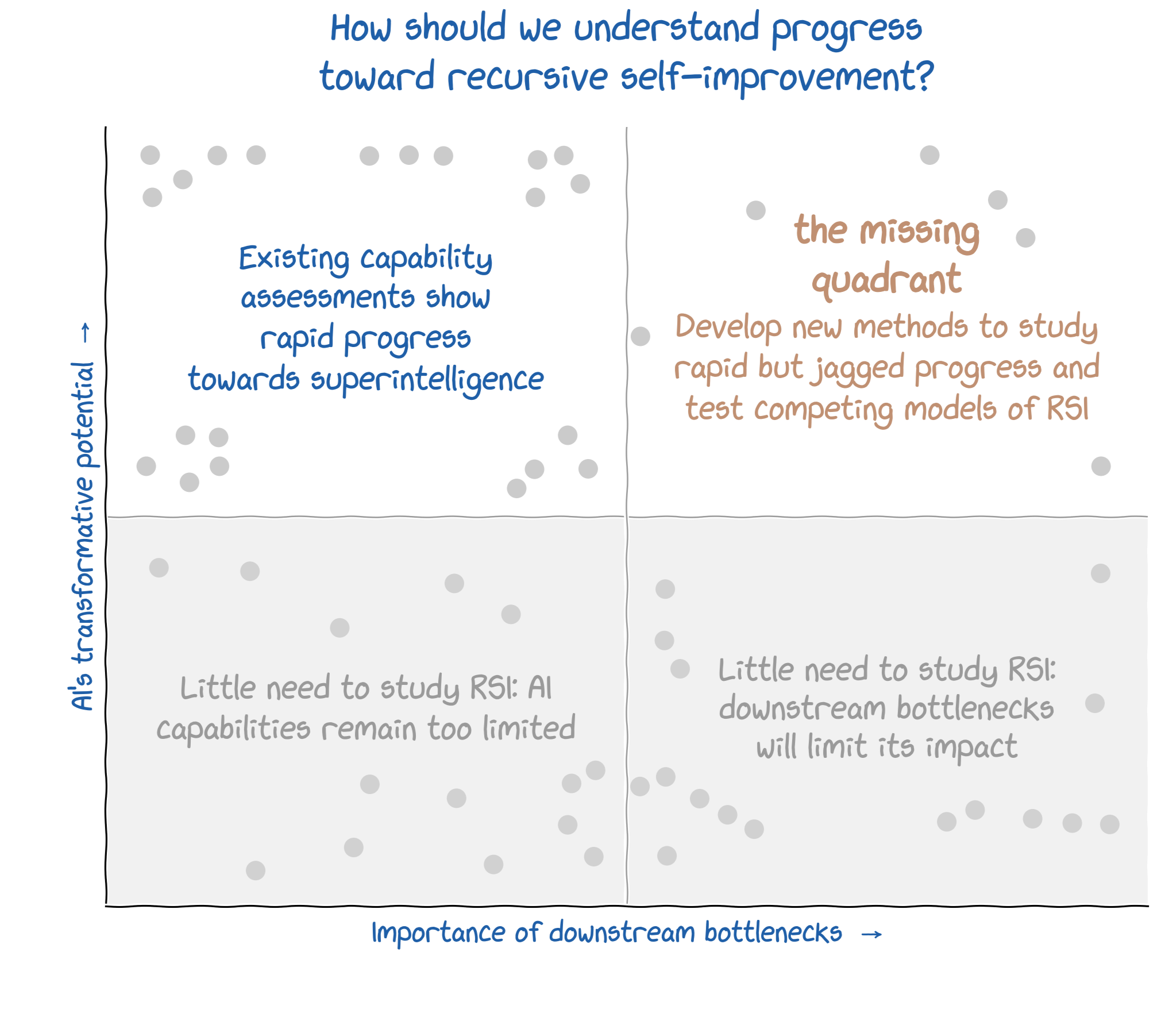
STABL also sees a need for more variety in the assumptions used to study recursive improvement. If researchers share the same contested model of AI progress, their conclusions may inherit the same blind spots. It proposes comparing causal explanations of progress rather than choosing one model in advance. One question is whether better performance on verifiable tasks reliably translates into better performance in real settings.
Data is another potential constraint. Progress on tasks with abundant, high-quality training data may not transfer to fields where useful examples are scarce. Studying when improvements carry across domains could help distinguish broad recursive gains from more limited progress shaped by data availability.
Finally, researchers may need to separate different dimensions of capability. Many benchmarks rely on automatic verification, which also makes them suitable for reinforcement-learning training. Evaluations that go beyond such benchmarks could reveal which abilities improve through recursive processes and which remain difficult to measure or develop. STABL wants a research community that takes these dynamics seriously without assuming they inevitably produce superintelligence.
2. Defending against advanced AI risks
AI safety has often concentrated on the model itself, with alignment as a central technical challenge. Open models complicate that approach because alignment can be changed or removed after release. STABL argues that capable systems are likely to become widely accessible, including to people who may misuse them, so defenses need to extend beyond alignment and efforts to limit distribution.
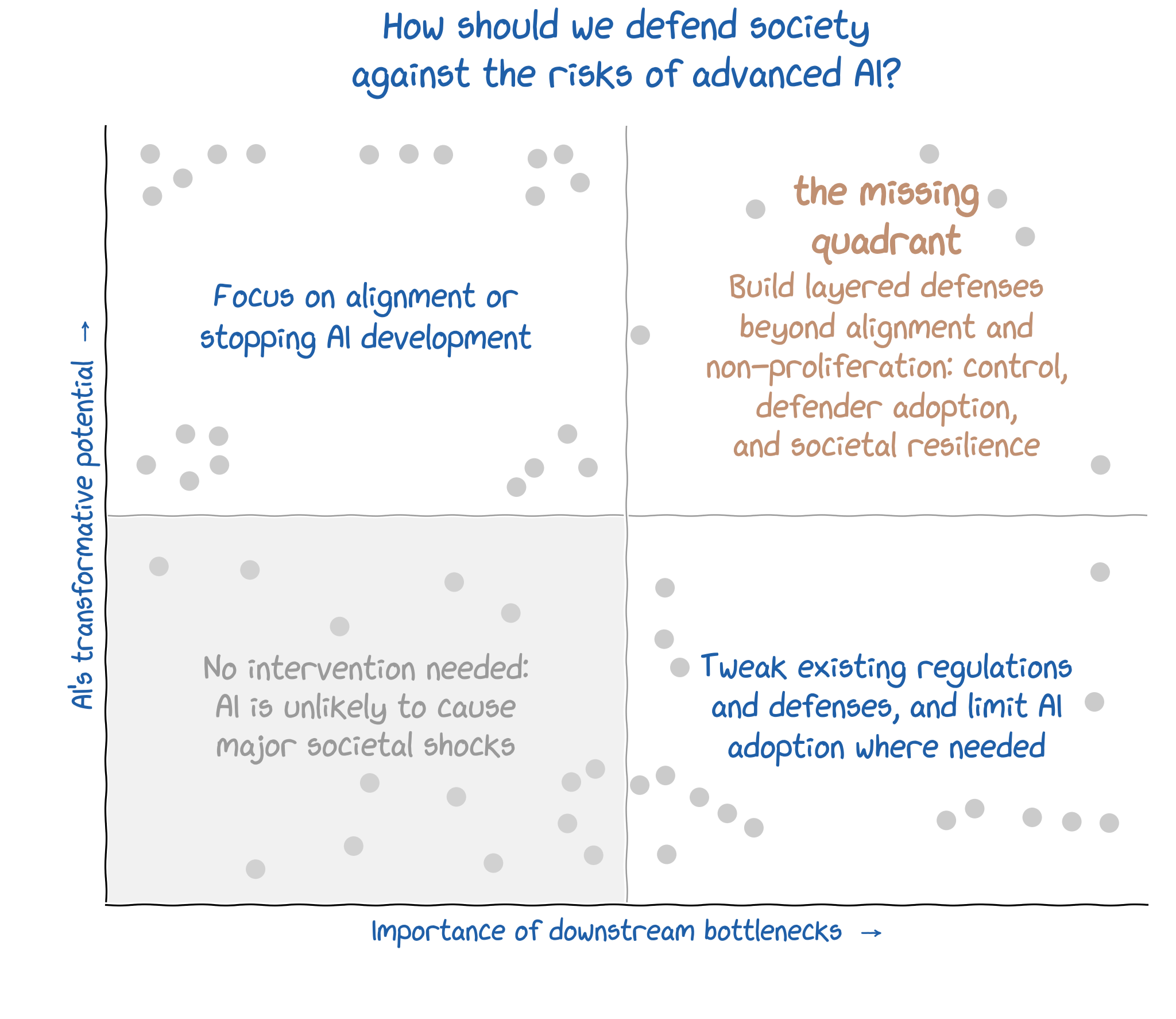
The organization describes three additional layers of defense. AI systems need to be controlled, monitored and secured to reduce unintended actions, including when they are misaligned. The systems and sectors exposed to harm need stronger protections, such as better cybersecurity for essential infrastructure. And communities need resilience measures that limit damage when technical defenses fail.
STABL identifies resilience as the least developed of these approaches in practice. It wants to turn the concept into a set of specific actions. That work, it argues, should be tailored to particular sectors and threats: for example, assessing what it takes to protect hospital systems from cyberattacks, who can deploy those protections and how to implement them at scale.
The organization also calls for more ambitious investment in areas such as pandemic preparedness and large-scale cyber defense. And it wants planning to cover severe scenarios, including recovery from AI-related catastrophes. The aim is to connect concern about extreme outcomes with concrete response plans, rather than leave resilience as a general aspiration.
3. Shaping AI’s economic effects
AI tools have reached customers, workers and firms, but the overall benefits and costs remain difficult to measure. Workplace adoption is visible, yet broad productivity gains have not clearly followed. At the same time, despite predictions of imminent, large-scale job loss, unemployment in the United States and other countries has remained largely unchanged.
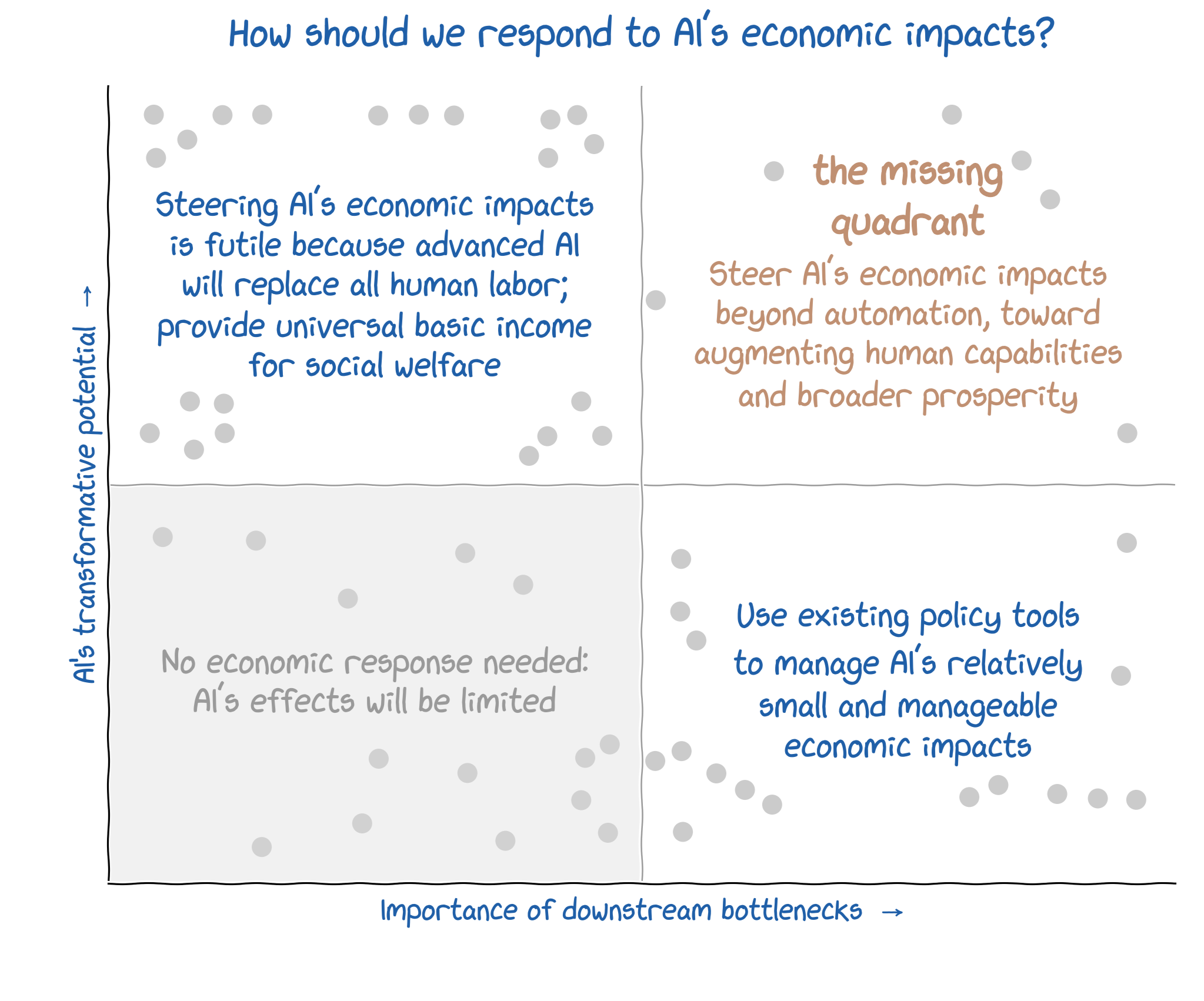
For STABL, these mixed signals reinforce the case for studying the bottlenecks that shape economic change. Capability tests alone can’t explain how adoption affects work, firms and households. Traditional measures still matter, but they may miss changes in the work people do and the choices they face.
The organization wants to shift attention from automating paid human labor toward using AI to augment workers and support new products, services and industries. Automation can produce gains, as it did in agriculture, but automating existing tasks may not be enough to produce wider prosperity. STABL sees augmentation as a more promising route to economic growth and a way to account for workers’ contribution and agency.
One proposed direction is to build prototypes that help workers keep up with changing AI capabilities and find uses that improve job satisfaction. Another is to examine how professions change even when employment numbers don’t. Coding agents, for instance, might transform software engineering without producing a large immediate shift in the number of software engineers. Students’ decisions about what to study and their expectations for jobs after graduation are also part of the picture.
AI use outside work may matter too. People who use AI for tax advice, for example, could gain value as consumers while reducing demand for paid labor. STABL plans to examine these effects alongside workplace adoption, working with other groups studying AI’s economic consequences.
4. Responses within professions and sectors
Neither benchmark scores nor measures of which jobs are exposed to AI can settle how particular occupations, industries and institutions will change. The effects depend on context. STABL cites work on science, legal services and software engineering as a starting point, and plans to study other forms of knowledge work.
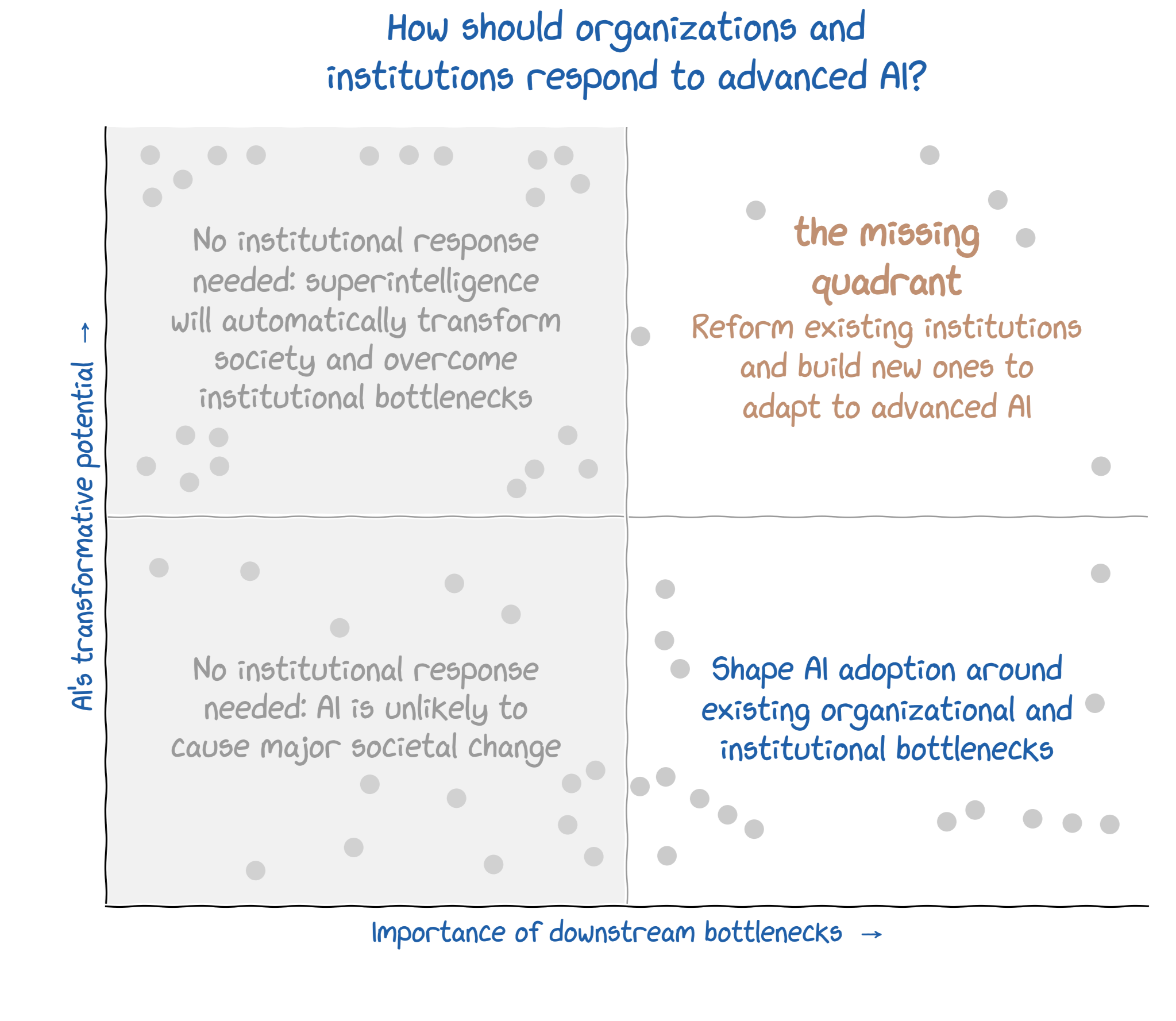
Its goal is to develop principles and institutional changes that keep knowledge professionals and public institutions in control while allowing productivity gains. That could mean changing workflows, removing unnecessary barriers to entry and improving institutional capacity. STABL also wants to encourage competition between established organizations and AI-enabled newcomers, including by considering different organizational forms.
Some institutional frictions serve a useful purpose, the organization acknowledges. The challenge is to distinguish those safeguards from obstacles that simply prevent beneficial change. Its proposed approach aims to make room for reform without displacing established structures wholesale.
Building STABL’s research program
STABL says it is raising funds and hiring across its four workstreams. Its advisory board includes Erik Brynjolfsson, Michael R. Strain, Audrey Tang, Helen Toner and Robb Willer, alongside a group of researchers and collaborators.
The organization expects to produce four kinds of work. First, conceptual research and public writing will clarify disagreements in AI debates and identify questions that evidence can resolve. The team points to its award-winning book AI Snake Oil, essays in the Wall Street Journal and WIRED, and a newsletter with more than 90,000 readers as examples of its past work.
Second, empirical research will track AI progress and social effects. STABL cites CRUX’s open-ended evaluations of AI research, agent benchmarks adopted by major AI companies and the Foundation Model Transparency Index, which it says has helped establish expectations for company disclosures.
Third, evidence synthesis will bring findings together across areas of use. Previous work on open foundation models and AI’s effects on science, law and software engineering provides a base for this effort. Fourth, STABL plans to offer independent expertise on AI governance, including transparency, third-party evaluation and openness. The team has contributed to international AI safety reports and work on evidence-based approaches.
The organization’s research agenda centers on a practical question: what has to change for AI’s capabilities to improve lives, and what defenses can limit harm along the way? Answering it requires tracking model progress while examining the bottlenecks in workplaces, institutions and essential services. STABL’s next step is to build that work into a sustained research program and collaborate with others studying the same gaps.