How LangChain’s GTM Agent Generates Sales Documents from Deal Context
- Cargo
- Machine Learning
- Shipped
- Shipper
- Joseph Miller
- Readers
- 378
LangChain’s agent generated 1,540 sales artifacts in 12 weeks, pairing deal context with templates, human review and proactive prompts.
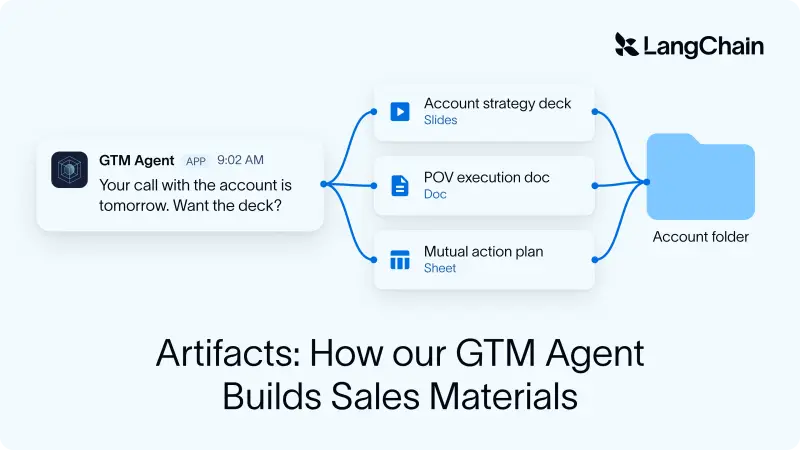
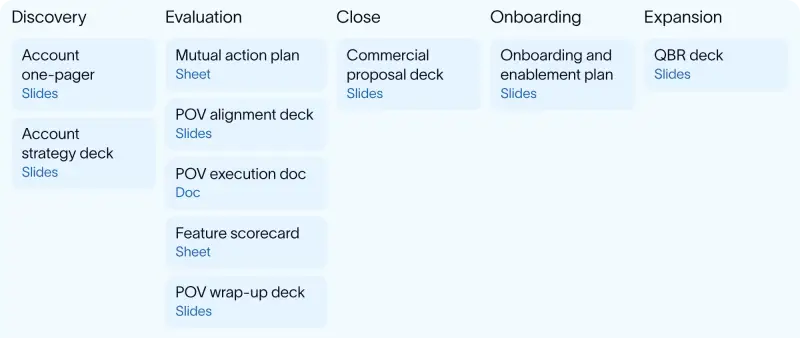
LangChain’s internal GTM Agent generated 1,540 sales artifacts over 12 weeks, helping its sales team prepare documents that were previously assembled by hand for each deal. The system’s central design choice is to give the agent detailed knowledge of the company’s sales process and customer accounts. That context appears to matter more than elaborate prompt tuning: it helps the agent create relevant documents and identify when a rep may need one.
The generated materials include account plans, proof-of-value documents, proposal decks and onboarding plans. LangChain reports that reps saved 337 hours on artifacts they sent to customers, and that the system generated more than 100 artifacts a week during the 12-week period. These figures describe internal use; they don’t by themselves establish that the agent caused deals to progress.
Putting deal process into the workflow
The agent already supported other sales and marketing work, including lead research, draft outreach for rep approval in Slack, and weekly summaries of account signals such as expansion opportunities and deal risks. Adding document generation put it to work on a task that sales representatives had been repeating across accounts.
Before the agent, account executives gathered product usage information, used a chat assistant and assembled proposal decks themselves. Different reps could produce different versions of similar material, while recurring work consumed time on each deal. LangChain wanted to standardize the quality of customer-facing documents, reduce repeated effort and make the sales process more consistent.
That last goal depends on more than filling in a template. Each deal stage has requirements that need to be met before a deal advances, such as identifying an economic buyer or agreeing on success criteria. LangChain tracks the deal’s stage and the artifact associated with each requirement. Previously, a missed step might only surface in a pipeline review weeks later. With artifact generation tied to active deal records, the agent can flag a missing document while the rep still has an opportunity to address it with the customer.
LangChain says 47% of deals where a rep sent a generated artifact moved to a later stage, compared with 16% of matched deals without one. It also reports that 46% of artifacts were followed by a customer call within 14 days. These are associations reported by the company, rather than evidence that the documents alone produced the movement or calls.
Context drives the output
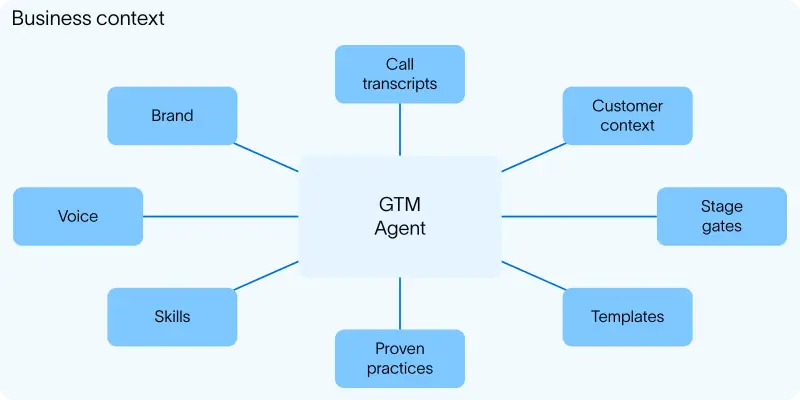
The agent’s instructions encode how LangChain conducts a deal: which documents are needed at each stage, what each document should contain, what follow-up questions are likely, and where to retrieve information. It can read Salesforce account records, product usage, call transcripts, risks, decision criteria and next steps. Templates and stage rules provide process context; customer data grounds the document in the specific account.
Brand guidance is part of that setup, too. The sandbox includes logos, colors, fonts, typography tokens and style guidance. LangChain says updates to these assets go through a reviewed code change, and the agent checks rendered pages against the guidance. The intent is to make the output consistent with materials created by the rest of the company.
Much of the development effort went into capturing this business knowledge and refining integrations through use by sales reps. That approach reflects a practical limitation of general-purpose models: they don’t automatically know a company’s sales stages, document standards, customer history or preferred sources of truth. The agent’s usefulness depends on supplying those details and keeping them current.
From Slack request to shared sales document
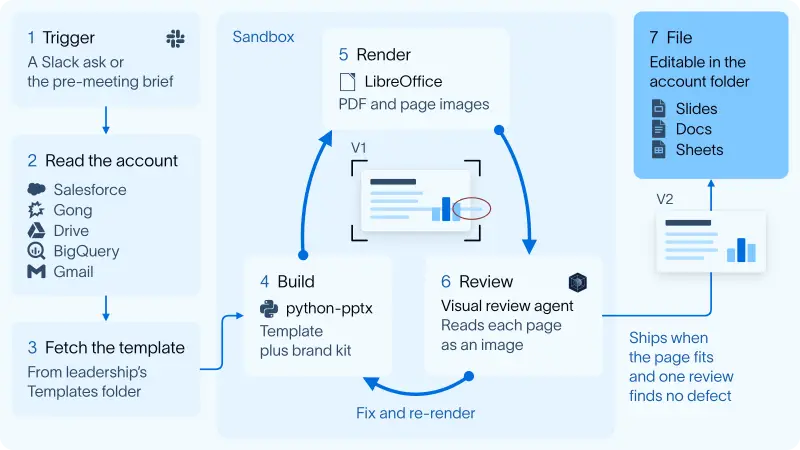
A rep can ask for an artifact in Slack, or the agent can suggest one while preparing for a meeting. Before drafting, it resolves the account in Salesforce and reads the account’s Google Drive folder. If required information is missing—for example, success criteria or the economic buyer—it asks the rep for it rather than treating an unknown as established fact.
Once it has enough context, the agent copies the relevant leadership-owned template into a sandbox and fills it using python-pptx. It renders the file with LibreOffice, converts the pages to images and reviews the layout. If it finds a defect, it makes a correction and renders again. After review, the file is converted into a native Google Slides, Docs or Sheets document and placed in the account folder. The rep receives a PDF preview and a link in Slack, along with flags for any fields that still need human input.
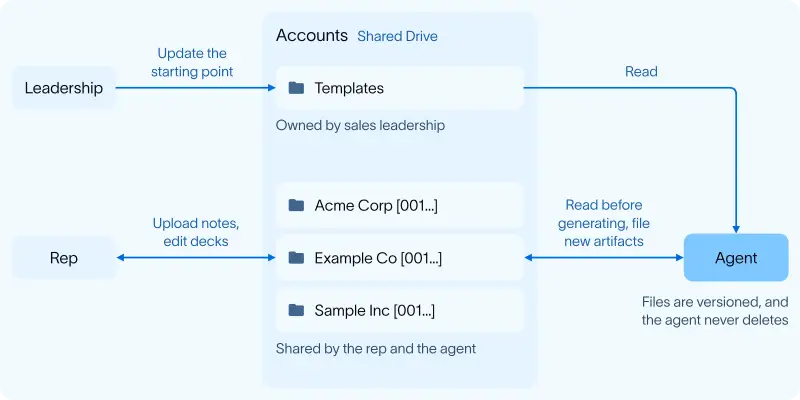
The handoff is designed as collaboration: the agent completes what it can support with available information, while the rep remains responsible for filling gaps and editing the result. Each account has a shared Drive folder where reps add call notes and revise generated documents. The agent reads the folder before producing the next artifact. Leadership templates live there as well, so an update can flow to the team’s subsequent work.
Review quality without letting it stall
Visual review helps catch layout problems that a text-only check could miss, but repeated review can add time and cost. Early versions sometimes examined pages that were already acceptable dozens of times. LangChain introduced a stopping rule: once a review finds no meaningful defect, the agent ships the artifact. On a one-page document, the company says this reduced a run from 18 minutes to 7 minutes.
The example points to a broader operational choice in agent design. Review can improve output, but it needs a clear endpoint. Without one, an agent may spend additional time repeating checks that don’t change the document. LangChain uses tracing in LangSmith to inspect renders, tool calls and review steps, and says that tracing helped diagnose the latency issue.
Proactive prompts and shared infrastructure
Reps may not request a document if they don’t know it exists or don’t realize it is relevant to the current deal. The agent therefore prepares meeting briefs from calendar events and account status. When a scheduled customer meeting is associated with a deal stage that lacks a required artifact, the brief can tell the rep which document to bring.
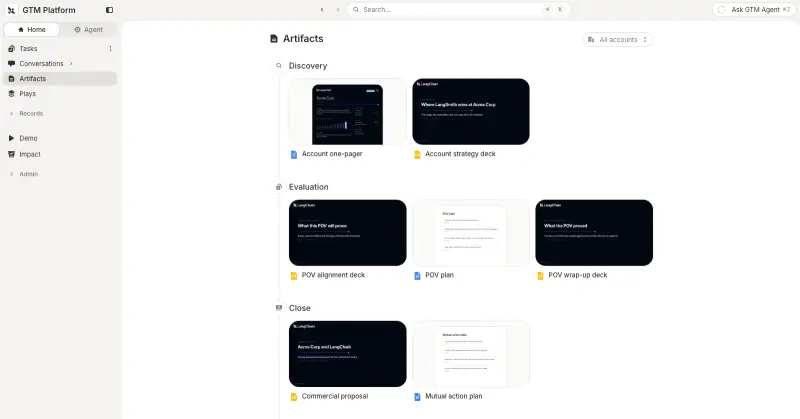
LangChain also assigns tasks to account executives to prepare the relevant artifact. The rep can use the agent or create the document manually; either way, the task helps keep the expected materials tied to the sales process. A web-based artifact hub gives the team a view of deals, their stages, existing documents and the next expected artifact.
The system depends on several pieces working together: versioned skills and instructions for sales rules and templates, a sandbox with office software, a Slack interface, scheduled runs, memory that carries information across conversations, and tracing. LangChain says these capabilities are available as building blocks in its Deep Agents harness and Managed Deep Agents, which includes sandbox, skills and memory support.
Human feedback and outcome tracking
Automated checks can show whether a document follows instructions, but they can’t establish that the instructions reflect what sales leaders and customers need. LangChain gathers feedback through weekly meetings with leaders who own different artifacts, presentations and office hours for the sales team, and Slack channels used by reps. Each artifact has an owner who gives detailed feedback on its contents and presentation. The team turns those discussions into improvements to the system.
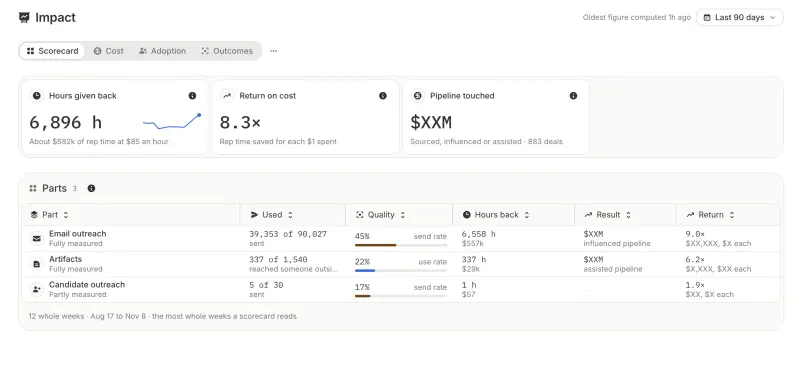
It also tracks whether generated work gets used. Its measures cover production volume, how many artifacts are shared outside the company, estimated rep time saved relative to run cost, and the pipeline touched by the documents. That distinction matters: a high artifact count can look productive even if reps rarely send the results to customers. The reported 337 hours saved applies to customer-sent artifacts, while the other measures help the company assess use and business outcomes.
LangChain’s account is a case study in building around a model: the agent draws on company process, customer records, shared files, brand rules and human judgment, then connects its output to the team’s day-to-day tools. The next practical test is whether those feedback and outcome measures can show which artifacts help reps and which need to change.