Promptim Automates Single-Prompt Optimization with Evaluation Loops
- Cargo
- Machine Learning
- Shipped
- Shipper
- James Martinez
- Readers
- 626
Promptim tests prompt revisions against datasets and evaluators, retaining changes that improve development scores while keeping human review in the loop.
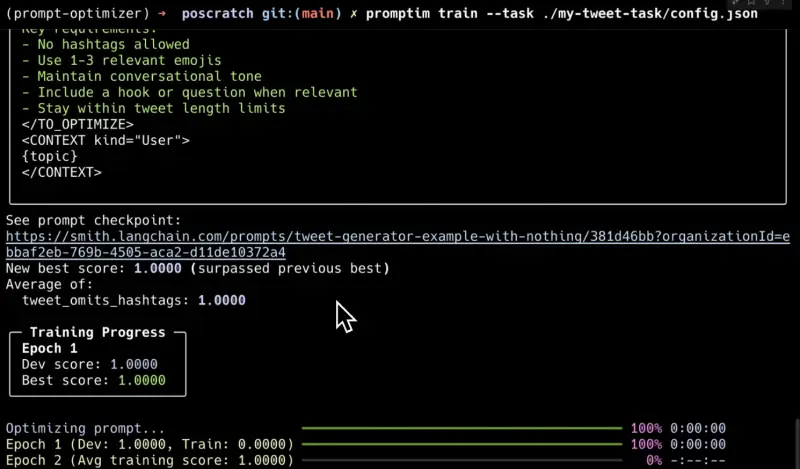
Promptim turns prompt revision into a repeatable evaluation loop: developers provide a starting prompt, a dataset and task-specific evaluators, and the library proposes changes that can be measured against a baseline. Its scope is deliberately narrow. It optimizes one prompt at a time, with results tracked through LangSmith and optional human feedback available during the process.
That focus makes Promptim a practical experiment for teams that already have evaluation data and want to reduce the manual work of tuning prompts. It doesn’t make prompt quality self-evident: the outcome depends on the examples and scoring methods a team supplies, and a higher score still needs human review to establish whether the revised prompt behaves acceptably in practice.
Evaluation sets the terms of optimization
Manual prompt engineering often involves changing instructions, trying examples and judging whether the output improved. Evaluation-driven development adds a more consistent basis for those judgments. A team gathers representative inputs, may include expected outputs, and defines metrics for assessing model responses. Each prompt revision can then be run across the same data and compared with prior results.
Promptim automates part of that cycle. Instead of relying only on an engineer to think of the next wording change, it passes task results to a metaprompt, which proposes a revision. The revised prompt is scored using the team’s evaluation setup. In this design, the evaluator is central: it determines what counts as improvement, while the dataset determines which cases the optimization loop sees.
LangSmith supports dataset curation and evaluation, and Promptim uses it for dataset and prompt management as well as tracking results. The project describes the library as open source and experimental. That status matters for teams assessing it: the workflow is an initial approach to a bounded task, rather than evidence that automated prompt optimization will work equally well across applications.
How the loop selects a prompt
A run begins with a LangSmith dataset, a prompt stored in LangSmith and evaluators defined locally. Teams can optionally divide their examples into train, dev and test splits. The initial prompt is evaluated on the development split, or on the full dataset if no split is used, establishing a baseline score.
Promptim then processes examples from the training split, or from the full dataset. It runs the current prompt and scores the resulting outputs. The inputs, outputs, expected outputs and scores are supplied to a metaprompt, which is asked to suggest changes to the current prompt. Promptim evaluates the candidate revision on the development split and retains it if the metrics improve. If they don’t, the prior prompt stays in place. The cycle runs for a specified number of iterations.
This separation between training and development examples is intended to give the system different data for proposing changes and checking their effects. But those splits don’t guarantee that a prompt will generalize to cases outside the dataset. Teams still need examples that reflect the range of inputs they expect, and should inspect behavior on cases that aggregate scores might obscure. A metric can make comparisons repeatable; it can’t by itself prove that the selected prompt is useful in production.
Human review remains part of the design
Automated evaluators may not capture every quality that matters. Promptim can therefore incorporate human feedback through LangSmith Annotation Queues. This option is relevant when a task lacks reliable automated metrics or when reviewers need to assess qualities that the scoring setup doesn’t measure.
Human review also fits the library’s broader workflow. Prompts are stored in LangSmith’s Prompt Hub, where teams can examine the resulting instructions after optimization, and evaluation results are tracked for review. The point is not simply to accept the highest-scoring candidate: a developer can use the recorded results and prompt itself to judge whether a revision makes sense.
This approach trades some autonomy for visibility. The process can generate and compare prompt variants, but the people responsible for the system remain involved in defining the task, choosing the data and metrics, and checking the final result. That’s especially useful when an evaluation score only partially reflects the intended behavior.
A narrower target than DSPy
Promptim and DSPy address related optimization problems with different scopes. Promptim focuses on rewriting a single prompt. DSPy targets a broader “compound AI system” and offers multiple ways to optimize it, including fine-tuning and few-shot prompting.
The human role differs as well. Promptim’s workflow emphasizes review, including optional feedback through annotation queues and access to stored prompts and evaluation results in LangSmith. The project presents DSPy as removing people from more of the optimization process. These differences make the tools suited to different needs: teams seeking a focused prompt revision loop may find Promptim easier to frame, while broader system-level changes call for a wider set of optimization methods.
Prompt optimization can also help when changing models. Different models may respond better to different prompt strategies, so switching the model alone may not preserve task performance. A dataset and evaluator that can be reused across models give teams a way to compare prompt adaptations. The evaluation setup still needs careful attention: model-independent examples don’t make every metric equally suitable for every model or use case.
What to watch as the project develops
The project identifies dynamic few-shot prompting, a LangSmith interface for Promptim, more optimization methods and optimization of LangGraph workflows as areas for future work. These would extend its reach beyond revising a single prompt, though they’re presented as directions the team wants to pursue rather than capabilities already available in the described workflow.
Developers can install the library with pip install promptim. The project also offers a walkthrough video and accepts feedback through GitHub discussions. For now, the clearest use case is a task with a defined dataset, evaluators that reflect meaningful outcomes, and reviewers prepared to inspect the candidate prompt. Promptim can speed up the search for a better instruction; the quality of that search still rests on the quality of the evaluation process.


