Kazakhstan Builds AI Compute Capacity for Local Models and Industrial Applications
- Cargo
- Machine Learning
- Shipped
- Shipper
- Rev Lebaredian
- Readers
- 735
Kazakhstan is expanding GPU infrastructure while local firms pursue generative media, robotics and autonomous mobility applications.

Kazakhstan’s AI push is taking shape across infrastructure, local model development and commercial applications. New GPU deployments are planned alongside projects in generative media and autonomous mobility, while the country’s technology leaders are emphasizing Kazakh-language systems and uses tied to local industries. The test will be whether more computing capacity connects with the people and organizations able to put it to work.
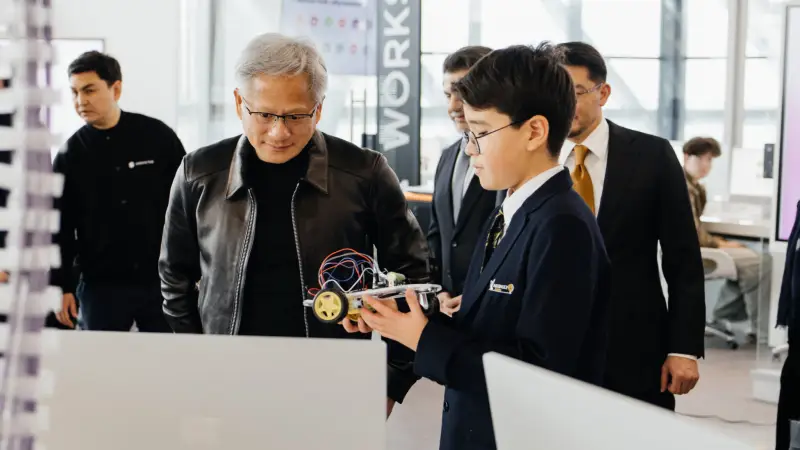
Those themes surfaced during NVIDIA CEO Jensen Huang’s visit to Astana, where he joined Deputy Prime Minister and AI and Digital Development Minister Zhaslan Madiyev for a discussion at Alem.AI, Kazakhstan’s international center for artificial intelligence. Their conversation ranged from the energy needs of AI to language, robotics and how to manage AI agents.
Local data, language and industrial use
Madiyev said Kazakhstan wants models that understand Kazakh and reflect the country’s cultural context. That goal depends on more than translating interfaces: language specific systems need suitable data and evaluation, while local applications must work with the terms and settings people actually use. The discussion framed the country’s own data as an important resource for that effort.
Huang linked Kazakhstan’s energy resources to the possibility of producing and exporting AI services. “Instead of just exporting energy, in the future, you could transform energy into intelligence and export intelligence,” he said. He also argued that a country’s data carries its history, values and culture, adding: “Your country’s data is your natural resource. It belongs to you.”
The conversation also turned to physical AI: systems that interact with the world through robots and other machines. Madiyev cited factories, mines, agriculture, transport and logistics as possible areas of development, and asked how Kazakhstan might become a center for training models used in physical systems. Huang said such technology could affect fields including mining, mineral processing and agriculture.
For developers entering the field, Huang recommended learning how AI works, including its principles, capabilities and weaknesses, rather than focusing only on how to use existing tools. That distinction matters as teams move from experimenting with models to building products that need to perform reliably in specific settings.
Huang also discussed the safe use of AI agents, describing NVIDIA’s OpenShell as a way to contain agents by restricting their access to files and tools and monitoring their activity. The description points to a practical concern for deployments: agents need enough access to complete tasks, while teams need ways to limit and observe what they can do.
During the visit, Huang praised the founders of Higgsfield AI, a startup founded in Kazakhstan, and NVIDIA announced an investment in the company. He highlighted the founders and their aim to compete globally, saying: “The first thing and the last thing is you invest in people, not companies.”
Compute projects set a longer timeline
Firebird is expanding into Kazakhstan after building its first AI factory in Armenia. The company has secured a U.S. export license for 45,000 NVIDIA Grace Blackwell GPUs. Its first phase, under construction with Kazakhtelecom at Data Center Valley, is targeting commercial launch in the third quarter of 2027.
A proposed second phase could bring Firebird’s total potential AI infrastructure capacity in Kazakhstan to approximately 500 megawatts. Firebird also plans to establish Firebird Labs Kazakhstan, with support for local startups, research and talent development through funding, access to computing resources and research partnerships.
Kazakhtelecom, the country’s largest telecommunications company, has deployed 400 NVIDIA H200 GPUs and 480 NVIDIA B300 GPUs in Astana and Almaty. Next year, it plans to add more than 1,000 GPUs at Data Center Valley, as well as more than 1,000 NVIDIA Vera Rubin GPUs in the Ekibastuz region. The planned infrastructure is intended to serve enterprise, developer and institutional workloads.
The figures point to a substantial expansion in available compute, but hardware alone doesn’t establish how much useful work it will support. Access, operating capacity and the ability to match compute to training, fine-tuning and inference needs will shape what developers can build. Kazakhtelecom’s deployments and Firebird’s longer-term plan have different schedules, so the near-term footprint will develop in stages.
Companies are building on the capacity
Higgsfield is expanding its AI infrastructure with NVIDIA Vera Rubin GPUs running through cloud service providers. The added capacity is intended to support growth in its models, products and customer demand for generative media applications.
In autonomous mobility, inDrive and Pony.ai are exploring robotaxi services, with Astana as the first city under consideration. The companies plan to assess whether Pony.ai’s seventh-generation robotaxis could be offered through the inDrive app. The proposed system would draw on NVIDIA’s Hyperion sensor and compute platform and Halos safety system. The collaboration is exploratory; the announcement describes a feasibility assessment, not an operating service.
More local compute can give companies room to train, adapt and serve models, while working applications can create further demand for that capacity. Connecting infrastructure with startups, universities, developers and established industries will determine whether the expansion becomes a broader base for products and research.
Huang’s visit also included a meeting with President Kassym-Jomart Tokayev and a public discussion with Madiyev. Tokayev presented Huang with the Order of Dostyk, First Class, described as recognition of his contribution to AI development in Kazakhstan; “Dostyk” means friendship. Later, International Judo Federation president Marius Vizer and federation director Timur Kemell presented Huang with an honorary judo black belt.
For Kazakhstan, the clearest measure of progress will be how these plans connect: GPU deployments that arrive on schedule, local teams able to use them, and applications that serve the country’s languages and industries. The infrastructure is growing; the next step is turning capacity into working systems.