Human Review Gives Agent Teams Better Context and Evaluation Data
- Cargo
- Machine Learning
- Shipped
- Shipper
- James Smith
- Readers
- 474
Expert reviews expose failures automated scores miss, then turn those findings into reusable evaluation criteria and test data.
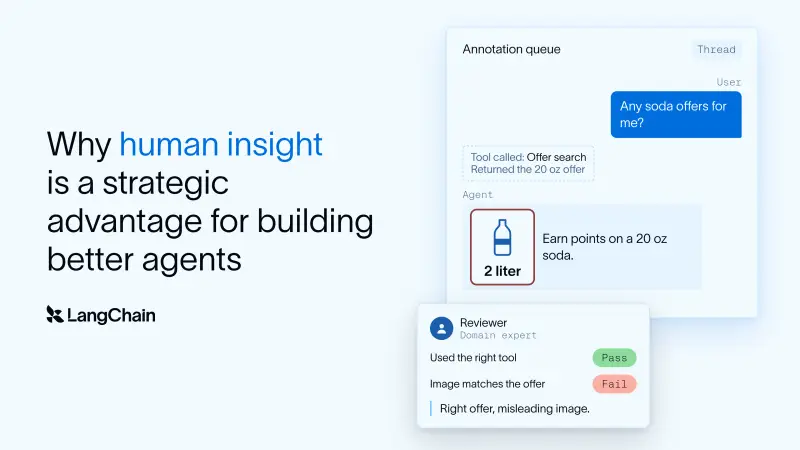
For agents that work across multiple turns and tools, the final answer alone is a poor measure of performance. Human reviewers can assess whether the system understood the user’s goal, chose appropriate actions, and produced a response grounded in the interaction. Their explanations also give teams material to improve evaluation systems and test future versions of the agent.
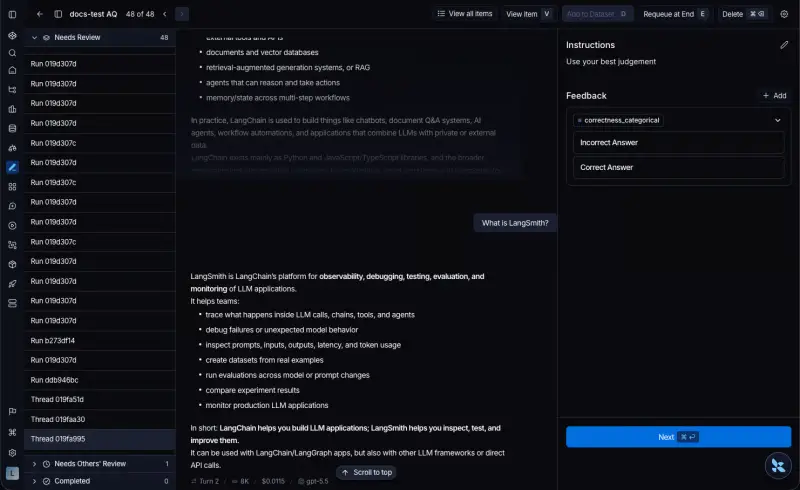
That’s the case for putting structured human review inside agent development. The workflow connects three pieces: expert judgment defines quality, full conversation context makes that judgment meaningful, and labeled reviews turn it into data that can be reused.
Review the agent’s work, not just its answer
An agent trace records an attempt, including user messages, model responses, tool calls, and intermediate steps. Teams use traces to investigate behavior and decide what to change. An engineer or an automated evaluator may flag a trace when something appears wrong, but a flag identifies a case for inspection; it doesn’t explain the failure or define a better response.
That explanation comes from a reviewer. In an annotation queue, a person examines a run or a full thread, scores the interaction against a rubric, and records why the agent succeeded or fell short. A run captures one step or span. A thread represents the multi-turn session, giving the reviewer the conversation the user experienced.
The distinction matters as agents take on longer tasks. A response can sound reasonable in isolation while contradicting an earlier request, or it can reflect a mistake made several steps before the final answer. Reviewing the conversation as one item helps the reviewer see what the user wanted, what actions the agent took, and where the outcome went off track.
Expert judgment sets the quality bar
Automated metrics can score defined behaviors, but they may not capture the judgment required in a particular role or business context. Domain experts know what a useful result looks like for their users, which details matter, and what the agent should have done when a response misses the mark.
The reasoning behind a score is especially valuable. A pass or fail label says how a reviewer judged an interaction; a comment can explain which behavior was wrong and what a stronger response would have done. That knowledge can expose gaps in the evaluation rubric, too. If reviewers repeatedly flag an issue the automated evaluator overlooks, the problem may sit in the evaluator’s criteria as well as in the agent.
One review can therefore inform more than a single correction. Stored with its run or thread, an expert’s score and explanation can help the team clarify its definition of quality and guide the next iteration of both the agent and its evaluation process.
Context makes judgments more reliable
A reviewer’s assessment depends on what they can see. If the queue presents only one step from a longer exchange, the reviewer may not know what the user said earlier, which tools the agent used, or why it took a particular path. Showing the full thread puts those details together.
For a multi-turn agent, the conversation is often the right unit to judge. A final reply may appear correct until it’s compared with a constraint the user gave several messages earlier. Similarly, a tool call may explain why the response is incomplete or unsupported. When the full session is presented as one review item, the reviewer doesn’t have to reconstruct the interaction from separate steps.
A trajectory provides a readable view of the conversation, with messages and tool calls in sequence and without the nested run tree or repeated information. The thread remains the item under review; the trajectory is a way to inspect what happened within it. This lets reviewers focus on the exchange without first learning to navigate a trace tree.
Turn reviews into reusable evaluation data
Human review becomes more valuable when its results can be applied after the queue is closed. A typical process starts with a reviewer scoring a run or thread against a rubric, such as pass or fail, a 1–5 scale, empathy, or correct tool use. A brief explanation records what drove the score.
That labeled example serves as ground truth for the interaction. It identifies the dimension that failed, rather than merely marking the whole exchange as bad. Teams can then use the evidence in several ways:
- Calibrate an LLM judge: Compare its scores with human scores on the same traces. Where they differ, revise the judge’s prompt or rubric and check whether its assessments align more closely.
- Improve online evaluators: When reviewers keep finding the same missed behavior, update the evaluator intended to catch it and apply that evaluation to later traffic.
- Create a golden dataset: Keep strong human-labeled examples for offline experiments, so teams can assess changes to an agent or prompt against a consistent set of cases.
Connecting labels and comments to the runs and threads they describe gives builders a record they can revisit. They can look for recurring failure modes, adjust rubrics, test evaluator changes, and compare new agent versions with earlier examples. Expert review becomes part of a feedback loop: judgments produce structured labels, labels inform evaluators and datasets, and those tools score later work against criteria shaped by human expertise.
Fetch Rewards checks answers against real data
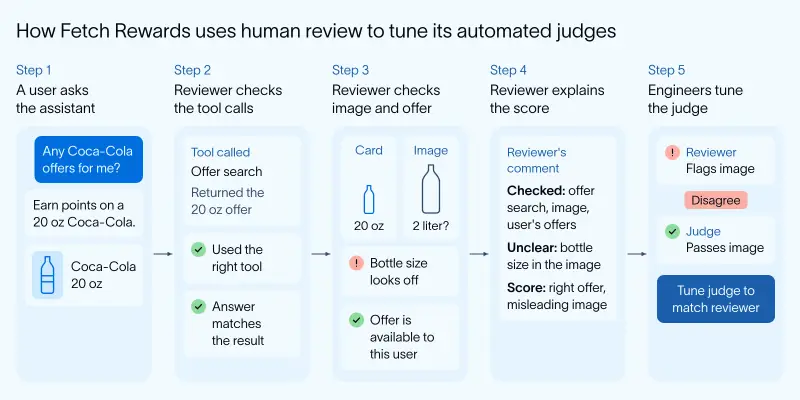
Fetch Rewards uses annotation queues to give its automated judges a human reference point. Reviewers assess individual turns from the AI Rewards Assistant, but the text exchange doesn’t always provide enough evidence to decide whether an answer is good. They may inspect trace metadata to see which tools the assistant called and whether the response matches the returned data.
When someone asks about an offer, reviewers check that the assistant searched for offers and accurately reflected the result. They also verify that product-card images match the products they represent; a card for a 20 oz Coca-Cola, for instance, should not display a 2 liter bottle. For recommendations, they check whether the suggested offers were actually available to that user.
Some judgments remain ambiguous. An image can be close but wrong, an offer can be valid yet unhelpful, or a factually accurate response can still miss the user’s intent. Reviewers document what they checked, what remains uncertain, and why they assigned a score. Engineers can use those notes to find differences between automated and human judgments and adjust the automated judge’s logic.
The practical takeaway is to make review specific enough to guide a change: give experts the full interaction, a clear rubric, and a place to explain their scores. Those records can help teams improve both agent behavior and the systems used to measure it.


