Google Cloud Adds Cross-Cloud Data Access and Agent Tools to Agentic Data Cloud
- Cargo
- Machine Learning
- Shipped
- Shipper
- Mike Wheatley
- Readers
- 384
Google’s updates target data access, business context and scale, with new lakehouse caching, agent workflows and infrastructure for concurrent queries.
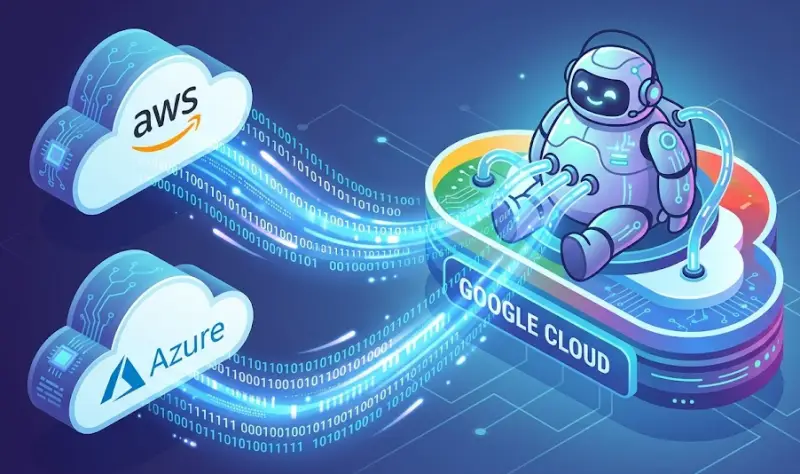
Google Cloud’s latest Agentic Data Cloud updates target three constraints that can limit autonomous data work: reaching information spread across clouds, grounding answers in business context, and serving many agents at once. The additions span lakehouse access, Gemini workflows, developer tooling and database capacity. Together, they outline Google’s approach to making agents work against existing data systems without requiring every dataset to move first.
Query data across clouds
The main data access update is borderless Lakehouse, built on the Apache Iceberg table format. Its caching capabilities let customers query data stored in Amazon Web Services and Microsoft Azure over a secure private link. Google says retrieved data blocks are cached in Google Cloud, helping later queries run faster. The approach is designed to avoid copying remote datasets and associated egress fees.
That could reduce friction for organizations that keep data in multiple cloud environments, though the announcement doesn’t provide benchmark results for query speed or describe the limits of the cache. The practical value will depend on workloads, data access patterns and how often queries can reuse cached blocks.
A new AlloyDB integration extends the approach to transactional data. Users can query external Iceberg tables with standard PostgreSQL queries, without first copying the data into AlloyDB. That connects current transactional records with historical lakehouse data in one query workflow, which could help agents and applications combine operational and analytical information.
Agentic Data Cloud, introduced earlier this year at Google Cloud Next, is Google’s architecture for letting agents access data where it resides. The company frames it as a shift from traditional extract, transform and load pipelines toward low-latency access, less data movement and automated governance. Google vice president of product management for data analytics Sirish Chandrasekaran said the aim is to make data available across systems while keeping results accurate and costs low.
More business context for agents
Data access alone doesn’t ensure useful answers. Google is adding a self-learning enrichment feature to Knowledge Catalog, now in preview. It scans unstructured information in Google Workspace, Jira, SharePoint and GitHub, then turns operational knowledge into context sets in the Open Knowledge Format. Agents can use that context to interpret company-specific terms and processes.
Google reports that early adopters saw average agent accuracy improve fourfold, with token consumption falling by up to 75%. Those figures are promising, but the announcement doesn’t specify the evaluation method, task mix or comparison baseline. Teams assessing the feature will need to determine whether the gains hold for their own data and use cases.
Knowledge Catalog is also being enabled by default in the Gemini application. Its integration is intended to resolve business metric definitions and access controls before Gemini turns a request into a Structured Query Language query. Organizations can also ground agents in semantic models for BigQuery, Snowflake, SAP, Looker and dbt. The goal is consistent calculations: a revenue or churn query should use the same governed formula business teams already rely on.
Gemini takes on data tasks
New autonomous machine learning capabilities in Gemini are aimed at both data engineers and business users. Engineers can describe a desired business outcome in natural language; Gemini then generates PySpark code, runs notebooks and attempts to fix data pipeline errors as it works toward the request. This puts code generation and execution in one workflow, with the agent handling some of the iteration that would otherwise require manual intervention.
Business users will be able to ask Gemini for real-time operational reports. The system uses reporting skills connected to BigQuery and Knowledge Catalog to construct and save a query. Once saved, teams can run that report on demand without further token costs, according to Chandrasekaran. Saved queries could also make repeated reporting more consistent, provided the underlying definitions and data remain suitable for the task.
For developers, the Data Agent Kit is generally available. It brings Model Context Protocol tools into development environments including VS Code, Claude Code and Antigravity. Developers can describe their business intent in natural language and have agents create, refine and test related data pipelines.
Infrastructure for more simultaneous work
Google is also expanding database options for high concurrency. The broader preview of AlloyDB Express offers sub-two-second provisioning for rapid agent prototyping. PostgreSQL for agents in AlloyDB adds an isolated workload environment that Google says can handle three million queries per second. The announcement doesn’t detail the workload or conditions behind that capacity figure, so teams will need to validate performance against their own query patterns.
BigQuery Graph is now generally available, bringing graph analytics at petabyte scale to relational database tables without ETL. Google also introduced previews of TimesFM 3.0, a forecasting model, and TabFM, a predictive analytics model.
The release ties agent capabilities to a broader data stack: access across cloud boundaries, organizational context, generated workflows and capacity for concurrent queries. The next test is operational. Teams will need to measure whether these tools deliver accurate results on their data, fit existing access controls and stay responsive under real workloads.


