Senior Data Science Jobs in 2026 Demand Production ML, Cloud and LLM Skills
- Cargo
- Machine Learning
- Shipped
- Shipper
- Vinod Chugani
- Readers
- 931
Senior data science roles now pair advanced Python and SQL with production ML, cloud experience, LLM skills and clear business communication.
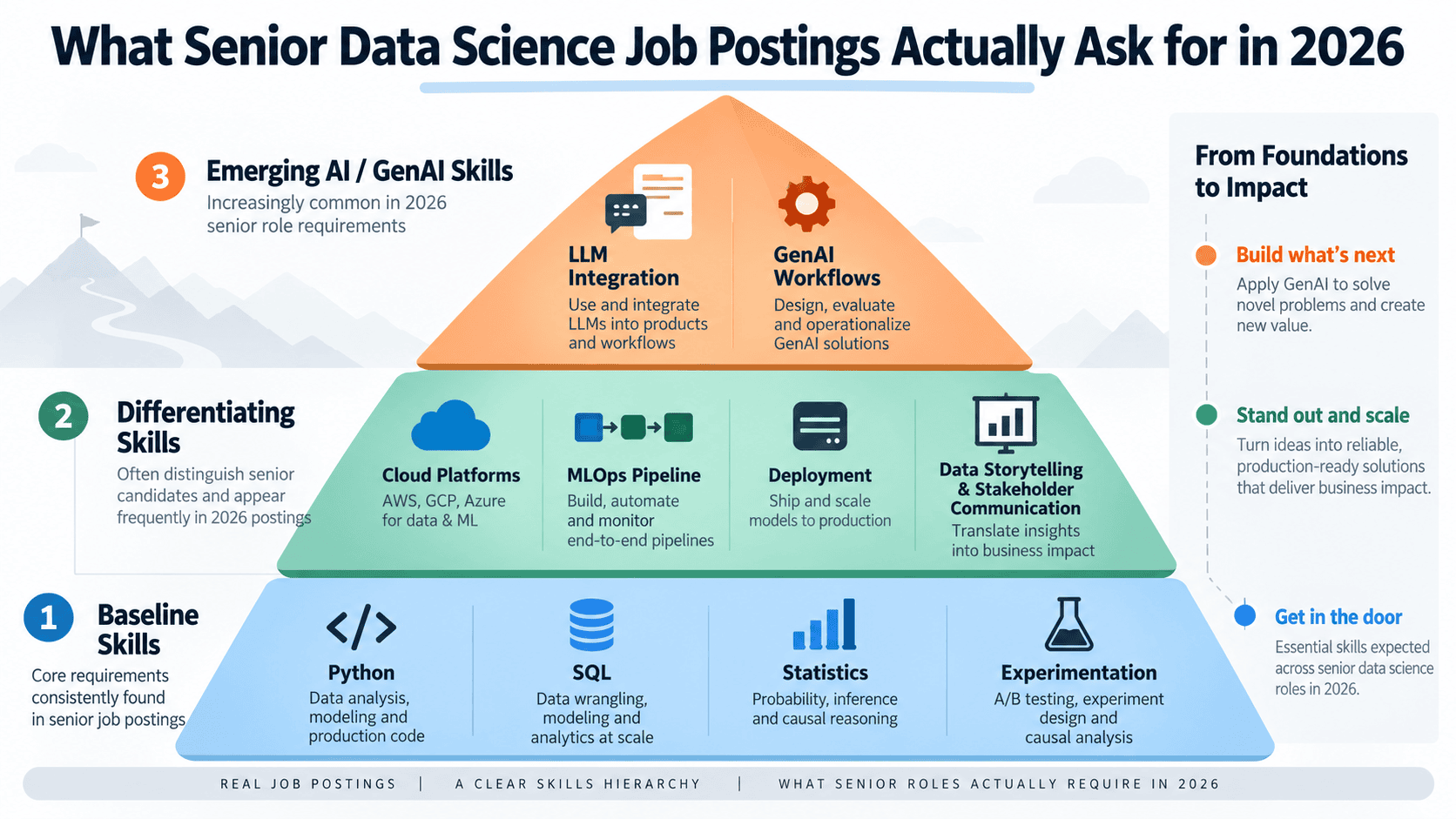
Senior data scientists are increasingly expected to take models from an idea through deployment and ongoing maintenance, while explaining their value to business teams. Job postings now combine production machine learning, cloud platform experience and generative AI skills with statistical judgment and communication. That combination marks a shift from roles centered mainly on analysis and model building.
The figures below draw on several analyses: a detailed review of 500 active U.S. postings on LinkedIn, Indeed and Glassdoor; a separate review of more than 7,000 postings for AI skill frequency; and a dataset of 12,148 postings tracked by Axial Search. These samples use different methods and counts, so their figures describe particular analyses rather than one unified census. Taken together, they show the breadth of skills employers are putting into senior role descriptions in 2026.
The technical baseline now includes deployment
Python, SQL and machine learning remain the most common technical requirements across data science postings. Their presence is widespread; the change is the depth and range of work associated with each skill. At senior level, employers describe candidates who can handle data, build and evaluate models, and deliver systems that others can use.
Python: 74% of postings
Python appears in 74% of data science postings. Fluency with libraries such as pandas remains useful, but senior descriptions commonly ask for more: machine learning pipelines using scikit-learn, deep learning with PyTorch or TensorFlow, and deployment through FastAPI or Flask. Some also name LLM frameworks such as LangChain and LlamaIndex.
The practical implication is that Python skill needs to extend beyond data cleaning and charts. Senior candidates are more competitive when they can write maintainable code, connect model work to applications, and contribute to systems that run outside a notebook.
SQL: 64% of postings
SQL appears in 64% of postings, with senior roles tending to expect advanced use. Examples include window functions such as ROW_NUMBER, RANK and LAG/LEAD; complex common table expressions and nested queries; and query tuning informed by execution plans. Employers also ask for experience with cloud data platforms and their SQL variants, including BigQuery, Snowflake and Redshift.
For senior work, writing a query is only part of the task. Candidates may need to understand how it performs against large datasets and how it fits into the organization’s data infrastructure.
Machine learning: 69% of postings
Machine learning is named in 69% of data science postings. Senior descriptions increasingly emphasize responsibility across the model lifecycle: feature engineering, evaluation, deployment, monitoring and maintenance. MLOps appears more consistently as a requirement than familiarity with any single classical algorithm.
In sectors such as finance and healthcare, postings also mention model interpretability, including tools such as SHAP and LIME. The broader signal is that a trained model is a starting point. Employers want senior practitioners who can judge whether it works, explain its behavior and support it in production.
Cloud and MLOps turn models into working systems
Cloud skills show up in 62% of the 500-posting sample, and they appear more often in senior descriptions. In that sample, Microsoft Azure was mentioned in 28.5% of postings, AWS in 19.7%, Google Cloud Platform in 14.2%, Snowflake in 11.8% and Databricks in 9.3%. These platform figures are reported for the reviewed postings; they should not be read as market-wide shares.
Senior listings often name concrete services rather than asking for general cloud familiarity. Examples include AWS SageMaker for machine learning workflows, AWS S3 and EC2 for storage and compute, Google Vertex AI, Azure ML and BigQuery. The expectation is practical: work with a cloud platform to deploy and scale data products, not simply use it to host an analysis notebook.
Cloud certifications are a notable exception to the limited role certifications otherwise play. Approximately 20% of data science postings explicitly requested one in the analysis. The AWS Certified Machine Learning Specialty appeared in 9.3% of postings, Azure Data Scientist Associate DP-100 in 8.4% and Google Professional Data Engineer in 7.1%. Postings naming a cloud certification tended to have higher salary bands, although the data provided doesn’t establish that the credential itself causes the difference.
MLOps requirements reinforce the production focus. Senior postings name MLflow for tracking and versioning models, Apache Airflow for workflow orchestration, and dbt for analytics engineering. Airflow appears in nearly 9% of all data science postings in the analysis, with greater concentration at senior levels. Docker, Kubernetes and continuous integration and delivery tools such as GitHub Actions or Jenkins also appear.
Data from 12,148 U.S. postings places hands-on technical execution ahead of boardroom influence as a defining leadership trait. Seniority, in this reading, means greater ownership of the work: building, shipping and maintaining systems, while setting direction through technical judgment.
Generative AI is becoming part of the senior skill set
Generative AI is the fastest-growing requirement category in the 2026 posting sample. Among 500 postings analyzed between April and May 2026, 31% explicitly mentioned GenAI, LLMs or prompt engineering. The same analysis puts those mentions near zero in 2023, showing how quickly the language of job descriptions has changed.
A separate review of more than 7,000 postings found AI skills in roughly two out of three listings overall. About half expected candidates to have specific AI skills or work on AI projects. LLMs led the named AI capabilities, appearing in approximately one in four postings, followed by retrieval-augmented generation (RAG), AI agents and natural language processing.
These requirements are concentrated in experienced roles. Research from the FutureProof Data Science newsletter found that 73% of postings mentioning AI skills targeted mid-level or senior candidates: 43% at mid level and 30% at senior level. Entry-level postings accounted for less than 6%. That pattern suggests employers increasingly expect AI fluency from practitioners who are already responsible for technical delivery.
Specific requirements include experience with LLM APIs from OpenAI, Claude and Gemini; implementing RAG and managing vector databases such as Pinecone, Weaviate and Chroma; and designing agent workflows with LangChain, CrewAI or AutoGen. Prompt engineering is named in 14% of postings. Some roles also call for LLM fine-tuning and evaluation methods.
Examples illustrate the level of application described. Wells Fargo’s Agentic AI Senior Lead Data Scientist role asked for “strong full-stack agentic AI skills.” The American Chemical Society listed production experience with LLM applications, RAG, multi-agent systems and model fine-tuning. Deloitte’s senior consulting role sought experience architecting agentic systems that connect LLMs with enterprise data pipelines. These examples point to expectations around integration and delivery, rather than familiarity with AI terminology alone.
Statistical judgment still separates experienced practitioners
Statistics and mathematics appear in 58% of postings. Senior roles call for probability and statistical inference, A/B testing and hypothesis test design, Bayesian methods, regression and time series forecasting. For jobs specifying a master’s degree or PhD, statistics was the most consistently named foundational skill in the analysis.
That emphasis complements the move toward automated tools. When software makes it easier to build a model, senior practitioners still need to decide whether the method fits the problem, test the evidence behind its results and identify where it may fail. The value lies in making sound choices, not just running an available algorithm.
Communication is part of the job, not a bonus
Data visualization appears in 53% of postings, but senior roles ask for more than dashboard experience. Their descriptions often emphasize data storytelling for executive audiences: explaining analytical results and model outputs in terms that help non-technical teams make decisions.
In the 500-posting review, Tableau appeared in 28.1% of listings, Power BI in 24.7%, Matplotlib and Seaborn in 21.4%, and Looker or Looker Studio in 9.7%. The analysis found Tableau mentions associated with advanced SQL and business communication requirements. Power BI tended to appear alongside Azure and other Microsoft ecosystem skills. For candidates, depth in a visualization tool that fits their target platform may be more useful than a long list of lightly used products.
Communication requirements are explicit elsewhere, too. “Communicate insights to non-technical stakeholders” appeared in 47% of the 500 postings, “work cross-functionally” in 39%, and leadership or mentoring of junior analysts in 19%. All three figures are higher at senior level.
In day-to-day work, that means turning an open-ended business goal, such as reducing customer attrition, into a measurable data problem; presenting findings without relying on technical shorthand; and partnering with product, engineering and business teams throughout a model’s lifecycle. Senior practitioners are also expected to mentor colleagues, set technical standards and recognize when machine learning isn’t the right solution.
A DataCamp analysis connects this emphasis to the growing automation of basic coding tasks with GenAI. As those tasks become more routine, employers place greater value on framing the problem, exercising business judgment and explaining technical findings. In the Axial Search analysis, execution and AI literacy ranked above strategy and influence as leadership capabilities. The profile that emerges is practical: build useful systems, explain their results and connect those results to business outcomes.
Experience, degrees and certifications carry different weight
Across 12,148 U.S. postings tracked by Axial Search, senior data scientist roles asked for a median of five years of experience. The median rose from two years for junior roles to four for mid-level, seven for principal and ten or more for director-level positions. Titles vary among employers, but the progression shows how postings distinguish scope and seniority.
The distribution has also shifted. In 2025, roles asking for six to eight years of experience were the least common, followed by roles asking for eight or more years and entry-level roles. In 2026, entry-level positions became the least common category. The analysis describes a more senior-weighted market in which entry-level applicants face greater competition, while mid-level and senior roles remain undersupplied.
Education requirements remain common. Axial Search found that 93% of data science postings require a degree, the highest share among the AI functions it tracked. Of postings that specified a degree level, 30% required a master’s degree and approximately 34–35% mentioned or preferred a PhD; PhD mentions rose from 2025 to 2026.
A separate 365 Data Science review of 827 active listings found that 26% did not specify a degree, while 30% required a master’s and 24% required a PhD. The samples differ, but both point to a market where degree requirements remain significant while some employers are becoming less explicit about them.
For many industry roles, a master’s degree paired with evidence of production work is a strong profile. A PhD is more relevant to research-heavy jobs and frontier AI labs. Candidates without graduate degrees can make their experience legible through shipped models, clear GitHub repositories and examples of production work.
Other certifications appear far less often. In the 12,148-posting analysis, the top eight certifications together accounted for less than 2% of postings. Cloud credentials are the exception, appearing in roughly 20%. A separate survey found that 78% of hiring managers cared more about portfolio projects than certifications. That finding supports a practical priority: for most candidates, a few well-executed projects with an end-to-end story offer stronger evidence than a long list of certificates.
Senior roles extend beyond large technology brands
The 500-posting sample found that 85–88% of active data science roles came from outside FAANG and major technology platforms. Technology and engineering accounted for 28.2% of postings, HR and staffing for 19%, health and life sciences for 13%, financial and professional services for 10%, manufacturing for 8.7%, and retail and e-commerce for 8.4%.
Healthcare was identified as the fastest-growing vertical for data science hiring, while financial services remained a top-paying sector. Mid-size technology companies, regional banks, hospital systems and manufacturers adopting AI contributed substantial senior openings. The job search can therefore extend well beyond the employers with the most recognizable names; the work, compensation and scope vary across industries and organizations.
What candidates should take from the postings
The baseline for senior roles now combines advanced Python and SQL, machine learning with production or MLOps experience, working depth on a cloud platform, and the ability to communicate findings to business stakeholders. The strongest differentiators are applied LLM experience, statistical judgment, orchestration skills and a record of connecting technical results to measurable outcomes.
Some signals are weaker than they may appear. A particular certification rarely functions as a broad requirement outside cloud roles. For non-research jobs, the difference between a master’s and a PhD may matter less than relevant delivery experience. Exposure to many tools also tells an employer less than depth with a smaller set of tools used in production.
The most reliable way to assess fit is to examine current senior listings in the intended industry. Five or ten postings can reveal which cloud services, AI capabilities and communication tasks recur in that slice of the market. That review gives candidates a concrete basis for choosing what to build next—and a more accurate picture of seniority than a general skills checklist.
For regular market comparisons, the Axial Search Data Science Job Market Dashboard tracks more than 12,000 U.S. postings and breaks them down by seniority, education and skill frequency. 365 Data Science publishes annual reviews, while FutureProof Data Science examines AI requirements by skill and seniority. Searching recent U.S. listings on LinkedIn or reviewing roles on Built In can add a current view of specific employers and, in some cases, salary ranges.
The central shift is not that any one requirement is entirely new. It’s that senior postings increasingly ask for technical depth, production ownership, AI fluency and business communication at the same time. Candidates who can demonstrate that combination with work they’ve shipped—and explain why it mattered—will be better prepared for the roles employers are describing.