Slurm Adds Shared Scheduling Support for Quantum Processors at Supercomputing Centers
- Cargo
- Machine Learning
- Shipped
- Shipper
- Sam Stanwyck
- Readers
- 519
Slurm’s new quantum interfaces aim to cut custom integration work, letting centers schedule quantum processors alongside conventional supercomputing resources.
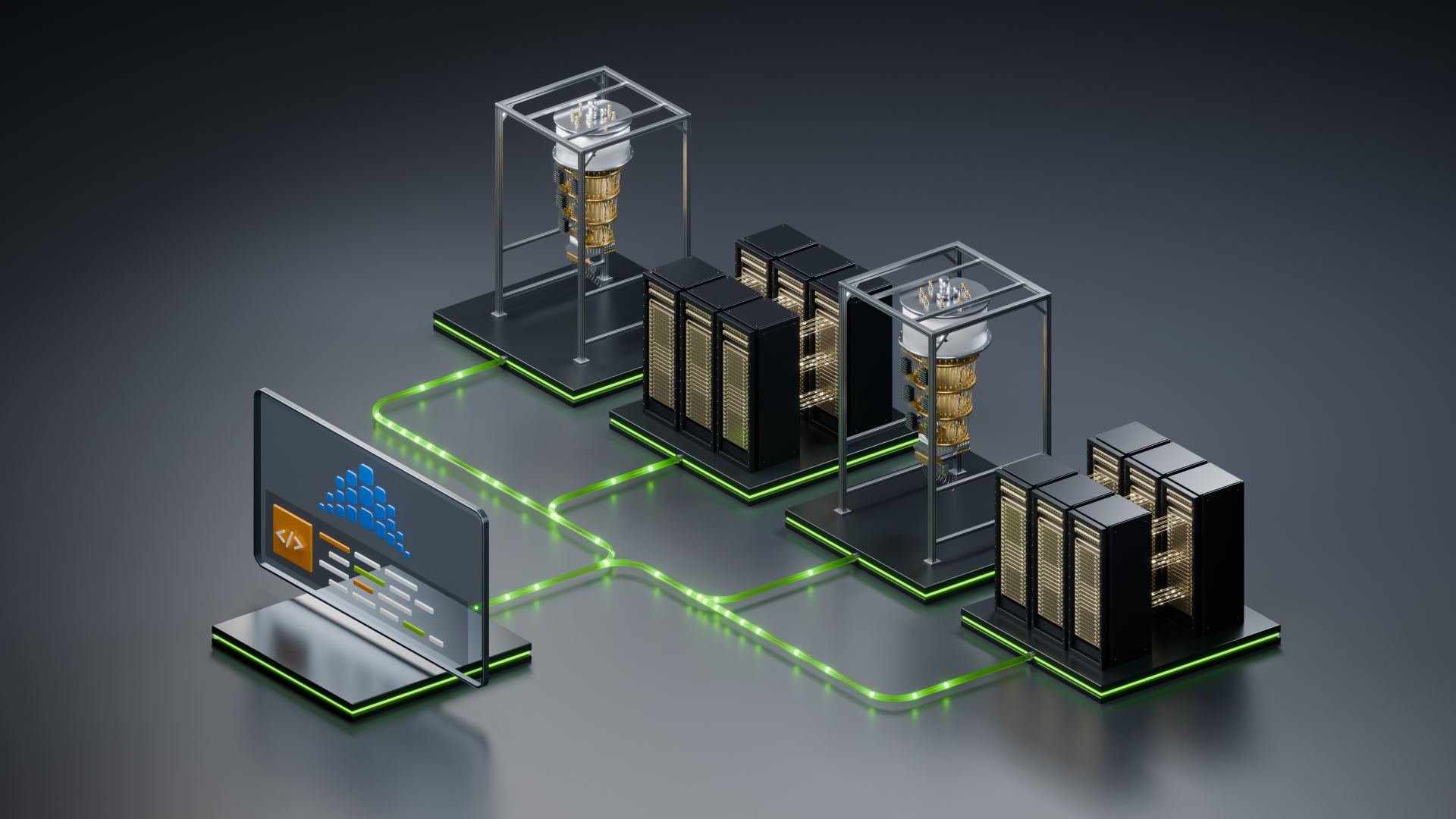
Connecting a quantum processor to a supercomputing center has often meant building a separate software integration for each pairing of hardware and center. Slurm’s expanded quantum support aims to reduce that work: quantum processor builders can describe their hardware through a shared interface, while centers can bring quantum resources into scheduling workflows they already use.
The change targets a growing set of deployments. Nearly 30 supercomputing centers around the world are in the process of deploying more than 50 quantum processors, and processor deployments at these centers have grown nearly sevenfold over the past five years. Many centers use Slurm to manage scientific computing workloads, making it a practical place to coordinate access to both conventional systems and quantum hardware.
A shared path from hardware to the scheduler
Previously, integrating a quantum processing unit (QPU) could require custom work for each center or each hardware provider. The new Slurm release builds on earlier work with IBM, Pasqal and the wider quantum computing community. It lets QPU builders provide a single interface to their hardware for supercomputing centers through a simple file.
The design builds on the QRMI and QDMI interfaces. Reusing those connections across deployments could reduce duplicated integration work for hardware builders, while giving centers a way to add processors to existing scheduling and resource-management practices without creating a bespoke solution for every QPU. That matters operationally: researchers need a way to request access to the hardware, and centers need to coordinate that access with the rest of their computing resources.
A number of organizations are already adopting the expansion: Alice & Bob, IBM, IQM, Pasqal, Quantinuum and MQSC. Slurm 26.11 was expected to be available later that month. The release’s practical value will depend on how consistently hardware providers implement the interfaces and how well each center can map its QPU into local scheduling workflows.
For research teams, the intended result is a more familiar route to hybrid work. Scientists can run quantum-classical applications built with platforms such as NVIDIA CUDA-Q, with Slurm coordinating access to the processing resources those applications need. The scheduler provides a way to organize access; it does not, by itself, make a QPU suitable for a given scientific task or remove the constraints of the hardware.
Slurm sits within a wider quantum-GPU platform
The scheduling work is one part of NVIDIA’s open platform for quantum-GPU supercomputing, which is centered on CUDA-Q for hybrid quantum-classical computing. At SC26, releases across that platform addressed error-correction research, application development, circuit control and large-scale simulation.
CUDA-Q QEC is aimed at researchers prototyping and testing quantum error-correction ideas. Its additions include a decoder server, and a new TCBP-JOBS decoder is reported to be 13,000 times faster than the industry standard. That speed figure describes the decoder comparison; it does not establish an equivalent improvement in the performance of a complete quantum system.
CUDA-Q also adds fault-tolerant primitives for compiling application ideas with more realistic assumptions. Fermilab used the platform for studies completed in three weeks that would normally have taken five months. The result illustrates how software tools can shorten a research workflow, though the reported comparison does not specify the studies’ full workload or compute setup.
CUDA-Q Algorithms supplies reusable components for quantum application developers, including capabilities for designing how data is loaded into quantum circuits and tools aimed at chemistry and materials applications. CUDA-Q Pulse provides hardware builders with tools for shaping the pulses used to control qubits on a QPU, including GPU-accelerated pulse generation. These components address different layers of the stack: application construction, hardware control and the coordination of access to physical resources.
Early work spans control, chemistry and simulation
Other projects show how teams are combining these pieces. Quantum Motion integrated its QUICHE chemistry framework with CUDA-Q. Altera and Oxford Quantum Circuits designed an FPGA-based controller that connects qubit control and readout to GPUs through NVQLink.
For simulation at larger scale, QunaSys used cuQuantum and 1,024 NVIDIA Hopper GPUs on ABCI-Q to simulate more than 300 million quantum operations. The work reached chemical accuracy for a model containing four hydrogen atoms. NVIDIA researchers used JUPITER to simulate 104 qubits under realistic noise, testing fault-tolerant designs before building them.
These examples span different goals and should be read on their own terms: one simulates a small molecular model at large compute scale, while another studies noisy qubit behavior for fault-tolerant designs. Together, they show why shared scheduling is useful as an infrastructure layer, while also underscoring that quantum research still relies on distinct hardware, simulation and software workflows.
The next measure of Slurm’s expansion will be whether centers and QPU builders can reuse the interfaces across real deployments without losing the scheduling controls their systems require. If that holds, researchers may face less center-specific integration work when moving hybrid applications from development toward shared supercomputing facilities.


