NVIDIA Vera Rubin Posts Up to 2x Training Gains and 10x Agentic Throughput per Watt
- Cargo
- Machine Learning
- Shipped
- Shipper
- Shruti Koparkar
- Readers
- 584
Vera Rubin leads MLPerf Training v6.1 and posts a provisional 10x throughput-per-watt gain on Kimi K3 agentic inference.

NVIDIA’s Vera Rubin NVL72 made its MLPerf debut with results spanning model training and agentic inference. The reported gains are substantial: up to 2x more performance per GPU than the GB300 NVL72 on training, and more than 10x the throughput per watt on one provisional agentic benchmark. The figures point to a system designed to handle both building models and serving workflows that make repeated tool calls.
The results also need to be read in context. The training submissions cover multiple benchmark types, while the largest-scale DeepSeek-V3 runs use different NVIDIA hardware. The Kimi K3 comparison is a provisional Endpoints result, and its systems ran with different accelerator counts and response characteristics. Those details matter when translating benchmark performance into expected capacity and cost for a real deployment.
Training results span the full benchmark set
MLPerf Training measures how quickly a system trains a model to a specified accuracy target. In v6.1, NVIDIA was the only platform with submissions across every benchmark, including large language models, image generation, recommendation systems and reinforcement learning post-training. NVIDIA reported that Vera Rubin NVL72 delivered up to twice the per-GPU performance of its highly optimized GB300 NVL72 system. The company describes the Vera Rubin figures as early results, with further gains expected from software optimization.
Vera Rubin combines accelerators, networking and software as a platform. That combination matters because training speed depends on more than the throughput of individual GPUs. As workloads grow, accelerators must exchange data quickly enough to keep one another busy. NVIDIA says NVLink connects GPUs within a system, while Quantum-X800 InfiniBand and Spectrum-X Ethernet link systems across a data center. The submission results reflect the whole setup, including optimized software, rather than an isolated chip measurement.
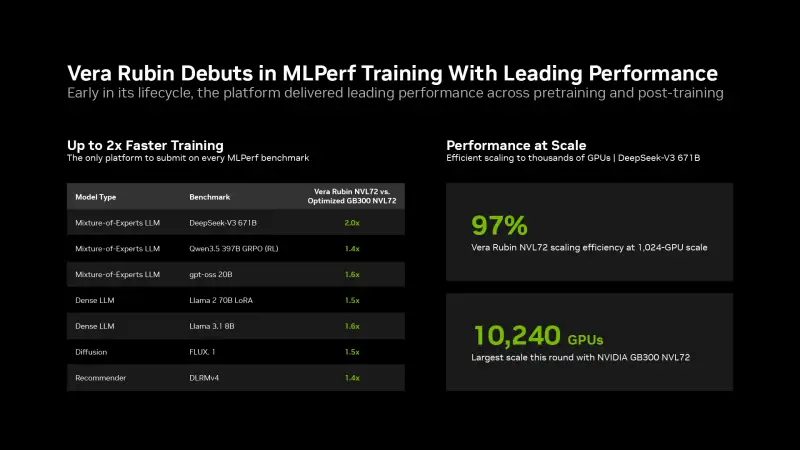
The DeepSeek-V3 scaling result offers a more direct view of how the system behaves as more GPUs are added. Vera Rubin NVL72 scaled from 256 to 1,024 GPUs at about 97% efficiency, according to NVIDIA. Increasing the GPU count fourfold reduced training time from 16 minutes to about four minutes. That near proportional scaling is relevant for teams that can divide a training workload across a large cluster, though the result alone does not establish how other models or configurations will scale.
Other entries show the scale possible with NVIDIA’s previous systems. NVIDIA ran the benchmark on 10,240 GPUs using GB300 systems, the largest submission in this round. Microsoft Azure matched that GPU count with GB200 systems. These runs provide evidence of large-cluster execution, while the Vera Rubin result highlights per-GPU gains and scaling at a smaller GPU count.
Agentic inference brings power and responsiveness into focus
Agentic workflows can involve many model interactions for a single task: reasoning, calling a tool, checking its output and continuing. MLPerf Endpoints evaluates systems on agentic coding and enterprise workflows, including whether tasks are completed correctly. That makes the benchmark more representative of multi-step serving than a simple measure of generated text alone.
On Kimi K3, an open model intended for agentic workflows, NVIDIA reports that Vera Rubin NVL72 achieved more than 10 times the throughput per watt of GB300 NVL72 at a shared minimum average interactivity of 50 tokens per second per user. The Vera Rubin result is provisional and awaits verification and peer review by MLCommons Association, so it may change.
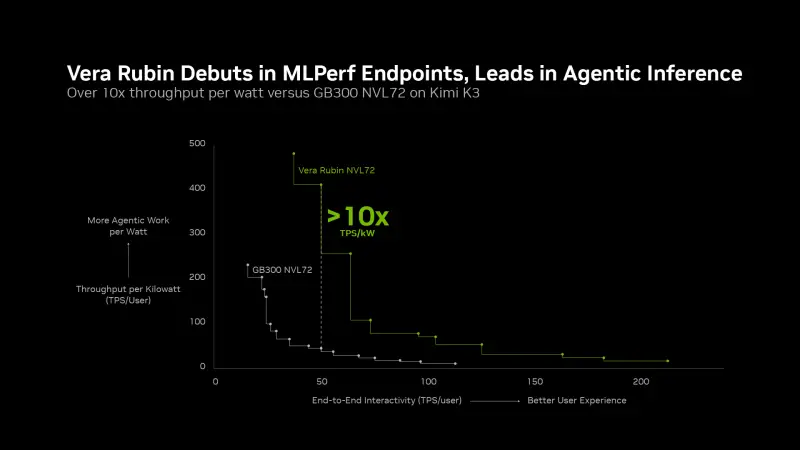
The underlying figures show why the comparison is framed around both power and user experience. Vera Rubin’s run used 32 accelerators, handled concurrency of 1,024 queries and delivered average end-to-end interactivity of 50.4 tokens per second per user. Its reported system throughput was 41,414.2 tokens per second at 100.89 kW. The GB300 run used 48 accelerators, with concurrency of 48 queries, average interactivity of 56.2 tokens per second per user, throughput of 2,210.4 tokens per second and power of 60 kW. These are benchmark configurations, not a controlled comparison with identical accelerator counts or concurrency.
For operators, throughput per watt captures a practical constraint: power limits how much inference capacity a data center can run. But service planning also depends on latency, concurrency, model behavior and workload mix. The Kimi K3 numbers suggest a large capacity gain at a specified response-speed threshold; they don’t by themselves predict costs or user experience for every agent workload.
A broad partner ecosystem, with more to validate
Twenty organizations submitted MLPerf Training results, including ASUS, Azure, Cisco, CoreWeave, Crusoe, Dell Technologies, Google Cloud, HPE, Lambda, Oracle, Supermicro and the University of Florida. Their participation illustrates the range of vendors and operators building on NVIDIA’s programmable platform, libraries and frameworks. It also makes the benchmark useful as a view of deployed system configurations across multiple organizations, rather than a single vendor’s lab setup.
NVIDIA also points to SemiAnalysis AgentX and Artificial Analysis AgentPerf as independent benchmarks where Vera Rubin performs strongly. Those results broaden the evidence beyond MLPerf, but the available figures here do not provide scores or test details for those benchmarks, so they can’t support a numerical comparison.
The clearest takeaway is that Vera Rubin pairs reported training improvements with a large, though still provisional, agentic inference efficiency result. For teams evaluating the platform, the next useful evidence will be verified Endpoints data, performance across additional workloads, and sustained results as software optimization continues. The benchmark figures show potential; deployment decisions will depend on how that performance maps to the models, response targets and power limits each operation actually faces.


