NVIDIA CUDA-X Libraries Speed Up Scientific Workflows Across Five Fields
- Cargo
- Machine Learning
- Shipped
- Shipper
- Kibibi Moseley
- Readers
- 591
CUDA-X tools report major gains in astronomy, fusion, molecular simulation, materials research and biology, with different libraries targeting each workload.
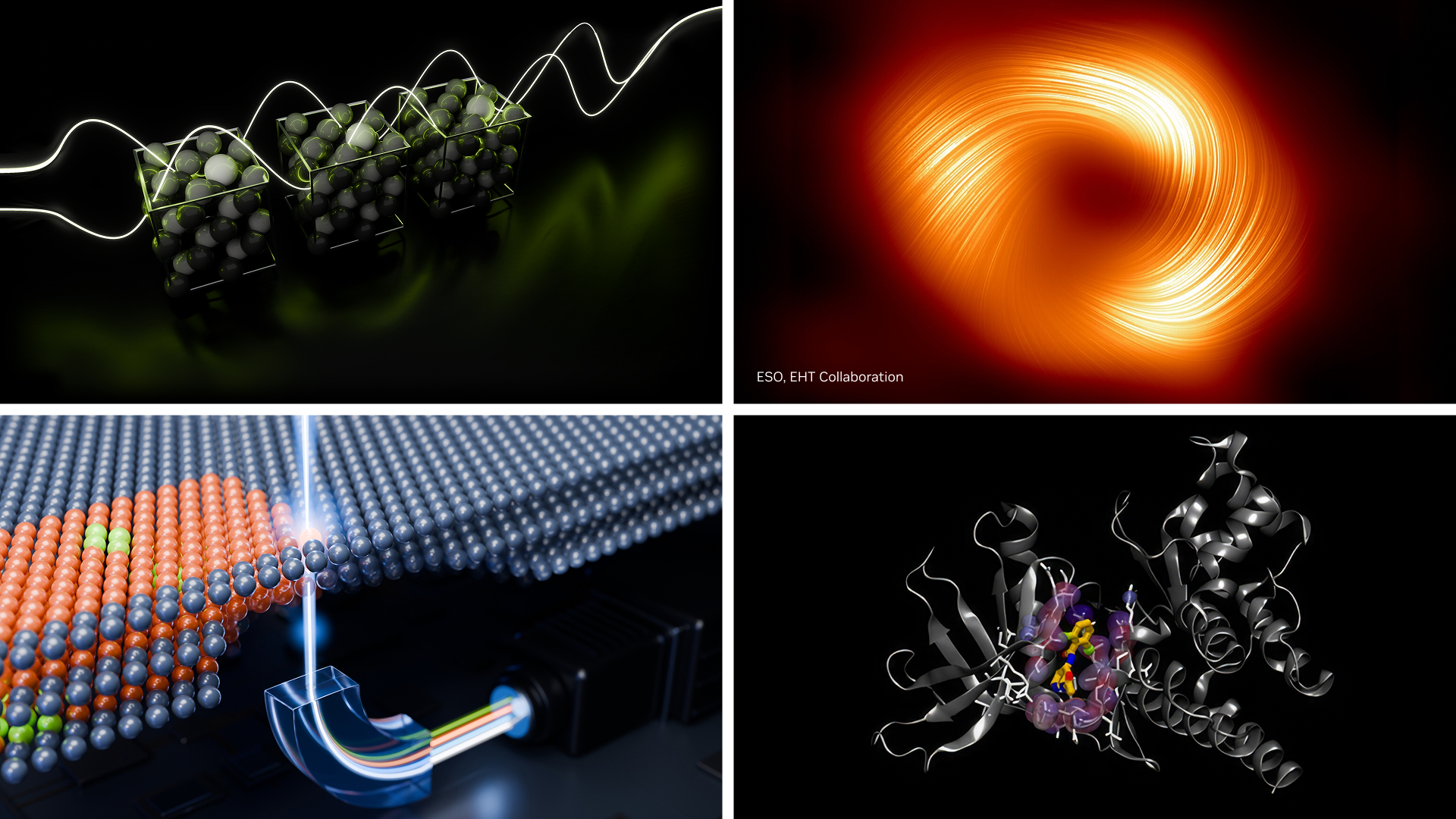
NVIDIA’s expanded CUDA-X libraries target a practical bottleneck in scientific computing: turning large, complex datasets into usable results quickly enough to guide the next analysis or experiment. The reported gains range from eight-minute processing of black hole observations to a 900x speedup for spatial cell calculations. Each result applies to a particular workflow, so the figures aren’t directly comparable, but together they show how GPU acceleration is being applied across several research fields.
The broader change is in where computation happens. Some of these tools accelerate established simulation or analysis software; others bring processing closer to an experiment as data arrives. NVIDIA also describes locally run AI agents as a way for researchers to query results and help steer simulations. That may make faster computation more useful in practice, though the supplied examples don’t quantify how much the agents themselves improve research outcomes.
Radio telescope data, processed in minutes
The Event Horizon Telescope combines radio dishes around the world to produce an Earth-sized aperture. Its observations generate petabytes of data, and correlating those measurements has traditionally taken months. NVIDIA says cuPhoton.xBeam, a module in the cuPhoton Toolkit, reduces a task that took more than a month to eight minutes.
The module has correlated observations of the black hole jets J1924 and 3C279. NVIDIA also describes real-time reconstruction of Messier 87* as a capability enabled by the toolkit. The full pipeline, from loading and processing data through visualization, can run on distributed multi-GPU systems or on an NVIDIA DGX Spark. For researchers, the potential value is a shorter loop between observations and examining the structure of matter moving around a black hole.
The reported time reduction is substantial, but it describes the correlation task; it doesn’t establish that every part of astronomical observation or image reconstruction now takes eight minutes. The computing setup and the specific workload matter when interpreting the figure.
Analysis while fusion simulations run
Fusion plasma simulations can be exceptionally slow: on petascale systems, a single time step may take days, and a simulation can run for weeks. Experimental data also arrives faster than traditional analysis pipelines can handle, delaying interpretation until an experiment has finished.
Pacific Fusion researchers used cuPhoton.xLens to extract and visualize information while plasma simulations were running. NVIDIA says the workflow can be paired with a locally running agent powered by Nemotron on the same system. Researchers can interact with the analysis and use emerging results to help steer simulations, with possible applications to fusion reactor target and chamber design.
The key practical distinction is timing: analysis during a run may help researchers make choices before a long simulation ends. The description doesn’t report a measured reduction in simulation time or a quantified improvement in design decisions, so the demonstrated benefit is access to results during execution.
Faster molecular calculations for drug design
cuPotential accelerates existing molecular simulation software, with NVIDIA reporting speedups of up to 3x alongside improvements in calculation stability and accuracy. The library builds on work by researchers at the Simons Foundation’s Flatiron Institute and D. E. Shaw Research. Its intended uses include generating synthetic data for generative AI models, searching for previously unknown molecular binding sites and calculating interaction strengths.
NVIDIA is working with Schrödinger and the AMBER, NAMD, GROMACS, LAMMPS and Open Molecular Software Foundation communities to bring the acceleration into molecular dynamics software and workflows. Cadence, Fathom Therapeutics, Topos Bio, Genesis Molecular AI and Terray Therapeutics are adopting cuPotential for drug discovery.
A speedup of up to 3x can increase the number of calculations researchers run within a given compute budget, or shorten the time required for a fixed workload. The stated figure is an upper bound, however; the source doesn’t give a single benchmark setup or say that every supported simulation will see the same gain.
GPU calculations for materials and experiments
Daviator is a collection of batched GPU kernels for the Vienna Ab initio Simulation Package, a widely used tool for quantum-mechanical calculations. It is coming to NVIDIA ALCHEMI. NVIDIA reports calculations up to 22x faster and costs up to 75% lower. The kernels are intended to cover atomistic systems of different sizes, including smaller systems that previously ran faster on CPUs. That matters for training and inference workflows that need millions of calculations of atomic interactions.
At Lawrence Berkeley National Laboratory, the DAQIRI networking library connects a high-speed electron microscopy detector directly to GPU processing. Researchers can analyze signals as measurements are collected, identify regions of interest and decide what to measure next. The workflow supports atomic-resolution studies that can distinguish elements, and could inform future automated experiments. Here, the stated advantage is a tighter connection between data capture and analysis, rather than a reported speedup figure.
Scaling single-cell and protein analysis
The open-source cuSpa library accelerates cell polygon calculations used to build large spatial graphs. At Memorial Sloan Kettering Cancer Center, those graphs support patient and cancer models; NVIDIA reports a 900x speedup over CPUs. The figure applies to the polygon calculation workload described, not to every stage of spatial biology analysis.
The rapids-singlecell framework, codeveloped with scverse, accelerates single-cell analysis and is available in a container designed for agent-based workflows. Therna Biosciences used it to process data 200x faster for therapeutic design. 10x Genomics integrated the framework into its Sentira platform, which supports work with large-scale spatial data.
NVIDIA’s open-source, GPU-accelerated HMMER library speeds annotation of predicted protein sequences, a data preparation step for biological foundation models. Basecamp Research reports benchmark searches up to 84x faster than standard HMMER, reducing the time needed to annotate large datasets used to train therapeutic design models.
These examples point to a broad deployment pattern: accelerate a specific stage in an existing scientific pipeline, then connect that stage to adjacent analysis or simulation work. The reported gains are promising, but their value depends on workload, hardware and how much of a research workflow the accelerated step represents. For teams evaluating CUDA-X, the next useful evidence will be benchmark details and end-to-end results on their own data and systems.


