LineShine Leads Top500 as AI Compute Growth Leaves Few New Supercomputers
- Cargo
- Machine Learning
- Shipped
- Shipper
- [email protected] (Anton Shilov)
- Readers
- 650
LineShine remains first with 2.198 FP64 ExaFLOPS, while just 27 new systems joined Top500 amid rapid growth in AI data-center capacity.
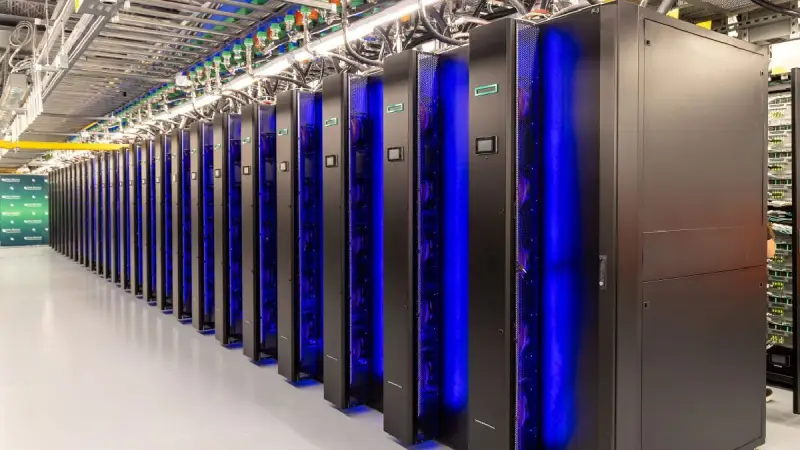
The latest Top500 list points to a widening gap between demand for computing hardware and the number of new machines built for traditional supercomputing. China’s LineShine holds first place with 2.198 FP64 ExaFLOPS, while only 27 systems entered the November edition. The list’s authors connect that slow turnover to a change in where new capacity is going: large AI data centers now absorb much of the industry’s compute investment.
CPU-only LineShine stays on top
Installed at the National Supercomputer Center in Shenzhen, LineShine achieved 2.198 FP64 ExaFLOPS on the High Performance Linpack (HPL) benchmark while drawing 42.22 MW. Its LingKun platform combines 13,789,440 cores based on 304-core Armx9 LX2 processors, clocked at 1.55 GHz, with the proprietary LingQi interconnect.
LineShine’s defining architectural choice is to rely entirely on CPUs, without compute accelerators. That gives it a different performance profile from systems that use hardware optimized for lower-precision calculations. Its reported performance increases 3.6 times when moving from FP64 to mixed precision, a smaller gain than systems using low-precision accelerators. For workloads that require double precision, its HPL result puts it first; the figure alone doesn’t establish which system is best for every scientific or commercial workload.
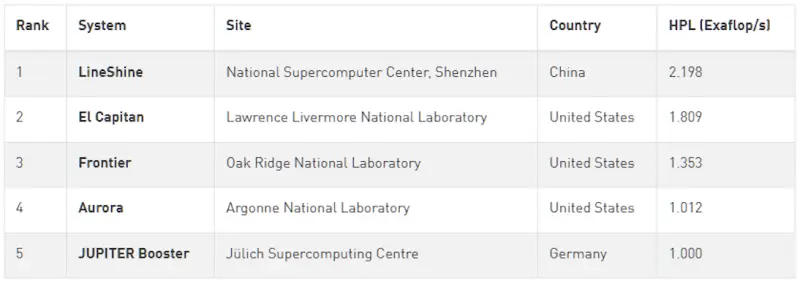
The closest listed comparison is El Capitan, the leading US system, which delivers 1.809 FP64 ExaFLOPS at 29.69 MW. It uses AMD Instinct MI300A accelerated processing units in an HPE Cray EX255a platform. Those figures make El Capitan significantly more power-efficient than LineShine by the reported HPL throughput and power draw, even though its measured FP64 performance is lower.
Two other US systems remain among the list’s leaders. Frontier, based on third-generation AMD EPYC processors and Instinct MI250X GPUs, reaches 1.353 FP64 ExaFLOPS at 24.61 MW. Aurora combines Intel Xeon CPU Max 9470 processors with Data Center GPU Max accelerators and records 1.012 FP64 ExaFLOPS at 38.70 MW. All three US exascale systems use HPE Cray EX platforms and Slingshot-11 interconnects.
Germany’s Jupiter Booster is the most energy-efficient exascale system on the list. Built with Nvidia GH200 Grace Hopper Superchips, a BullSequana XH3000 platform and Nvidia quad-rail InfiniBand NDR200, it delivers 1.0 FP64 ExaFLOPS at 15.79 MW. Those comparisons show why peak performance and power use both matter: systems can occupy very different positions depending on which measure a deployment prioritizes.
Few newcomers, rising entry threshold
The 10 highest-performing systems kept the same positions as in June, as did the 10 most energy-efficient machines. Only 27 new systems—5.4% of the 500—appeared in the November list, the smallest intake since Top500 began in 1993.
South Korea’s Hanggang, at the KISTI Supercomputing Center, is the strongest newcomer. It ranks 12th with 342.6 FP64 PFLOPS, using Nvidia GH200 Grace Hopper Superchips and HPE’s Cray EX254n platform. In the HPCG benchmark, which measures performance on a different set of computing operations, it ranks eighth with 4.29 HPCG PFLOPS. The distinct HPL and HPCG results offer different views of system performance; they shouldn’t be read as interchangeable scores.
Across all 500 systems, aggregate HPL performance rose 4.4% over six months to 19.57 FP64 ExaFLOPS. At the same time, the minimum result needed to make the list climbed 7.3%, from 2.662 PFLOPS in June to 2.857 PFLOPS. The system ranked 50th improved from 49.85 to 55.81 PFLOPS, a 12% increase, while the 100th-ranked system moved from 21.85 to 22.74 PFLOPS.
The number of systems delivering at least 100 PFLOPS also edged up, from 25 to 27. And 291 machines—58.2% of the list—now include compute accelerators, compared with 275 in June. The figures suggest that systems on the list continue to grow in capability, even as relatively few new entries arrive.
AI data centers change what gets counted
The small number of newcomers stands out against estimates of fast growth in AI computing. Epoch AI estimates, cited by the Top500 authors, put the quarterly addition of global AI compute capacity on a path to increase by 2.5 times per year. The same estimates put installed AI capacity at the equivalent of more than 15 million Nvidia H100 GPUs.
Five major US hyperscalers accounted for an estimated 71% of global AI compute resources as of the fourth quarter of 2025, much of it deployed in large clusters. That capacity serves a different market from systems designed for scientific workloads and measured through Top500’s HPL benchmark. A huge AI cluster may add substantial computing resources without entering this ranking, so the list captures only part of the buildout.
For researchers and infrastructure teams, the distinction matters when using Top500 to judge how quickly high-performance computing is expanding. Its numbers track a particular benchmark and a particular class of machines. The next lists will show whether more AI-era investment also produces new systems that meet the ranking’s criteria, or whether traditional supercomputing continues to advance mainly through upgrades to machines already on the list.


