AMD Systems Reach 202 of 500 Places in Latest TOP500 Ranking as Lux Debuts
- Cargo
- Machine Learning
- Shipped
- Shipper
- Jake Roach
- Readers
- 622
AMD-powered machines account for 202 TOP500 entries. Newcomer Lux combines MI355X GPUs with high FP64 and AI performance.
AMD expands its footprint across TOP500
AMD-powered systems now occupy 202 places in the latest TOP500 ranking, up from 177 in the previous edition. That puts the company’s hardware in more than 40% of the list, an increase of 14% from the prior year. The count shows AMD’s reach across the ranked supercomputer fleet, while the leading positions remain largely unchanged from the last listing.
China’s LineShine holds first place. AMD-based El Capitan remains second, and Frontier stays third. The AMD-powered HPC7 and HPC6 systems are still sixth and eighth, respectively. Each of these machines retained the same position it held in the preceding TOP500 edition. Lux, a new system built for high-performance computing and AI work, enters at number 14.
The top ten also includes systems built around Intel and NVIDIA hardware. Aurora is fourth, JUPITER Booster fifth, Eagle seventh, Supercomputer Fugaku ninth and Alps tenth. The stable ordering gives Lux’s debut and AMD’s broader system count more weight than any reshuffling among the leaders. The list captures a snapshot of systems’ reported performance; it doesn’t, by itself, describe how often each machine is used or how its performance varies across different tasks.
Lux pairs GPU capacity with multiple performance targets
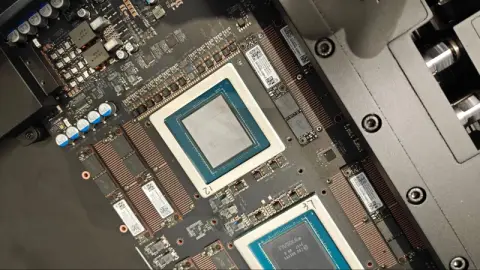
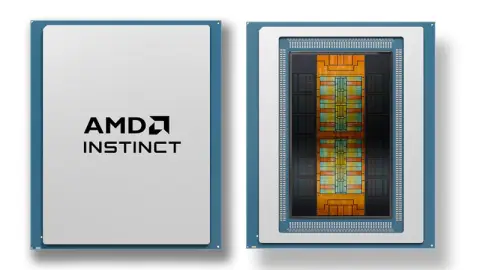
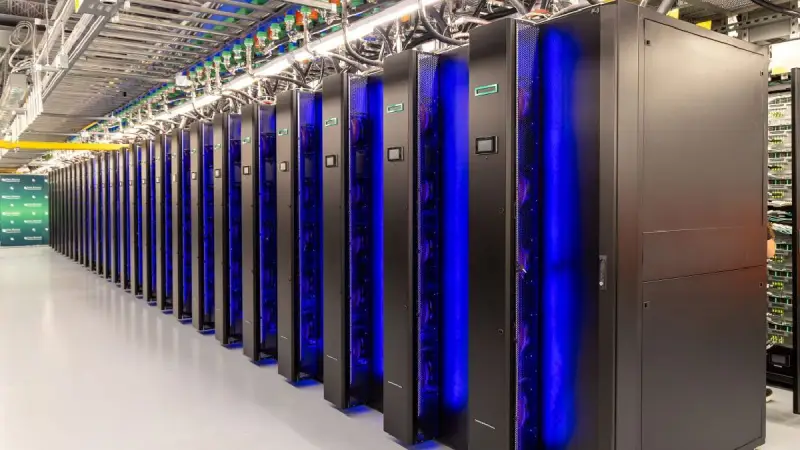
Lux is housed at Oak Ridge National Laboratory’s Oak Ridge Leadership Computing Facility, alongside Frontier. HPE built the system, which uses more than 4,000 AMD Instinct MI355X GPUs across more than 500 nodes. The hardware is arranged to support both traditional high-performance computing workloads and AI research, with different peak figures reported for different numerical formats.
For FP64 computing, Lux is rated at 317 petaflops. Its stated peak is 20 exaflops for FP8 AI training and 40 exaflops for FP4 inference. Those figures describe different forms of computation and precision; they shouldn’t be read as interchangeable measures or as a direct comparison of performance on a single workload. In practice, useful throughput depends on the models, software and workload being run, as well as how efficiently the system is kept busy.
Each GPU has 288 GB of HBM3E memory, for a reported system total of 1.1 petabytes. That large pool of high-bandwidth memory is relevant to work that must keep substantial model or scientific data close to the accelerators. The system uses AMD EPYC host CPUs, though the specific processor generation hasn’t been identified, and AMD Pensando networking. Its nodes are built into HPE ProLiant Compute XD685 systems.
The specifications point to a machine designed to handle varied compute demands: FP64 work for scientific simulations, alongside lower-precision formats commonly used in AI training and inference. The peak numbers indicate the system’s capability under the applicable measurement conditions; they don’t establish that every research workload will achieve those rates. Software support, data movement and scaling across nodes will shape results in use.
Research access and the next system to watch
Lux has 3.5 million node-hours available each year, where a node-hour means one node running for one hour. Half of that capacity is reserved for research associated with the Genesis Mission. The allocation gives a concrete measure of the machine’s planned access, though the total doesn’t specify how hours are divided among individual projects or how much work each project can complete.
Lux is the first supercomputer dedicated to that research effort. It joins other machines that also support research, including Aurora, the Intel-powered system at Argonne National Laboratory that ranks fourth. This puts Lux into an existing research computing environment rather than making it the only large-scale option available to researchers.
Lux is primarily intended for AI research, not as a replacement for Frontier. A separate next-generation flagship system, Discovery, is scheduled to debut in 2028. It is being developed jointly by the Department of Energy, AMD and HPE. Its arrival will offer another point of comparison for the systems now appearing on TOP500, but the current ranking makes Lux’s role clear: it brings a large AMD GPU installation to a research-focused facility and adds a new system optimized for both scientific computing and AI workloads.
For developers and researchers, the most useful signals to watch next are how Lux performs on real applications, how its capacity is allocated, and whether its high-precision and AI capabilities translate into practical throughput. The TOP500 entry establishes its place in the ranked fleet; sustained workload results will show what that position means for research teams.