Nvidia’s Rubin HPC GPU Targets Large-Scale Simulation With More Than 50,000 CUDA Cores
- Cargo
- Machine Learning
- Shipped
- Shipper
- Jeffrey Kampman
- Readers
- 486
Rubin HPC is designed for data-heavy simulation and agent workflows, but Nvidia has yet to disclose its memory specifications or chip layout.
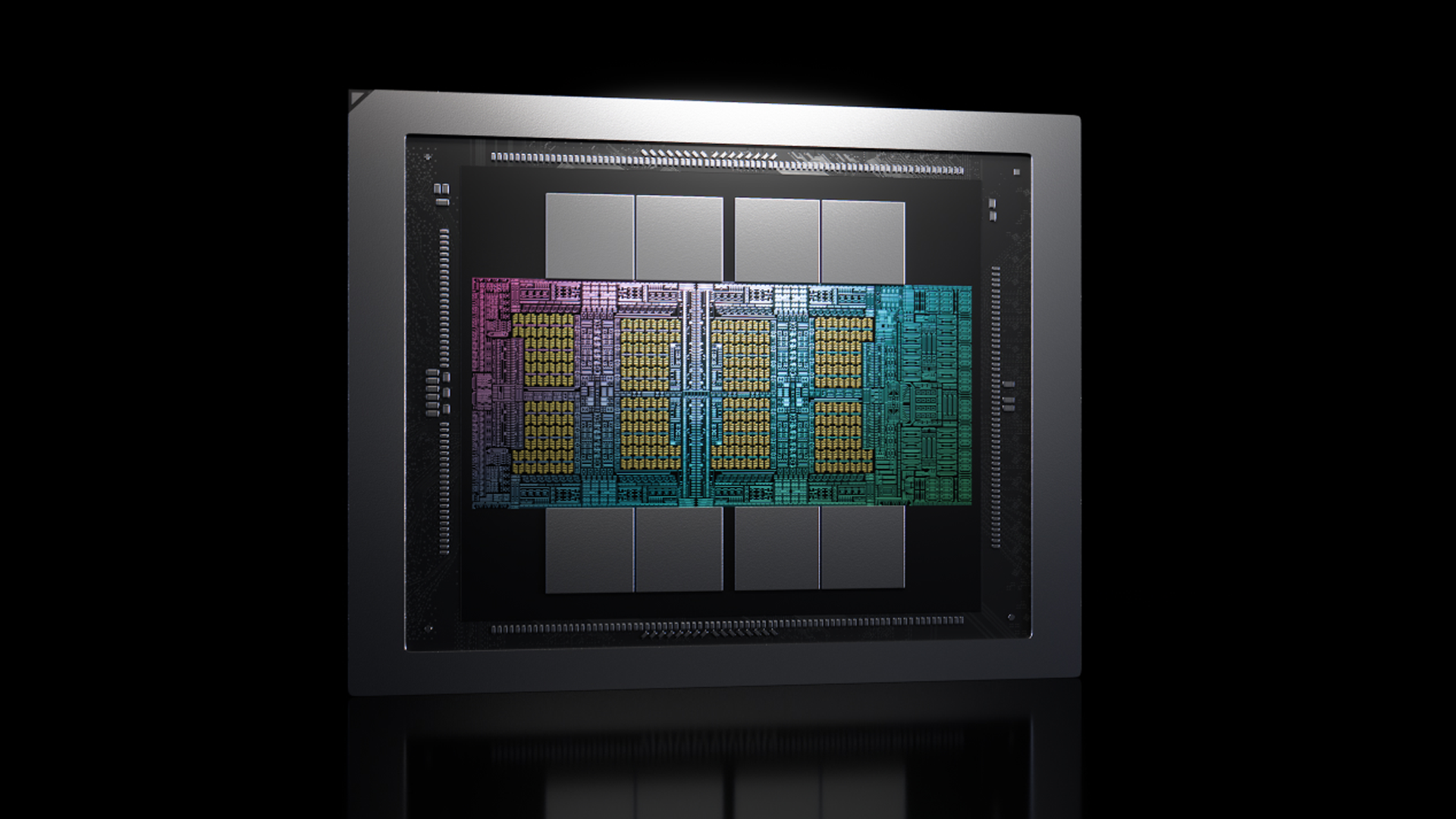
Nvidia’s Rubin HPC GPU is aimed at workloads where large simulations and data movement can limit how much accelerator compute researchers can use. The company says the chip will have more than 50,000 CUDA cores, the highest count on any of its GPUs, and is intended for scientific and engineering work with large data sets. Nvidia expects it to arrive in 2028.
That core count is the clearest specification Nvidia has shared so far, and it points to a substantial increase in compute resources. The currently described Rubin GPU has 224 streaming multiprocessors (SMs) and 28,672 CUDA cores. Rubin HPC’s stated count is far higher, but Nvidia hasn’t described the chip’s physical layout or explained how it reaches that figure.
A larger GPU, with its layout still undisclosed
The scale of the core count raises questions about how Rubin HPC is assembled. One possibility is a multi-die design, similar in broad outline to the four-die Rubin Ultra GPU configuration, whose dies connect through NVLink-C2C. That remains an inference: Nvidia has not confirmed Rubin HPC’s die count, package design, or internal arrangement.
The company’s representative image doesn’t resolve those questions. Without layout details, it’s difficult to infer how compute units are distributed, how data moves within the package, or what the design means for power and cooling. Those details will matter to system designers assessing how a GPU with this many cores fits into a larger compute system.
Memory is another open part of the specification. Nvidia has not given Rubin HPC’s HBM capacity or bandwidth. Those figures will help determine whether the GPU can keep its compute resources busy on data-intensive tasks, and whether a particular workload is limited by arithmetic throughput or by moving data into and out of the processor.
NVLink 7 is the disclosed path between GPUs
Nvidia says Rubin HPC systems will use NVLink 7 to connect GPUs. It hasn’t provided new figures for the interconnect’s bandwidth or physical implementation within a rack. Earlier disclosures indicate that NVLink 7 retains NVLink 6’s 3.6 TB/s of bandwidth per GPU while expanding the scale-up domain—the group of processors that can communicate as a tightly connected system. Nvidia has not supplied further Rubin HPC-specific measurements. Previous details about Rubin Ultra and its interconnect offer context, but they don’t fill in the missing Rubin HPC specifications.
For simulations spread across multiple GPUs, interconnect performance can shape how effectively processors share data and coordinate work. A larger scale-up domain could give system designers more room to connect accelerators, while the actual benefit will depend on the topology, software, and workload. The available information doesn’t establish how Rubin HPC will perform on any particular simulation or how its full system configuration will compare with other accelerators.
Scientific workloads and agent workflows
Nvidia is positioning the GPU for climate research, genomic analysis, and financial simulation, along with agentic workflows that use software agents to explore a problem. In these settings, an agent may propose a hypothesis or set of parameters, run a simulation, and use the result to guide another round of work. Nvidia’s case is that faster simulation can shorten that loop, allowing researchers and analysts to evaluate more possibilities in the same amount of time.
That payoff depends on more than the number of CUDA cores. An application must be able to use the available compute, and large data sets must reach the GPU quickly enough to avoid leaving it idle. Nvidia describes Rubin HPC as having a “balanced design” intended to combine higher compute resources with faster data movement between nodes. Its public specifications don’t yet quantify that balance through memory capacity, memory bandwidth, or workload results.
Developers may also draw on Nvidia’s CUDA-X libraries, which provide domain-specific tools for applications built on the company’s computing platform. Those libraries could help teams adapt existing scientific software or optimize parts of an agent-driven simulation workflow. The practical effect will depend on which libraries support each domain, how well they fit a team’s software, and how much work is required to use them. Nvidia hasn’t shared Rubin HPC performance figures for these applications.
There’s a further comparison to watch at the system level. AMD and Intel are also promoting GPUs with attention to native FP64 compute, a precision format used in many scientific calculations. Nvidia hasn’t said whether Rubin HPC reallocates resources toward FP64, or provided figures that would allow a direct comparison on that measure. Core count alone can’t answer that question: performance depends on the chip’s mix of compute resources, memory behavior, interconnect, and software support.
What to watch before 2028
Rubin HPC’s announced core count sets an ambitious target for GPU compute, while key details remain undisclosed. Memory specifications, FP64 capabilities, package design, power requirements, and measured performance will determine how useful the chip is for specific scientific workloads and how it compares with competing systems.
For now, the clearest takeaway is Nvidia’s intended use: large data sets, simulation, and agent workflows that repeatedly test and refine possible solutions. The next meaningful assessment will depend on system-level measurements and implementation details, especially whether Rubin HPC can keep its expanded compute resources supplied with data. Nvidia says the GPU is due in 2028.


