Intel’s Classiq Deal Aims to Build a Commercial Quantum Computing Business
- Cargo
- Machine Learning
- Shipped
- Shipper
- [email protected] (Anton Shilov)
- Readers
- 999
Classiq would give Intel quantum software, enterprise customers and revenue as it builds silicon processors, control electronics and complete systems.
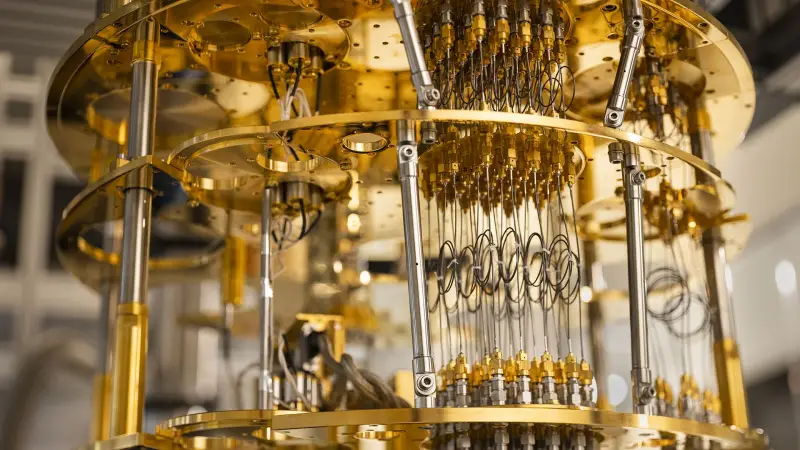
Intel’s planned purchase of quantum software company Classiq would give its decade-old quantum computing effort a commercial foothold before its own processors are ready for broad use. The deal, which Intel expects to complete in the first half of 2027, adds software with existing customers and revenue to a strategy spanning silicon qubit chips, cryogenic electronics, foundry services and full systems.

That breadth is the point. Intel wants to sell more than quantum processors: it aims to provide components and tools that help customers develop applications, and eventually to assemble complete computers that combine quantum and conventional hardware. The company says its manufacturing infrastructure can support production at scale, but reaching useful workloads and profitable operations will depend on technical progress that the field has yet to demonstrate.
“Up until now […] our quantum computing group for the last ten years was […] purely a research and development project,” said Pushkar Ranade, Intel’s chief technology officer, during a media briefing. “It was not really viewed as a commercial activity.” Classiq changes that starting point by bringing a business with paying customers into Intel’s quantum plans.
Building on silicon manufacturing
Intel’s quantum work began in 2015 through a research collaboration with QuTech, the quantum research institute of TU Delft and TNO. The project focused on silicon spin qubits, which encode information in the spin states of individual electrons. Intel’s rationale was that its experience with silicon devices and high-volume chip production could help address manufacturing challenges as quantum processors grow in complexity.
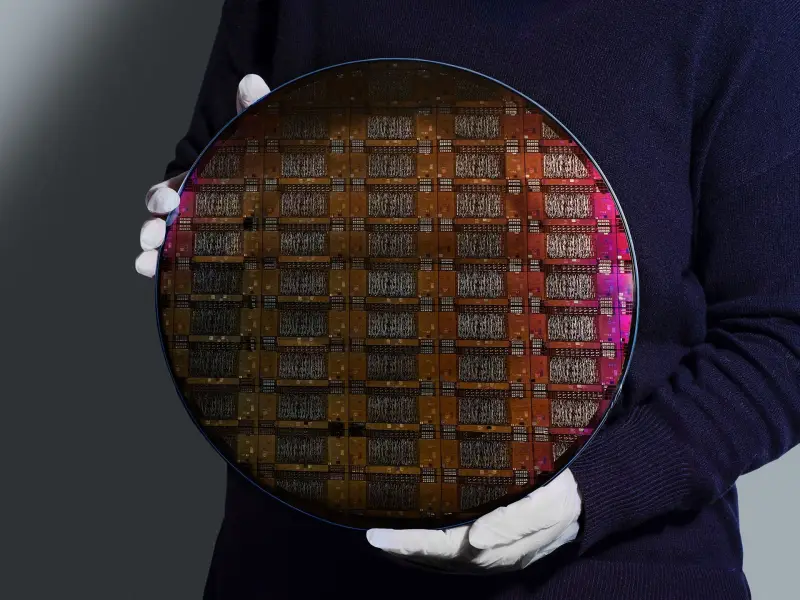
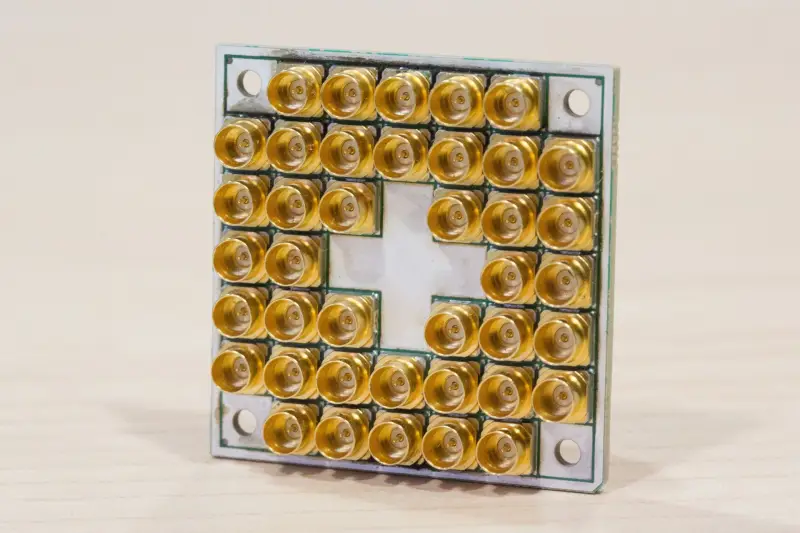
The company has since developed hardware for both quantum processing and control. In 2020, it introduced Horse Ridge, a cryogenic control system-on-chip made using a 22-nanometer process. In 2023, it presented Tunnel Falls, a 12-qubit silicon spin processor produced on a 300-millimeter wafer.
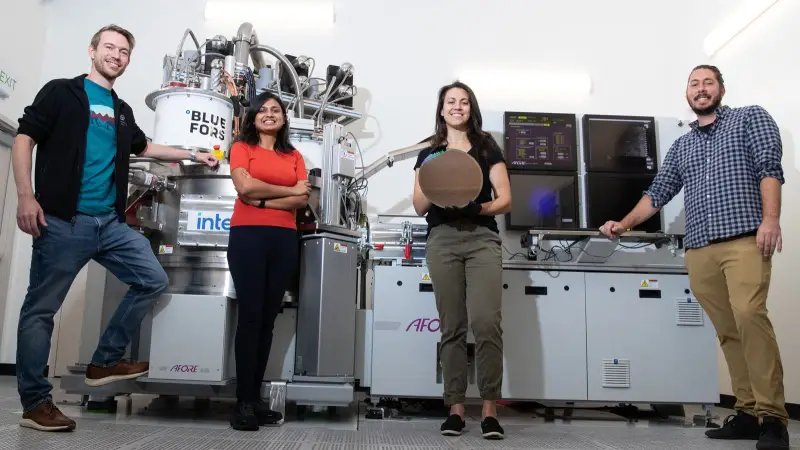
Silicon spin qubits appeal to Intel in part because they can be made with equipment and methods related to conventional semiconductor production. That could let the company draw on existing fabrication expertise and facilities instead of building dedicated factories for a product category whose commercial scale remains uncertain.
Intel has developed two versions of its 18A manufacturing technology for quantum systems: 18A-Q for silicon spin-qubit processors, and 18A-CC for cryogenic control and readout electronics. The company worked with Hitachi, AIST and NEDO on 18A-Q, and has a design kit intended to support larger quantum systems.
The overlap with standard chip production is substantial, but the quantum process is not identical. Ranade said the qubit devices need a specialized thin-film stack and additional manufacturing tools. Intel says more than 90% of the equipment is the same as that used for conventional semiconductor production. The underlying qubit process is unique, he explained, while fitting within design rules derived from Intel 18A.
For 18A-CC, Intel uses geometry based on 18A, with additional characterization needed to ensure operation at cryogenic temperatures. Reusing most fabrication equipment could help limit the investment needed to expand production. It also gives Intel a potential manufacturing service for quantum hardware developers, including those pursuing architectures other than silicon spin qubits.
“We are committed to spin qubits,” Ranade said. “But we are also open to providing foundry services to other modalities.” Intel points to its capabilities in photonics, advanced packaging and semiconductor manufacturing as areas that may serve quantum developers whose processors rely on different physical approaches.
Classiq adds a higher-level software layer
Intel’s existing quantum software includes a Quantum SDK with a C++ compiler, runtime environment and simulator for hybrid quantum-classical applications. Classiq would add tools at a higher level: its hardware-agnostic platform lets developers model algorithms and have software synthesize and optimize the quantum circuits, rather than requiring them to assemble circuits gate by gate.
The platform applies ideas from electronic design automation to quantum programming. It supports algorithm design, synthesis, optimization, debugging and execution across different quantum processors and simulators. In practice, this could give software teams a way to develop quantum programs without deep knowledge of the details of each hardware system. Intel’s SDK would continue to serve lower-level compilation, simulation and hybrid execution tasks.
Intel has compared the potential role of this software layer with tools that helped developers build ecosystems around other computing platforms, including MS-DOS for personal computers, CUDA for GPU computing and EDA software for chip design. The comparison describes an ambition, not a demonstrated outcome: Classiq’s value to Intel will depend on whether its tools continue to attract developers as quantum hardware evolves.
Classiq brings commercial activity that Intel’s quantum hardware effort has not yet established. It employs about 130 people, serves more than 50 enterprise customers and supports over 50 quantum processors and simulators. Its named customers include BMW, Comcast, Lufthansa, Rolls-Royce and Toshiba. The company also participates in more than 10 national quantum computing programs.
Those customers are largely preparing for hardware that can handle more demanding applications. They use Classiq to develop algorithms, train engineers and create intellectual property while current processors remain too limited for many practical workloads. That gives them a reason to work on quantum software before a commercially useful processor is available, and gives Classiq a potential source of revenue during the hardware development period.
Ranade described Classiq’s revenue and expected growth as healthy, but Intel did not provide financial figures. He said the company had “a very healthy revenue this year and a very healthy revenue CAGR over the coming years,” adding that Intel wants that growth to continue.
Intel says Classiq will retain its hardware-agnostic approach and keep supporting competing processors and simulators. That matters to customers who want to build applications without committing to one quantum architecture. It also leaves Classiq positioned to earn software revenue even if the eventual market favors hardware vendors other than Intel.
From components to complete systems
Intel’s intended offer extends from processors and control electronics to software and integrated quantum computers. A complete system would combine quantum hardware with cryogenic control, conventional computing resources and application tools. The company has several of these pieces in development, but it still needs to show that they can work together reliably and at a scale customers will pay for.
“We want to be in the business of building quantum foundry components, but also complete quantum systems,” Ranade said. Offering manufacturing services alongside Intel’s own products could broaden the customer base for its processes and related capabilities. It could also give other developers access to semiconductor production without requiring them to build their own facilities.
For Intel, the acquisition offers a path to customer relationships before its own quantum processors reach commercial maturity. Classiq’s software can serve users across different hardware platforms, while Intel develops its silicon processors and explores system integration. The approach makes the software business useful across the field, even as Intel pursues its own hardware.
Profitability depends on adoption and hardware progress
The timing presents a challenge. Intel chief executive Lip-Bu Tan has emphasized profitability, financial discipline and higher-margin products in the company’s established businesses. Quantum computing, by contrast, has yet to show widespread applications that justify the cost of large systems, and Intel’s quantum work has so far been primarily research and development.
Ranade framed quantum computing as a long-term investment alongside Intel’s mainstream products. “This is really a bet on the future,” he said. “This is something we also have to do in addition to our mainstream businesses today.” He acknowledged that quantum computing is not likely to become a high-margin business in the near future.
Classiq gives Intel an operating software business and current customer relationships while its hardware effort continues. But the company has not disclosed the purchase price or other financial terms, and Ranade did not offer a forecast for the division’s gross margins. He said he expected the hardware side to become profitable quickly, while emphasizing that it was too early to tell.
The acquisition therefore offers a near-term commercial base, while the larger financial case remains tied to adoption. Intel must turn its manufacturing and integration work into products customers can use, and the field must deliver processors capable of valuable workloads. Qubit scalability, error correction, control electronics and system integration remain central engineering challenges.
Quantum systems will work alongside conventional computing
Intel expects quantum processors to operate with CPUs and GPUs in data centers and high-performance computing environments. Quantum hardware is not positioned to replace conventional processors for everyday computing. The likely model is hybrid: conventional machines handle much of the workflow, while quantum processors are used for tasks suited to their capabilities.

Classiq’s tools can sit above systems such as Nvidia’s CUDA-Q. Classiq chief executive Nir Minerbi characterized CUDA-Q as operating closer to the gate level, while Classiq provides a higher-level environment for developing programs. He said customers including Rolls-Royce and BMW use Classiq on top of CUDA-Q, making the tools complementary in those workflows: developers can create programs in Classiq and simulate them with CUDA-Q.
Intel’s commercial plan is taking shape before quantum hardware has reached the scale needed for many valuable applications. Classiq brings software, customers and revenue into the business now; Intel’s processors, manufacturing services and complete systems are longer-term bets. Whether those parts add up to a profitable operation will turn on the industry’s ability to build useful machines and on Intel’s ability to deliver them as integrated products.