Claude Mythos Runs Anthropic’s Model on AMD MI355X GPUs in About Three Days
- Cargo
- Machine Learning
- Shipped
- Shipper
- Shane Downing
- Readers
- 996
Anthropic says Mythos cut MI355X onboarding from an estimated six to 12 months to about three days, though workload coverage and performance remain unclear.
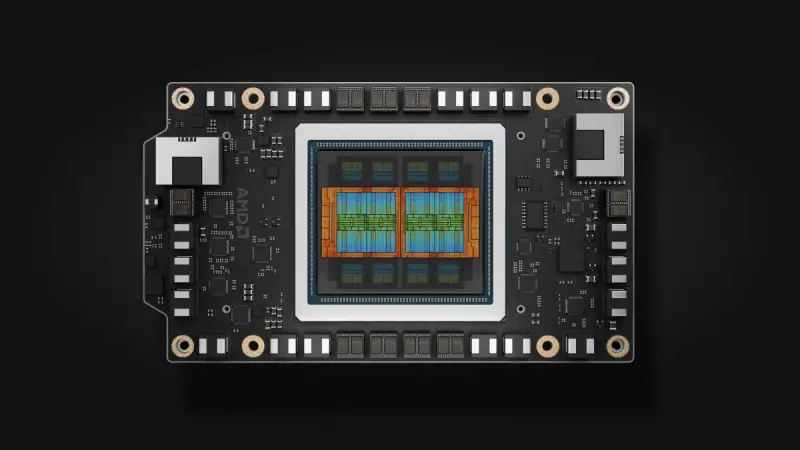
Anthropic says Claude Mythos Preview brought one of its models up on AMD’s MI355X GPUs in about three days, a task the company estimates would have taken six to 12 months with traditional engineering. The result points to a smaller software barrier between accelerator platforms, but it doesn’t yet show that AMD hardware matches Nvidia’s speed or efficiency on the same workload.
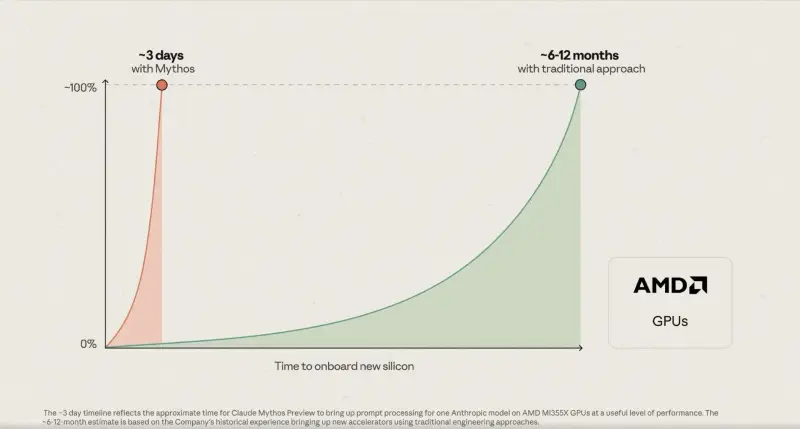
The three-day figure has a specific scope. Anthropic’s roadshow slide describes prompt processing, or prefill, for one model running on MI355X GPUs at a “useful level of performance.” Prompt processing handles the input before a model starts generating a response; Anthropic hasn’t said whether the work also covered decoding, the response generation stage. The company says Mythos ported or wrote “almost 100% of the kernels,” with “basically no human intervention.”
What the time comparison captures
Tom Brown, Anthropic’s co-founder and chief compute officer, compared the result with the company’s past experience bringing up new accelerators through conventional engineering. That work, he said, could take six to 12 months and involve dozens of engineers. The estimate describes a historical engineering process, while the three-day result concerns a particular model and workload on one GPU platform.
Anthropic has also described an earlier step in the work. At AMD’s Advancing AI event in July, Brown said one engineer asked Claude to bring up an MI355X rack and left the task running “over the weekend.” The company didn’t give a duration for that attempt. In the later roadshow account, Mythos completed the defined prompt processing task in about three days. Those accounts suggest continued progress, but their descriptions aren’t detailed enough to establish that they measured identical work.
The company’s prospectus makes a broader claim without a specific time: Anthropic can bring new chip platforms into production “in a fraction of the time it once took.” Its roadshow chart labels the comparison “Time to onboard new silicon” and shows both approaches reaching “~100%,” without defining what that percentage measures. The prospectus and chart therefore provide less detail than would be needed to compare deployment completeness across platforms.
Why kernel work matters to AMD
GPU kernels are low-level programs that carry out model operations on a particular chip. Adapting them to each accelerator has long added engineering work when moving between hardware platforms. Nvidia’s CUDA software ecosystem is nearly two decades old; AMD’s competing stack includes ROCm and its HIP programming layer. CUDA code generally needs conversion to work in AMD’s environment, and AMD built HIPify to help with that task.
AI coding tools could reduce the conversion effort, but results depend on more than producing code. Kernels need to run correctly and perform well on the target hardware, and developers need access to that hardware to test and refine them. Anush Elangovan, AMD’s vice president of AI software, said in an April interview with EE Times that Claude was better than HIPify because it had web search built in.
AMD has been pursuing this approach for more than a year. Researchers presented GEAK, an agent for writing GPU kernels, in August 2025. On a set of 30 kernels written by experts, GEAK produced 19 correct results and averaged 0.92 times the experts’ speed. That showed progress, while also leaving a gap against human-written code.
By July 2026, AMD’s senior vice president of AI, Vamsi Boppana, said AMD engineers were using AI models to generate GPU kernels. He said some generated kernels performed better than the best manually tuned versions. AMD is also using Claude to optimize workloads for its Instinct GPUs and speed up ROCm development, under its agreement with Anthropic.
A multi-chip strategy gains evidence
Anthropic already runs its models on Nvidia and AMD GPUs, Google TPUs and AWS Trainium. Brown said the company manages these systems as “one fungible pool of compute,” describing its earlier choice to support multiple chip types as an “unconventional bet.” That gives Anthropic options when allocating compute, although a shared pool doesn’t make the hardware or software interchangeable in every practical sense. Google’s TPUs, for example, are becoming more specialized.
Anthropic began working with AMD GPUs this year and has an agreement for up to two gigawatts of AMD Instinct MI450 capacity. The company is a chip buyer, so its account of getting a model running on AMD carries a different perspective from a chipmaker describing its own tools. Still, the result covers one model, one chip family and one part of inference. The missing performance comparison matters: Anthropic hasn’t said how quickly the model ran on MI355X relative to Nvidia GPUs.
Other comments from the industry underline the shift in kernel work. At AMD’s July event, OpenAI’s Philippe Tillet said one engineer confirmed that OpenAI’s Helios racks worked within a few days, and that “agents are taking over our jobs, in a sense, as kernel engineers.” Nvidia CEO Jensen Huang said in an April interview that Nvidia uses AI to create kernels for its own hardware and argued that the company knows its architecture best. Both points can hold: coding agents may reduce the effort required to adapt software, while platform-specific expertise and hardware access still affect performance.
The remaining constraints
AI-generated code still needs GPUs for testing. A July analysis by SemiAnalysis noted that each coding agent requires GPU capacity to test its work, and described a shortage of GPUs inside AMD for this development. That creates a practical limit: faster code generation can shift the bottleneck toward access to the chips needed for validation and tuning.
The three-day result narrows one part of Nvidia’s CUDA advantage by suggesting that model-assisted engineering can speed up onboarding. It doesn’t establish that the rest of the software ecosystem, optimization work or performance gap has disappeared. Anthropic’s MI450 systems in AMD Helios racks are expected in the first half of 2027, offering a chance to see whether the faster bring-up extends to another generation of hardware and workloads.


