Local AI, Memory Efficient Servers and New TPU Designs Lead This Week’s Hardware Coverage
- Cargo
- Machine Learning
- Shipped
- Shipper
- [email protected] (Sayem Ahmed)
- Readers
- 317
This week’s coverage examines local AI performance, AMD’s memory saving server system, AI chip design tools and Google’s latest TPU variants.

Local AI hardware, server memory limits and specialized accelerators are shaping the next phase of AI infrastructure. This week’s reporting also examines AI tools for chip design and a proposed way to classify how easily language models can be pushed past their safeguards.

Local AI puts desktop systems to the test
Running models locally is drawing interest beyond large cloud providers, and the hardware choices now include systems built around very different architectures. A comparison of Nvidia’s DGX Spark and Apple’s Mac Studio with M5 Ultra tested both machines using synthetic and real world benchmarks, as well as large models.
The comparison matters because advertised hardware specifications don’t tell the whole story for local inference. Model size, memory requirements and software support can determine whether a system runs a workload comfortably or needs careful configuration. The Mac Studio tests also highlight the role of Apple’s MLX software stack: larger models may require specific inference engine settings, so usable performance depends on both the machine and the setup.
With both devices carrying high prices, the practical question is which workloads each can handle well. Developers choosing a local system need to weigh model compatibility, inference speed and the effort required to configure larger models against the cost of the hardware. The tests offer a basis for that decision, while also showing why a single benchmark is unlikely to settle it.
AMD targets server memory pressure
AI infrastructure demand has tightened DRAM availability and pushed up costs for client and enterprise hardware. AMD’s MEXT system aims to reduce the memory needed by servers through predictive memory management. It uses a transformer model alongside flash storage, with AMD saying the approach can preserve 95% of server performance while using half the DRAM.
AMD reported that MEXT was running on 145 servers, with plans to expand deployment to 2,000 in 2027. Those figures make the system more than a lab concept, but its broader value will depend on how well its performance holds across workloads and at larger scale. The reported 95% figure describes AMD’s claim; the available information does not specify the workloads or measurement method behind it.
The design reflects a wider infrastructure tradeoff: when a resource becomes expensive or scarce, software can help stretch existing capacity. Predictive use of flash storage may reduce pressure on DRAM, though operators will need to assess the effects on their own applications, performance targets and storage setup.

AI tools move into chip design
Cognichip is developing AI assisted tools for semiconductor engineering under the name Artificial Chip Intelligence, or ACI. The company revealed its proprietary models in September and is now describing how it plans to apply them to chip design tasks that involve substantial manual work.
The pitch is a shorter development cycle, potentially cutting tasks that take months down to days through automation. That remains a prospective benefit: the tools have not yet been used in a shipping product. For chip teams, the useful test will be whether ACI can produce work engineers can verify and incorporate into established design flows, while delivering time savings without adding review burdens.
Google broadens its eighth generation TPU lineup
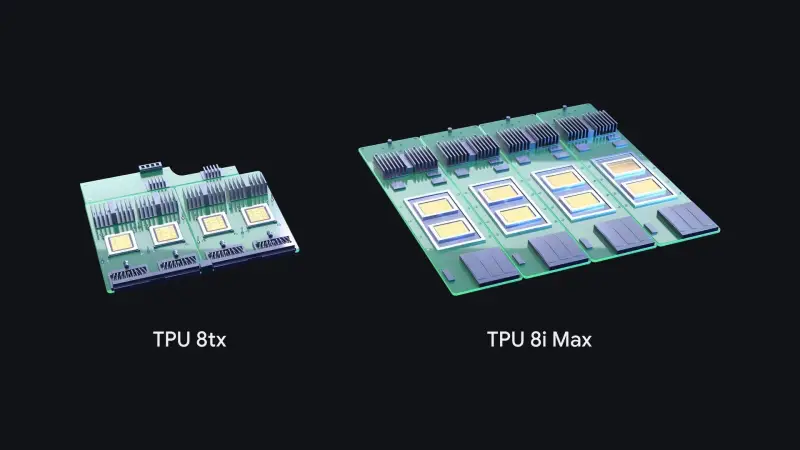
Google has added TPU 8i Max and TPU 8tx to its eighth generation accelerator family. The two designs target different needs: TPU 8i Max is aimed at long context AI agent workloads, while TPU 8tx is designed for specialized security work.
TPU 8i Max places two chips on one package and doubles the specifications of the original TPU 8i, according to the reported lineup details. TPU 8tx changes the host configuration, replacing Arm hosts with AMD EPYC. Together, the additions show Google building out distinct configurations for different workloads rather than treating one accelerator design as a fit for every task.
A proposed way to rate model jailbreaks
The Frontier Model Foundation has proposed a Jailbreak Rating Framework to classify how a model’s safeguards can be bypassed. Its four scoring components are intended to capture the type and severity of a jailbreak, including the capability gain, its scope and how easy it is to deploy.
A shared rating could help teams compare reported weaknesses and prioritize testing before a jailbreak is used in practice. The proposal’s usefulness will depend on whether evaluators can apply its categories consistently across models and attack methods. For now, it offers a structure for describing failures that can otherwise be difficult to compare.
Across these developments, the next practical test is deployment: whether local systems can run target models efficiently, whether memory saving techniques maintain performance at scale, and whether specialized chips and design tools deliver measurable gains on real workloads. Those results will determine which approaches matter most to teams building and running AI systems.


