LangChain Raises $300 Million to Expand Its Agent Platform
- Cargo
- Machine Learning
- Shipped
- Shipper
- John Rodriguez
- Readers
- 364
LangChain raised $300 million at a $3 billion valuation to expand tools for running, improving and governing AI agents.
LangChain’s $300 million financing puts a $3 billion valuation behind a bet on the software infrastructure needed to operate AI agents. The company says it will use the funding to advance its goal of helping businesses build and control their own agent systems. CapitalG led the financing, with participation from new investors GIC and DFJ Growth and existing investors IVP and Sapphire Ventures.
The strategy starts from a practical observation: agents built for particular fields will depend on specialized data, domain knowledge and user experience. Businesses may sell them as standalone products or use them to change internal operations. For organizations building these systems, the question is not only which model to use. They also need ways to manage data and infrastructure, improve agent performance over time, and set controls for how agents operate.
LangChain’s answer is LangSmith, a platform designed to run, improve and govern agents across different frameworks. The company says more than 7,000 organizations use it, including startups Harvey, Rippling and Listen Labs, and larger businesses such as NVIDIA, Toyota and Salesforce. Those customer examples indicate the range of intended use, from developing products to managing agents across established organizations.
Two examples point to the operational scale LangSmith is intended to support. Clay uses the platform to monitor hundreds of millions of agent runs each month and improve its agents. Workday uses it to run and govern agents across its organization; LangChain says this has cut the time to deploy a new agent from five months to less than a day. These are company-reported examples, rather than independently assessed performance results, but they illustrate the kinds of development and operations bottlenecks LangSmith is meant to address.
Three parts of the platform
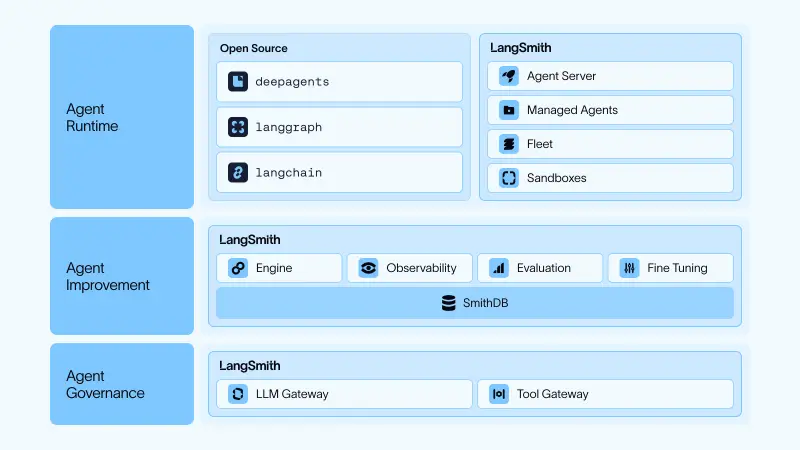
LangSmith groups its offering into runtime, improvement and governance. Together, those categories cover the lifecycle from deployment to monitoring and access control. The breadth of that scope may appeal to teams that want a shared operating layer for agents, though the announcement does not provide comparative benchmarks, pricing or deployment costs to help organizations assess the trade-offs.
Agent Runtime covers the architecture and infrastructure for running agents. Deep Agents, LangGraph and LangChain give developers options for working across models and managing context. LangSmith Agent Server and Sandboxes are intended to support secure deployment in the cloud or within a customer’s own environment. LangSmith Managed Agents and Fleet offer managed services for building, deploying and running agents in production.
That mix spans developer frameworks, deployment infrastructure and managed services. Model flexibility and control over context can matter when an agent must work with a particular set of tools or business data. The deployment options also address a common operational choice: whether a team wants to manage the runtime itself or hand more of that work to a service. The announcement does not detail the technical or cost differences among these options.
Agent Improvement focuses on evaluating behavior and making changes as systems run. LangSmith Observability and Evaluation provide visibility into agent activity and ways to measure quality. LangSmith Engine is described as an in-platform agent that can identify errors, suggest code and prompt fixes, and monitor production traffic for regressions. LangSmith Fine-Tuning is designed to turn agent traces into training data for fine-tuning and evaluating specialized models.
This part of the product addresses a persistent challenge for agent teams: a system can produce plausible results in a test and still fail on real tasks or change behavior after an update. Monitoring and evaluation can help teams spot those problems, while traces may provide examples for further model work. The announcement outlines these capabilities but does not give accuracy figures or explain how much human review Engine’s proposed fixes require.
Agent Governance provides centralized controls for how agents use models, tools and data. LangChain’s LLM and Tool Gateways are meant to manage model budgets and fallbacks, protect sensitive information, and control tool access and authentication across teams and agents. These controls become more relevant as organizations move from individual experiments to multiple agents that interact with internal systems. The details of how these controls are configured and enforced will matter to teams evaluating the platform.
What the financing supports
The company says it will share additional LangSmith capabilities at a release event scheduled for November 20. Its announcement does not name those capabilities, so the event is the next point at which developers can judge how the product’s runtime, improvement and governance features are changing.
LangChain describes building high-performing agents as work that remains harder than it should be. The financing backs its effort to make that work easier through a platform spanning development and production operations. For teams considering LangSmith, the useful questions are concrete: how its components fit existing systems, what control customers retain over models and data, and whether its monitoring and improvement tools reduce the effort required to keep agents reliable at scale.
The company also credited its developer community and customers for shaping the platform. It welcomed Salesforce Ventures, Insight Venture Partners, QuantumLight and MongoDB Ventures, and said Sequoia, Amplify and Benchmark increased their support in the financing. The next test for LangSmith will be whether its expanding toolkit can translate its customer examples into repeatable results for teams with different models, data and operating requirements.