Goal Engineering: Designing AI Agents Around Human Feedback
- Cargo
- Machine Learning
- Shipped
- Shipper
- Robert Garcia
- Readers
- 726
Agents that pursue open-ended goals need review workflows built around how people can teach them, as Actively AI’s sales motions illustrate.
As AI agents move from drafting text to using tools and completing multi-step work, their goals become harder to specify and their mistakes harder to catch. The next step is agents pursuing open-ended objectives. For teams building them, the design challenge is not only choosing an outcome; it’s structuring the work so people can teach the agent how to pursue it.
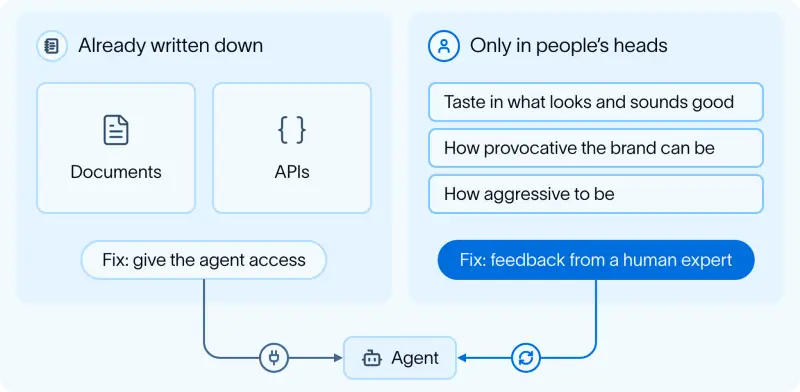
That’s the idea behind goal engineering. An agent may have access to the right documents and APIs yet still lack context that was never written down: a team’s preferences, judgment, and sense of what makes a good decision. Human review can supply that knowledge, but only if the work is arranged so reviewers can give useful feedback without excessive effort.
Make feedback part of the agent’s scope
When an agent performs poorly, missing context is often part of the problem. Some gaps are straightforward to address by connecting the agent to relevant information. Other gaps concern how work should be done, and require an expert to explain what the available information cannot capture.
This distinction matters as agents take on subjective work alongside people. Consider an agent asked to improve marketing performance. A metric can describe the target, but it won’t tell the agent how a brand wants to sound, what kinds of creative work fit its identity, or how far it should push a message. Those preferences shape the work, and the agent has to learn them through feedback.
The goal’s scope affects whether that learning is practical. If a person can review many related outputs together, they can spot patterns, explain preferences, and apply the same guidance repeatedly. If review is fragmented across unrelated tasks or separate agent sessions, each correction takes more effort and useful lessons are harder to carry forward.
That makes the review experience part of the system’s performance. An intuitive interface can help people assess work and communicate what should change. Since feedback is often the bottleneck in teaching an agent, reducing the effort required to give it can improve how quickly the agent adapts to a team’s needs.
Actively AI shifts from accounts to jobs
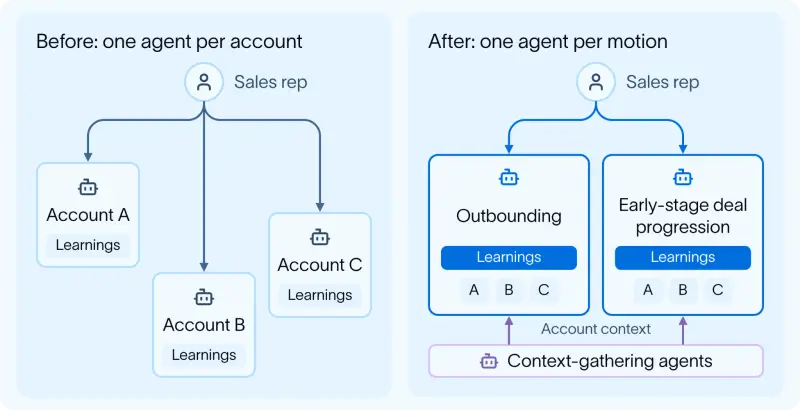
Actively AI, which builds agents for sales teams, encountered this design problem in its early goal-oriented system. It created one agent for each sales account: a prospective customer the team hoped to sell to. Each agent was tasked with progressing that account and produced actions for a sales representative to approve.
The setup had a clear logic. The account was the target, and account-specific information seemed like the natural foundation for the agent. But working on an account involved several different jobs, often separated in time. A salesperson might need to review only a small number of suggested actions at any given moment, making it awkward to move among account agents and provide feedback efficiently.
Actively also found that some of the most useful lessons weren’t specific to an account. Salespeople needed to teach agents how to contact prospects, respond, plan deals, choose an appropriate level of assertiveness, and navigate large organizations. A lesson learned while working on one account could apply to many others. With a separate agent for each account, sharing that knowledge was cumbersome.
Actively’s second design organizes agents around jobs, which it calls “motions.” Built on Deep Agents, a motion handles a category of work such as outbounding or early-stage deal progression. The agent can work across multiple accounts on similar tasks, giving a salesperson a related set of outputs to review together.
That structure makes feedback more reusable. Guidance about how to handle one task in a motion can inform other tasks in the same motion. It also gives the salesperson a clearer place to express preferences that may be personal to their approach and absent from written account records. The agent’s scope now matches the scope of the feedback that helps it improve.
Account information still matters. Actively uses background agents to gather and organize context about individual accounts, while motions handle the work of progressing those accounts. In effect, one part of the system assembles account-specific facts; another applies learned practices across similar sales tasks and draws on the relevant account context as needed.
Review design shapes autonomy
The broader lesson is that a goal should be designed around both the desired result and the human judgment needed to reach it. A long-horizon agent will encounter decisions that can’t be fully settled by written instructions or a score. Review gives people a way to supply that missing knowledge, while a well-chosen scope helps the agent apply each lesson beyond a single output.
Human review takes time, but it can also be the mechanism that adapts an agent to a particular team or domain. As agents take on more open-ended work, their usefulness will depend in part on whether people can inspect what they do, explain what matters, and see those corrections carry through to related tasks.
Prompt and context design may change as agents become more capable, but the need to define goals around effective human feedback is likely to remain. The practical measure of a goal-oriented agent won’t be just whether it can pursue an objective; it will be whether its work is organized so people can guide it and those lessons can improve what it does next.