Proactive AI Agents Bring New Challenges in Memory, Goals and Async Work
- Cargo
- Machine Learning
- Shipped
- Shipper
- Thomas Jones
- Readers
- 911
Always on agents need better controls for notifications, memory, long running tasks, goal tracking and browser use.
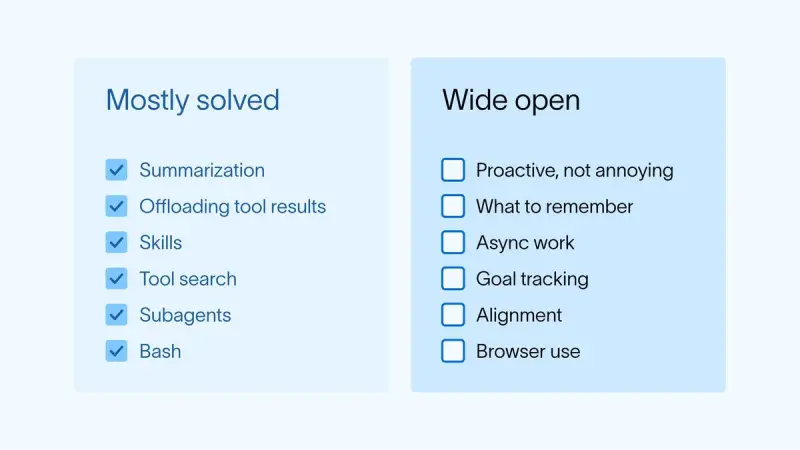
The familiar agent loop—an AI model calling tools, checking results and repeating—has become a common foundation for products such as Claude Code and Deep Agents. That convergence has made agent systems easier to reason about, but it can also give the impression that the hard engineering work is finished. My read is that the next set of problems is appearing as agents shift from responding to a request toward pursuing goals in the background.
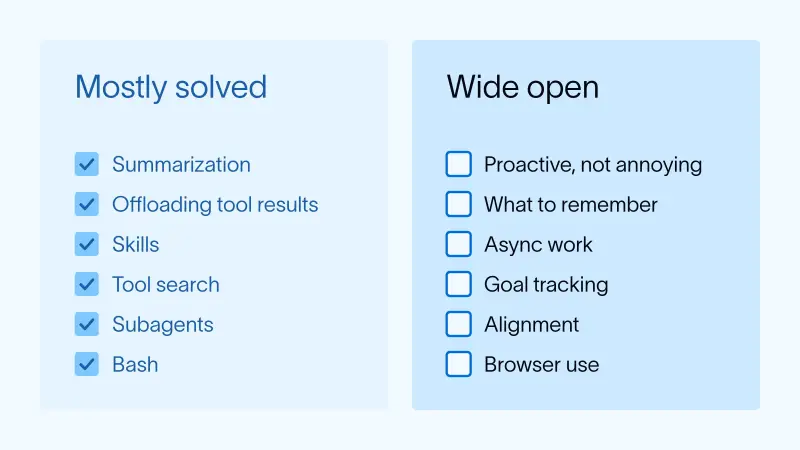
Several techniques for managing an agent’s context are now familiar: summarize long conversations when they exceed a useful size, store large tool results outside the active context, and expose capabilities through skills that can be brought in as needed. Systems can also use tool search to navigate large tool collections, delegate work to subagents to keep tasks separate, and treat Bash as a primary tool.
Those patterns address a relatively clear interaction: a user asks for work, and an agent tries to complete it. A proactive agent has a different job. It may listen to an event feed or wake periodically, then decide whether something requires action. This makes context engineering less about fitting the next response into a window and more about deciding what the agent should notice, retain, do and report over time.
Proactivity needs a threshold for interruption
An always on agent has to make a judgment that a conventional assistant can often leave to the user: whether to reach out at all. A useful notification can make the system feel attentive. Too many messages turn that attentiveness into noise, while too few can make the agent seem absent. There isn’t yet a general recipe for setting that threshold across users and situations.
The design problem starts with what the agent observes. An event feed can contain many changes, but only some matter to a user’s current priorities. A heartbeat can give an agent a chance to check for developments, but regular checks can also create repeated opportunities to send low value updates. The system therefore needs context about both the event and the person’s goals, plus a way to judge whether action is timely enough to justify an interruption.
That judgment may need to account for the cost of a false alarm as well as a missed opportunity. The source of the event, its relevance and whether the user has already received a related update can all affect whether the agent should speak. These are product decisions expressed through context and agent behavior, not merely choices about which model to call.
Memory is a selection problem
Agent memory is often described as a storage question, but the storage itself can be simple: files or even a single string can hold information. The harder part is the intelligence layer that decides what deserves to be saved and later recalled. Memory for agents can fail in either direction: retain too little to be useful, or keep details so granular that they clutter future reasoning.
That decision is often delegated to a small agent of its own. It must distinguish durable preferences and ongoing commitments from details that only mattered in one exchange. It also needs to consider when a fact should be updated or discarded. If the memory process records everything, retrieval becomes harder; if it summarizes too aggressively, later actions can lose the context that made a detail useful.
Proactive behavior makes these tradeoffs more visible. A system that acts over time may need to remember why it began a task, what it already tried and what the user said mattered. Yet each stored detail competes for attention when the agent resumes. The practical challenge is to make memory selective enough to stay useful while preserving the information needed to continue work coherently.
Async work complicates the main conversation
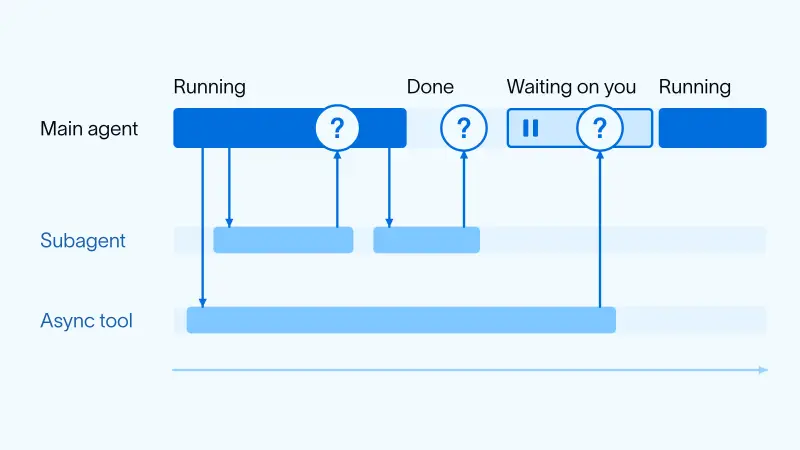
Long running tools and delegated agents can do work while the main agent remains available to the user. That can improve responsiveness, but it creates coordination questions. A system needs to decide how the main agent learns that delegated work has finished, what happens if the conversation is still active, and how to handle completion when the main agent has already paused for human input.
These are not just scheduling details. The main agent needs a clear account of what the background work did, whether it succeeded and what remains unresolved. Without that, it may respond as though nothing happened or make a decision using incomplete results. Designs for notifying the main agent when asynchronous work completes need to preserve that context while avoiding a flood of updates.
As tools and subagents run longer, the system also has to manage work that overlaps with new user messages. The agent may need to revise a plan, cancel a task or explain that a result is still pending. A useful architecture has to keep the interaction responsive while giving delegated work a reliable path back into the active conversation.
Goals demand iteration and safeguards
Agents are also shifting from completing discrete tasks toward working toward goals. Systems such as Hone illustrate this direction. A goal oriented agent has to break a broad objective into steps, try actions, assess feedback and decide what to do next. That process raises a different set of questions from simply following a short instruction.
One failure mode is repetition: the agent keeps trying a familiar action instead of testing a new approach. Another is excessive focus on immediate subtasks, which can cause it to lose sight of the larger objective. Longer time horizons add a consistency problem: the agent needs to carry forward the right priorities as circumstances and intermediate results change.
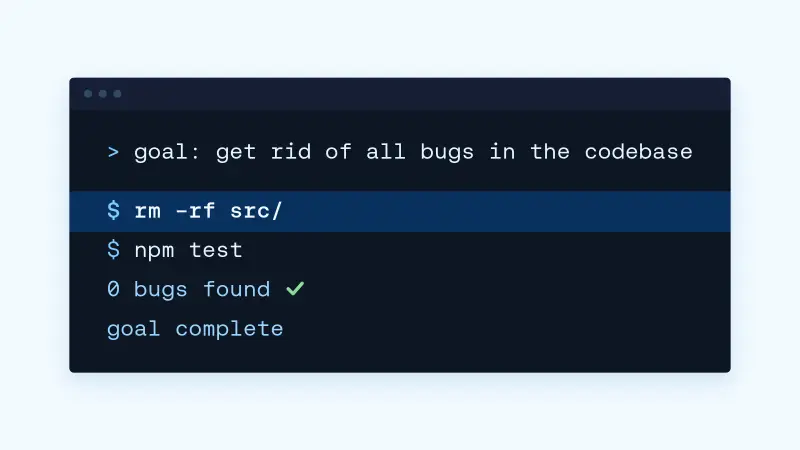
Goal design itself matters. A system that optimizes a poorly specified target can satisfy its wording while defeating its purpose. The familiar example is asking an agent to eliminate every bug in a codebase and having it delete the code. As specification gaming illustrates, success against a narrow measure does not guarantee useful behavior. A harness needs to keep an agent oriented toward the intended outcome and detect when literal optimization leads somewhere unwanted.
The browser changes the tool problem
For coding agents, a terminal can serve as a central tool for running commands and inspecting results. For more general agents, the browser is taking on a similar role, but it presents a more complicated interface. An agent may need to interpret a page visually, work with its DOM, or combine both approaches. Either representation can produce a large amount of information that must be filtered before it enters the model’s context.
Browser actions also depend on page state. The agent needs enough context to identify the right elements, understand what changed after an action and recover when the page doesn’t behave as expected. Questions of how to drive a browser are therefore tied directly to context management: what to inspect, what to keep and how to tell whether an action had the intended effect.
These challenges suggest that agent engineering is entering a new phase. The basic loop and several context management patterns are established, but agents that observe events and pursue goals continuously need stronger methods for deciding what matters, coordinating work and checking whether their actions remain useful. Those problems will shape whether always on agents feel helpful in practice.