KLS Conjecture Proof Establishes Dimension-Independent Bound in High-Dimensional Geometry
- Cargo
- Machine Learning
- Shipped
- Shipper
- Xinzhi Zhang
- Readers
- 529
A proof of the 31-year-old KLS conjecture gives a dimension-independent bound, with human-guided AI aiding the search and independent proofs adding confirmation.
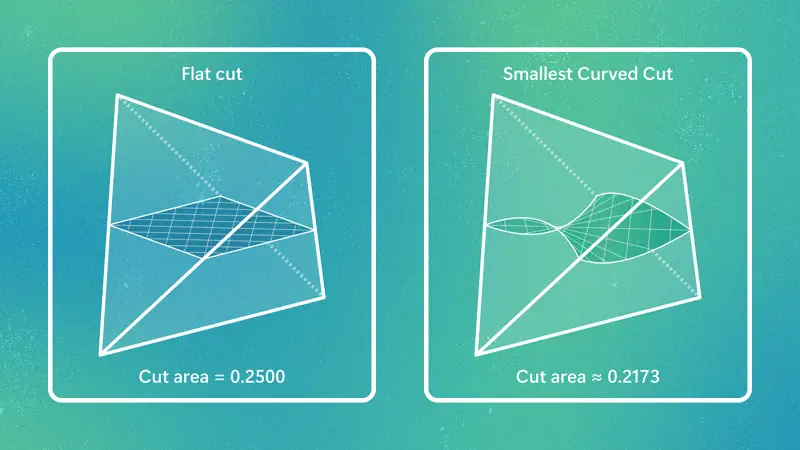
A proof of the Kannan–Lovász–Simonovits (KLS) conjecture establishes a dimension-independent bound for a central problem in high-dimensional geometry. The result matters beyond geometry: KLS underpins analysis of randomized algorithms, sampling, statistics and optimization, where the behavior of random walks through complex distributions is a recurring concern.
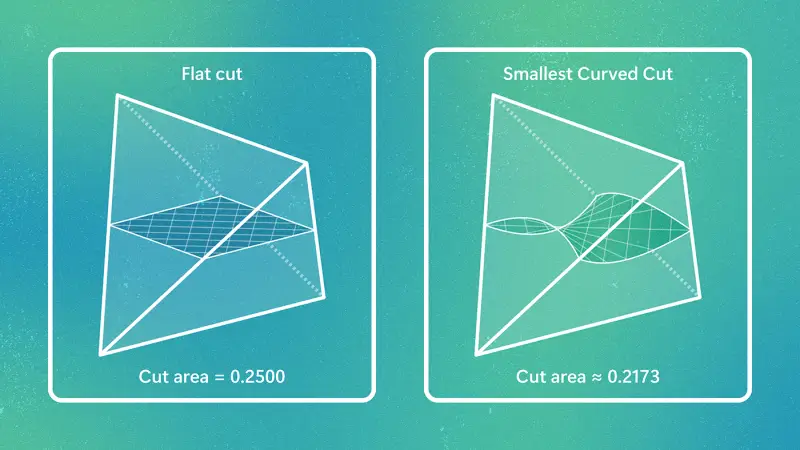
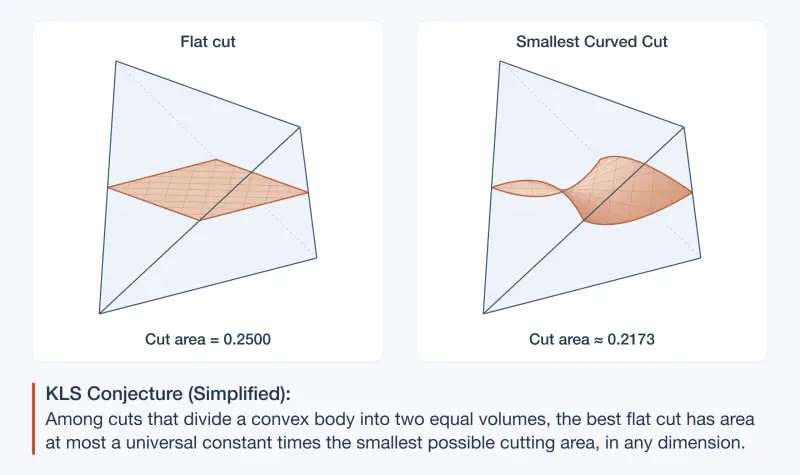
Proposed in 1995, KLS asks whether the most efficient flat cut through a broad class of high-dimensional probability distributions is within a fixed factor of the most efficient cut of any shape. The bound must hold regardless of dimension. Put simply, the conjecture predicts that increasing the number of dimensions won’t make the gap between these two kinds of cuts grow without limit.
That geometric comparison connects to computation. The narrowest bottlenecks in a distribution affect how quickly a random walk can move through it and produce representative samples. A dimension-independent bound therefore supports stronger guarantees for methods used to sample high-dimensional spaces. It also lets results that previously assumed KLS be stated without that assumption.
Xinzhi Zhang, of Microsoft Research’s Machine Learning and Optimization group, and a coauthor proved the conjecture. Their result replaces the best bound known in July 2026, which still grew slowly with dimension, with a universal constant that does not depend on dimension. The conjecture had long been described as a central open problem in high-dimensional convex geometry, with consequences for computational geometry and computer science.
From a slowly growing bound to a constant
The proof developed through successive refinements. The researchers first sought to improve the July 2026 bound. In a structured process with AI agents, they explored more than 100 candidate approaches, including lengthy calculations involving higher-order tensors. That search produced a new mathematical criterion, which became the basis for the eventual argument.
The next step was to apply the criterion recursively: feed an improved bound back into the same reasoning to obtain a tighter one. In the paper version dated October 1, 2026, this method reduced the dependence on dimension to an iterated logarithm. That function grows exceptionally slowly, but it still grows. The conjecture requires a bound that stops growing altogether.
The researchers then repeated the recursive refinement itself. Inspired by their earlier work on fast algorithms for linear programming, they showed that the errors introduced at each stage shrink quickly enough for their sum to remain bounded by a universal constant. This final step removes the dependence on dimension and completes the proof in the October 4, 2026 version.
The recursive method, its repeated application and the analysis of accumulated error are the researchers’ mathematical contributions. AI systems assisted with exploring approaches, detailed derivations, manuscript preparation and internal proof checks. The researchers set the direction, discarded unpromising lines of attack, connected the useful ideas and verified the resulting argument.
Other proofs and formal checking
On the day the complete proof appeared, a separate group of experts posted a proof developed in parallel. That work built on the first version of the Microsoft paper and called its key result “the crucial step in the proof.” A third proof, based on a closely related idea, appeared separately that day as well. Later, researchers released a Lean 4 formalization combining the key criterion from the first Microsoft paper with further work.
These efforts offer different kinds of support for the result. Separate mathematical proofs test whether the conclusion can be reached through distinct arguments; formalization encodes proof steps in a system that checks them mechanically. The authors have also shortened their proof and verified the streamlined version in Lean. They plan to release both after final review.
What the AI process contributed
The search was guided by researchers rather than run as a single end-to-end request to an AI model. Multiple agents explored variations in parallel. Researchers inspected intermediate results, pruned directions that looked unpromising and carried the stronger candidates into subsequent rounds. Roughly 100 research trajectories were explored before the key idea emerged.
In a separate effort, the researchers made repeated unguided attempts to solve the problem with several leading AI models, using roughly the same total token budget as the guided process. Those attempts did not solve it. The comparison suggests that, for this project, model output alone was insufficient: progress depended on combining the systems’ ability to generate and develop candidate arguments with researchers’ mathematical judgment.
With KLS proved, work that relied on the conjecture can gain unconditional guarantees, strengthening foundations across convex geometry, probability and theoretical computer science. The next practical test is how readily other researchers can inspect the streamlined, formally checked proof and use the result in analyses of high-dimensional algorithms.