NVIDIA Adds Open Source Agent Security and GPU Tools to Kubernetes Stack
- Cargo
- Machine Learning
- Shipped
- Shipper
- Warren Barkley
- Readers
- 803
NVIDIA is contributing OpenShell and Agent Substrate work to CNCF while adding Kubernetes tools for GPU cluster management and faster inference recovery.
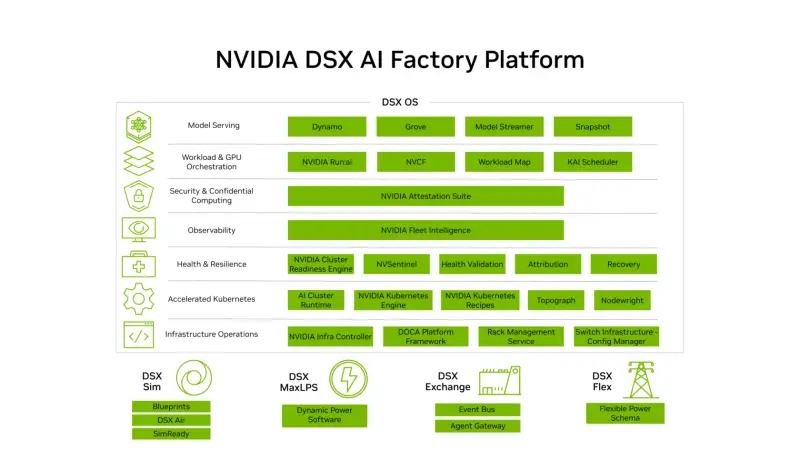
NVIDIA’s latest Kubernetes work targets three operational pressure points for AI infrastructure: controlling what autonomous agents can do, running their workloads without reserving idle compute, and bringing inference capacity online faster. The company is contributing OpenShell to the Cloud Native Computing Foundation (CNCF), working on the Google-originated Agent Substrate project, and introducing three components for its DSX AI Factory Platform.
The projects address different layers of the stack. OpenShell applies controls to agent activity; Agent Substrate manages agent environments and compute over time; NVIDIA Kubernetes Engine, Kubernetes Recipes and Snapshot focus on cluster operations and workload recovery. Together, they show NVIDIA placing more of its AI infrastructure work in open source projects and community development, while also extending the tools available for GPU-based Kubernetes deployments.
OpenShell puts agent controls in a shared project
NVIDIA is contributing OpenShell, an open source runtime for securing and governing autonomous agents, to the CNCF as a Sandbox project. The foundation hosts the KubeCon + CloudNativeCon community, where NVIDIA announced the contribution. Sandbox status gives participating organizations a shared project to build on and develop; it does not, by itself, establish how widely the runtime will be adopted or how its safeguards will perform in different deployments.
OpenShell applies deterministic controls to agent activity. Organizations can set policies for agents as they use tools, access inference services and execute workloads. Its extensible design allows teams to connect their own compute, inference providers, credential storage and monitoring tools, which may make it easier to incorporate the runtime into existing systems across cloud and on-premises environments.
That flexibility is significant because agent security depends partly on how an agent interacts with the services and credentials around it. A runtime that can sit between agents and those resources can provide a place to apply and inspect rules. The source description does not specify the full policy model, enforcement mechanisms or threat scenarios OpenShell covers, so teams will need to assess those details against their own requirements.
NVIDIA says hundreds of organizations have used OpenShell and that the project has received tens of thousands of contributions in less than a year since launch. The announcement does not clarify whether “contributions” refers to code changes, other forms of participation or a specific counting method. Linux Foundation CEO Jim Zemlin described the project as a shared foundation for developers to shape as agent security evolves.
Agent Substrate aims to reduce idle agent compute
Agent Substrate, a Google-originated framework accepted into the CNCF Sandbox, addresses a separate scaling problem: agent environments can persist between tasks, even when their compute is not needed. The project preserves environments while releasing compute during idle periods, then suspends and resumes them from a shared pool as work changes.
This approach could reduce the need to keep dedicated compute running for every agent session. Its practical value will depend on the workload, the time and resources needed to suspend and resume environments, and how well the system handles demand peaks. The announcement provides no benchmarks for those tradeoffs.
NVIDIA is contributing to Agent Substrate and says it is working to support integration with NVIDIA Dynamo for model inference and KAI Scheduler for shared cluster resource allocation. The combination connects agent execution with inference serving and scheduling on Kubernetes. NVIDIA and Google are also working on integrating OpenShell with Agent Substrate, with the stated aim of governing agents across cloud and on-premises systems.
Cluster tools target GPU infrastructure operations
The other announcements extend the NVIDIA DSX AI Factory Platform. NVIDIA Kubernetes Engine (NVKE) and NVIDIA Kubernetes Recipes (NVKR), both in public preview, are open source components for delivering managed Kubernetes services on GPU infrastructure. They automate cluster lifecycle management and provide signed, version-pinned images.
Those capabilities address routine operational work: creating and maintaining clusters, and keeping deployments tied to known image versions. They may help service providers offer Kubernetes while retaining control over their infrastructure, software and customer experience. The announcement does not provide performance results or details about the range of configurations supported.
NVKE and NVKR have integration plans involving Mirantis, Netris, OpenNebula Systems, Rafay, Spectro Cloud, vCluster, Firmus and SK Telecom. These organizations have aligned with NVIDIA on plans to bring the components into their offerings. That indicates interest across infrastructure and cloud service providers, though the announcement does not say when integrations will ship or which capabilities each will include.
Snapshot cuts model reload and warmup from recovery
NVIDIA Snapshot targets delays that occur when inference capacity must start or recover. Loading a model and warming up a workload can hold up availability. Snapshot is an open source, modular component that restores checkpointed replicas in seconds without reloading the model or repeating warmup, according to NVIDIA. It is intended for inference and agent workloads on Kubernetes, including faster startup, recovery and scaling from low capacity.
Two design partners evaluated Snapshot on their own workloads using NVIDIA HGX B300 systems. Crusoe tested GLM-5.3 on Crusoe Cloud and reduced the time until the workload was ready from roughly eight minutes to 31 seconds. Saturn Cloud measured vLLM startup for scaling inference from zero, reporting a reduction from between two and 8.5 minutes to between six and 34 seconds.
These results offer concrete examples of the potential benefit, but they come from specific workloads and systems. The announcement does not provide enough methodology to compare the figures across providers or predict results for other models, cluster setups or checkpoint sizes. For teams evaluating Snapshot, the central question is whether their own recovery path can restore replicas quickly enough to justify adding checkpoint management to their serving stack.
NVIDIA’s announcements put community development and operational tooling alongside one another: OpenShell and Agent Substrate cover agent control and execution, while NVKE, NVKR and Snapshot focus on GPU cluster management and workload readiness. Adoption will turn on project maturity, integration effort and results on each team’s infrastructure. The published Snapshot measurements give a starting point for evaluation; the broader projects still need deployment evidence across varied environments.


