NVIDIA’s Open Wireless Tools Put 6G Research to the Test
- Cargo
- Machine Learning
- Shipped
- Shipper
- Soma Velayutham
- Readers
- 633
NVIDIA reports growing use of its wireless tools, with projects testing faster robot responses, neural receivers, lower radio access power and quicker simulations.
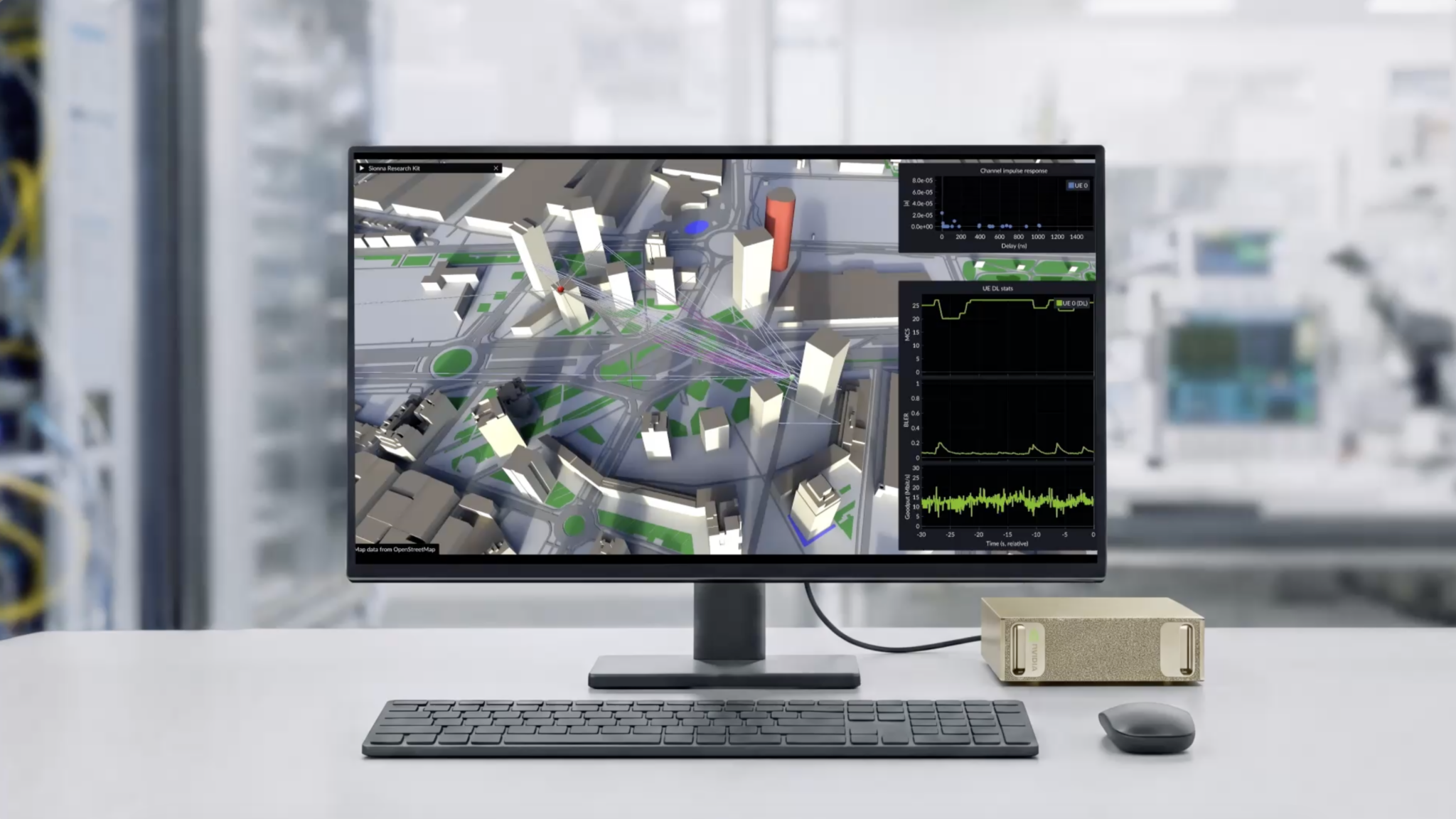
Open wireless software is giving 6G researchers a way to connect simulation, AI training and experiments on real radio equipment. NVIDIA says global developer adoption of its AI Aerial and Sionna software grew 10x over the past year, its open 5G and 6G tools passed 1 million downloads, and more than 8,000 research and academic institutions worldwide use the platforms. Those figures indicate growing use; the more concrete test is what researchers have been able to measure with them.
The work spans four practical problems: reducing delays in robot tasks, improving reception under interference, adjusting network power to demand, and running network simulations faster. Together, the projects show how a software-defined network could coordinate connectivity, computing and sensing. They’re research demonstrations, though, and the reported results come from specific test setups rather than a single end-to-end 6G deployment.
Sending robots the information they need
When a robot relies on AI running at an edge server or in the cloud, its wireless link affects how quickly it can respond. One research direction, called goal-oriented semantic communications, sends compact descriptions of objects, positions and relationships instead of transmitting full images at regular intervals. The aim is to communicate the information needed for a task while avoiding unnecessary data transfer.
Researchers at King’s College London connected a camera-equipped robot arm to an NVIDIA Jetson AGX Orin running NVIDIA Sionna. The setup supported a software-defined 5G network and edge AI processing. In fruit-packing and cube-stacking experiments with deliberately introduced faults, the approach reduced task completion time by up to 52.6% and improved task success compared with sending periodic images.
The fault handling matters alongside the speed result. The system detected dropped objects and recovered from unsuccessful actions. In configurations that included a digital twin, it also checked planned movements for possible collisions before the robot carried them out. That suggests a role for the network and its computing resources beyond moving camera data: they can help coordinate decisions and actions. The experiments don’t establish how the approach would perform across different robots, radio conditions or production environments.
Learning to decode difficult radio signals
Wireless interference and changing radio conditions can make signals harder to decode, leading to errors and retransmissions. A neural receiver uses AI to recover information from incoming signals, with the goal of improving the amount of usable data a connection can deliver.
SoftBank integrated a neural receiver into NVIDIA Aerial CUDA-Accelerated RAN (ACAR) and tested the system with a commercial 5G smartphone. In controlled tests involving interference, the neural receiver achieved higher uplink throughput than a conventional receiver at all 15 tested settings. Its maximum reported gain was roughly 60%.
A separate project at ETH Zurich examined how local measurements could help tune neural receivers for the conditions in which they operate. Using NVIDIA Aerial Testbed, the researchers reduced block error rates by more than one-third compared with selected pretrained versions. The result points to a practical tradeoff: a model trained for a particular environment may perform better there, while teams need measurements and tuning to adapt it. The reported comparison applies to the versions the researchers selected and the conditions they tested.
Matching radio capacity to demand
Network traffic changes over time, but radio equipment may need to be ready for periods of high demand. Predicting quieter periods could let operators put some base stations into sleep states, then restore capacity when devices need service. The challenge is making those decisions without leaving affected devices without a connection.
Researchers at the University of Leeds built a system that forecasts network demand 10 minutes ahead and uses the predictions to guide base station sleep decisions. Before a station powers down, the system checks whether nearby active stations can serve affected devices. It also watches for changes that call for capacity to return.
The team tested the system on a portable 5G “network-in-a-box” powered by an NVIDIA DGX Spark, alongside a digital twin used to validate decisions against real wireless equipment. Researchers reported a 45.6% reduction in radio access network power consumption relative to a full-power baseline while maintaining device connectivity. That result shows the potential of pairing demand forecasts with checks on available coverage; the measured reduction belongs to this test configuration.
Getting more network designs through simulation
Simulation lets researchers study how networks might behave when many devices compete for connections or signals encounter interference. But realistic radio channel calculations can make large simulations slow, limiting how many designs and scenarios teams can evaluate.
The Centre Tecnològic de Telecomunicacions de Catalunya is integrating GPU-accelerated radio channel models running on ACAR with the open-source 5G-LENA network simulator. The models calculate how signals travel between antennas and devices, a computation that becomes more demanding as simulated networks grow.
In an early evaluation, the integration cut simulation runtime from approximately three hours to 10–20 minutes, depending on the integration, while preserving expected statistical behavior and network performance. Faster runs could let teams compare more designs and test more demanding conditions before committing to equipment or field trials. The evaluation establishes a runtime improvement for the tested integration; how much time a team saves will depend on its simulation and setup.
What the results show
Across these projects, the common thread is a software platform for moving between models and real wireless equipment. The findings offer measurable examples of potential gains in task time, throughput, power use and simulation speed, but each addresses a different workload and test environment. Further work will show how reliably those results carry across devices, radio conditions and network sizes.
NVIDIA’s AI Aerial and Sionna tools are available on GitHub. For teams assessing 6G approaches, the immediate value is a shared set of tools for testing ideas against simulations and wireless hardware, with the reported measurements providing specific starting points for further evaluation.